This piece was reprinted by OpEdNews with permission or license. It may not be reproduced in any form without permission or license from the source.
But, asserting "executive privilege," the administration of Gerald Ford withheld some of the dramatic documentation posted today from the Church Committee. As U.S. officials sought to falsify the purpose of U.S. intervention in Chile, Senate investigators did not have access to the complete historical record on the White House deliberations and decisions on Chile in the days before and after Allende's inauguration.
The Official NarrativeIn the immediate aftermath of the Hersh revelations, President Ford issued an unprecedented, if mendacious, acknowledgement of CIA covert operations. "The effort that was made in this case," he told the press, "was to help assist the preservation of opposition newspapers and electronic media and to preserve opposition political parties." U.S. intervention to preserve Chile's democratic institutions was "in the best interests of the people of Chile and certainly in our best interests," President Ford submitted as the Pinochet regime marked the first anniversary of what would become a 17-year military dictatorship.
In testimony before the Senate Foreign Relations Committee, Henry Kissinger advanced this "preservation of democracy" rationale. "The intent of the United States was not to destabilize or to subvert [Allende] but to keep in being [opposition] political parties".Our concern was with the election of 1976 and not at all with a coup in 1973 about which we knew nothing and [with] which we had nothing to do." Kissinger reiterated this argument in his memoirs, The White House Years.
Other former U.S. officials who participated in the anti-Allende operations also used their memoirs to re-write the history of U.S. intervention in Chile. In Good Hunting: An American Spymaster's Story, published in 2014and excerpted in the pages of the prestigious journal, Foreign Affairs under the title "What Really Happened in Chile"the former CIA officer Jack Devine asserted that the CIA was merely "supporting Allende's domestic political opponents and making sure Allende did not dismantle the institutions of democracy." The goal, according to Devine, was to preserve those institutions until Chile's 1976 election when those democratic forces, bolstered by covert U.S. support, would prevail over the evils of Allende's Popular Unity coalition.
The "preservation of democracy" rationale made for good spin, but it is completely disproven by the declassified White House records. Those records reveal that the U.S. State Department, which feared an international scandal if U.S. efforts to overthrow Allende were exposed, argued for a prudent policy of co-existenceknown as the "modus vivendi strategy"while supporting the opposition parties and bolstering their chances of prevailing in the 1976 election. If Washington violated its own pronounced policy of "respect for the outcome of democratic elections," the Bureau of Inter-American Affairs argued in one briefing paper during the internal debate over how to respond to Allende's inauguration, it would "reduce our credibility around the world " increase nationalism directed against us," and "be used by the Allende Government to consolidate its position with the Chilean people and to gain influence in the rest of the hemisphere."
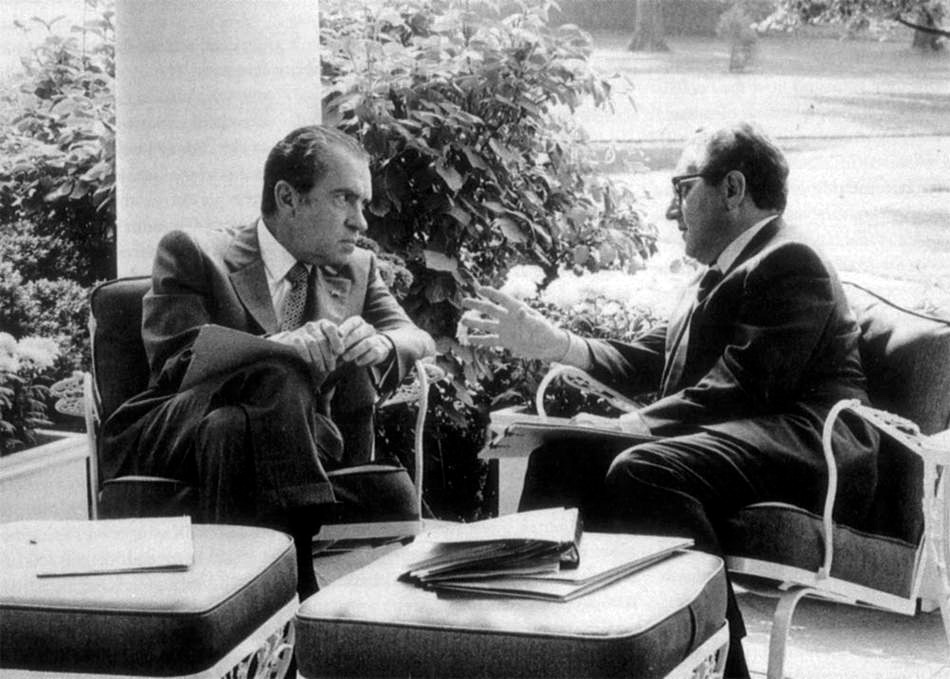
But the documents also reveal that Kissinger forcefully rejected that option, and personally convinced President Nixon to overrule it in favor of an effort to destabilize Allende's ability to govern. "It is essential that you make it crystal clear where you stand on this issue," Kissinger privately lobbied Nixon in preparation for the November 6 NSC meeting on Chile. "If all concerned do not understand that you want Allende opposed as strongly as we can, the result will be a steady drift toward the modus vivendi approach."
Kissinger's ArgumentsNext Page 1 | 2 | 3 | 4 | 5 | 6 | 7
(Note: You can view every article as one long page if you sign up as an Advocate Member, or higher).