




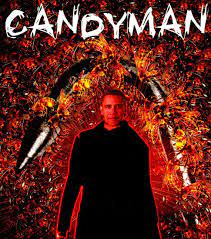
The Silly Film Olympics � Board of Governors is pleased to announce three films have recently been submitted for consideration in its inaugural 2022 challenge: Candyman, directed by Bernard Rose and released in 1992, Candyman, a "sequel" directed by Nia DaCosta and released in 2021, and The Candyman, written and directed by Barack Obama, released in 2004 and continuing to this day in a theatre near you. He also stars.
The first two films are feature-length social commentaries occupying space somewhere between nursery rhyme and gothic romance. The third is postmodern cinema verite', a relatively new sub-genre that relies heavily on close ups, jump cuts, computerized special effects and bait-and-switch plot devices. All three have the same title and all three highlight similar concerns with regard to structural racism, economic inequity and the gendering of power, but they do not tell the same story. That task falls to the dedicated professionals at Silly Film Olympics �, crusaders for truth and defenders of irony, skilled readers who do not let low wages, long hours or unsafe working conditions keep them from completing their appointed duties. (It's in their contract.) They will continue to offer slanted analyses based on cherry-picked examples, worn out polemics and, in times of stress or indigestion, the expository equivalence of holding a finger to the wind. We who are about to write salute you.
[Full disclosure: there is no Silly Film Olympics � Board of Governors, only a few deeply disturbed individuals teetering between the highly Symbolic and the mostly Imaginary.]
CANDYMAN (Rose 1992)
Bernard Rose's re-telling of Clive Barker's short piece of fiction, "The Forbidden" (1985), moves the action from Bob's Corner, a low-income section of Liverpool, to Cabrini-Green in Chicago. Once a vibrant community, the area is now an urban wasteland of hollowed-out buildings, graffiti covered alley ways, garbage ridden streets and exhausted public spaces, where the inhabitants are fearful or threatening or both. In doing so, the film substitutes the horrors of capitalism --- Bob's Corner was decimated by Thatcher's privatization policies --- for the horrors of slavery, American style.
The Candyman myth begins shortly after the Civil War when a talented Black painter, Daniel Robitaille, falls in love with one of his subjects, the daughter of a wealthy white landowner. When she becomes pregnant, her father sends a gang of thugs to deal with the situation. They kidnap Daniel, saw off his hand and replace it with a hook. Then they douse him with honey (hence his title) and stand back as a thousand angry bees sting him to death. Finally, they burn his body and scatter the ashes in what will later become Cabrini-Green. Welcome to the neighborhood.
Into this world wanders Helen Lyle, the inquisitive white woman doing graduate research on urban myths, specifically, the story of the Candyman. It's a tricky path. One critic describes Helen as the real victim of the film, the innocent inge'nue "degraded by mentors, gang members, the police, her husband, and ultimately Candyman himself." Does she kill Bernie, the dog and her therapist? Does she kidnap the baby, only to save him? Or is it all the work of the hook? Either way, viewers are conflicted, mesmerized by the power of the myth while at the same time repulsed by the actual events that provoked it. One is "immortal," the other definitely flesh and blood. No surprise, then, to discover later in the film the two are connected: Helen is not only the reincarnation of Daniel's lover, she's the magic elixir that absolves white audiences of their racist history.
Yet questions remain. What percolates at the center of this film? Is it racism? Or miscegenation? Or the angry Black man seeking revenge? Is it a white director using the suffering of Black people to sell another feel-good film to white audiences? At the end of Rose's concoction, the recently diseased Helen is conjured up by her unfaithful husband, Trevor, in a bathroom mirror. He does this, it's worth noting, by repeating her name, not Candyman's, and the inference is clear. She's the new myth now, the new "Candyperson," and she wastes no time gutting her 'ex' and framing his new trophy wife for the crime.
A final narrative twist, the last shot framing Helen's mythic image, and just like that the evils of structural racism give way to the vicarious pleasures of white female revenge. Perfect.
CANDYMAN (DaCosta 2021)
Nia DaCosta's "sequel" is a bit of a puzzle. Whereas the original Candyman subordinates the title character to a white savior narrative, her film attempts to return the character to his racist origin, even as it riffs on the institutions that continue to oppress him. Reclaiming the narrative, as it were.
Critics tend to think she succeeded. Slant suggests the film transforms the Candyman myth into a story about "black trauma and resilience." It depicts not just a "vengeful spirit," but the "vengeance of every Black man who has suffered." In similar language the Jacobin calls the film an insightful "commentary about racial oppression," while the NYTimes argues the film is "fundamentally" about telling African-American "stories," their pain, their loss.
(Note: You can view every article as one long page if you sign up as an Advocate Member, or higher).






