




If the U.S. leaders allow today’s low prices to reduce its sense of urgency regarding energy independence, the consequences will be shocking. The existing energy infrastructure is rusting away. The estimates to rebuild the crumbling infrastructure, that is 80% beyond its original design life, run as high as $100 trillion. The Cantarell oil field in Mexico is collapsing and will lead to Mexico becoming an oil importer in the next five years. The U.S. currently gets 11.1% of our supply from Mexico, almost as much as from Saudi Arabia. Another 30% comes from unstable countries such as Venezuela, Iraq, Nigeria, and Russia. We are not in command of our energy future.
By doing nothing today, we ensure that $147 oil will seem like a bargain in the not too distant future. An all out effort to implement the Pickens Plan now is necessary to regain the upper hand regarding our energy future. Converting our country to wind power, natural gas, and nuclear power would decrease our dependence on foreign oil and keep $700 billion in the United States rather than transferring it to the Middle East.

Unintended Consequences of 0% Interest Rates
The Gross Domestic Product of the United States is $14.4 trillion. Consumer spending makes up $10.2 trillion or 71% of GDP. Government spending makes up $2.9 trillion, or 20% of GDP. Domestic investment makes up $2.0 trillion, or 14% of GDP. The trade deficit of $700 billion reduces GDP by 5%. President Obama has quite a dilemma in trying to revive this economy. The American consumer has borrowed from their homes and credit cards to fuel a colossal spending spree in the last twenty years.
The dilemma is that the U.S. economic growth during the entire Bush administration was a debt induced fraud. From 1953 through 1983, consumption as a percentage of GDP ranged between 61% and 64%. Consumers rarely, if ever, borrowed against their houses. Paying off your mortgage was a goal of all families. A normalized level of consumer spending at 65% of GDP will require consumers to spend at least $1 trillion less per year. Less consumer spending will also contribute to reducing the trade deficit. The Federal Reserve and politicians running our country see a $1 trillion reduction in consumer spending as a disaster. Their positions of power would be in jeopardy. They will do everything in their power to not allow this to happen. The unintended consequences will commence shortly.
click to enlarge
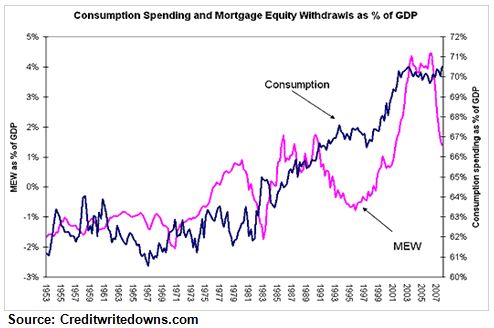
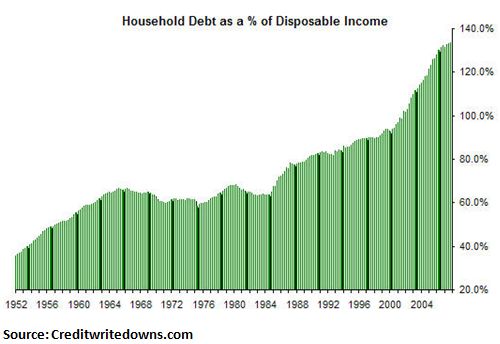
From the time Alan Greenspan took over as Federal Reserve Chairman in 1987, consumption and household debt rose at a faster rate than the economy. The Greenspan Put was a major contributor to these developments. Everyone knew that Greenspan would lower rates and inject liquidity into the system whenever an economic bump in the road came along. Greenspan’s reduction of the discount rate to 1% in 2003 led to the greatest debt bubble in history that still threatens to bring down the financial system.
click to enlarge
(Note: You can view every article as one long page if you sign up as an Advocate Member, or higher).
 2
2
 2
2
 1
1





