







The most recent article in this series, Familiarity Breeds Contempt, discusses a hypothetical BAV election that is summarized in Tables 1 and 2. This presents us with an opportunity to compare BAV with some similar voting systems.
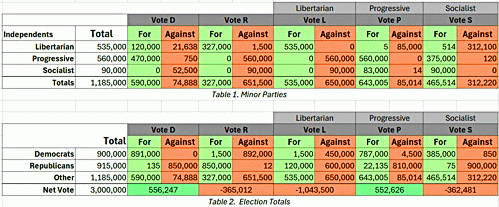
Often it is hard to make such comparisons. In general, how a voter will vote using one system often gives little insight into how they will vote in another. But when voting systems are sufficiently similar, this can be less of a problem.
In the past I have mentioned two important ingredients we should look for in a voting system.:
1. The voting system should be balanced
2. The voting system should be evaluative
BAV meets these two requirements, and it is arguably the simplest voting system to satisfy both. This suggests that we might want to see whether we could predict voting in a system that is much like BAV, but which fails to satisfy one or the other condition. Oh yes, the third condition (in the title) is simplicity, and we should not consider abandoning simplicity. A complex voting system that is hard to understand may raise voters doubts about whether voting is worthwhile.
Approval voting (AV) is one alternative system; what is very important is that AV is evaluative as well as simple; but it does fail to be balanced. As with BAV, a voter is asked to evaluate, or abstain from evaluating, each candidate. But in evaluating a candidate, AV provides the voter with no alternative beyond expressing support for that candidate. This means that when a voter abstains, it might be because the voter opposes the candidate, but possibly only that the voter is indifferent to that candidate. Perhaps the voter first learned, while voting, that candidate's name. At the other extreme, the voter may think favorably of the candidate, but not so favorably as join the other in votes of support. AV makes no attempt to distinguish between these possibilities and consequently, anyone trying to understand voter opinions can only speculate.
But let us consider a voter who has just voted in the BAV election. When a BAV ballot shows support for a candidate then almost certainly the voter would do the same on an AV ballot. And if the voters BAV ballot shows opposition then the voter would surely avoid voting in support of the candidate; the voter would abstain.
But while abstention on a BAV ballot might convert to support on an AV ballot, that is not necessarily the case; many voters who abstain may be on the fence about their decision. Clearly some BAV voters may abstain only after seriously considering a vote of opposition. And similarly, a voter who abstained on the BAV ballot may have considered voting support; such a voter, faced with the fewer options on the AV ballot, may choose to instead vote in support of the candidate.
The point to take from this is that in the AV election, some of the BAV abstentions might convert to support votes in the AV election. We do not know how many, but probably less than half.

Table 3 shows possible results for this AV election with the MINIMUM column assuming there are no conversions of abstentions to support and with the MAXIMUM column assuming there is at most a 30% conversion. For the sake of simplicity, the conversion is assumed as a uniform percentage across all five political parties.
While the Progressive Party candidate comes in second, the lead of the Democrat over the Progressive is more than 100,000 voters; that is a different situation from being a close second (as happened in the BAV election). As with the BAV election, the Republican candidate makes a poor showing, but the AV election does not show that the Progressive Party is positioned to potentially replace the Republican Party in the duopoly. Many voters will still make voting decisions assuming a duopoly continues to rule.
BAV is both balanced and evaluative. Being evaluative is very important and the example election illustrates how similar the behavior of AV is to BAV. But the lack of balance keeps the vote tallies significantly higher for AV and that keeps a win for a minor party a more distant possibility. By adding balance to an evaluative system, polarization between two parties of roughly the same size leads to a mutual cancellation of votes within the bounds of those two parties. This gives the remaining parties much more in control of the election.
The simplest example of a voting system that is balanced but not evaluative is Balanced Plurality Voting (BPV). With BPV (just as with Plurality Voting), a voter must choose a single candidate to evaluate. But the BPV voter can choose whether to support or to oppose that candidate. The winner is selected as with BAV, using a count of net votes. But BPV is a voting system that is particularly well suited only for an election with three (or fewer) candidates. For BAV there is nothing so special about there being only three candidates.

(Note: You can view every article as one long page if you sign up as an Advocate Member, or higher).






