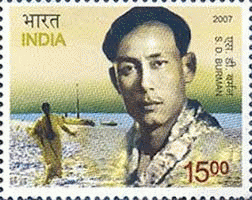
 Commemorative stamp issued by Government of India
(Image by Chandrakantha.com) Details DMCAs
Baul and
Bhatiali as the former being an
instrument narrating a philosophy, while the latter as one which depicts a
mood, sometimes philosophical. A
particularly noteworthy and daring assertion SDB makes in the interview is to
claim that in his opinion not only are folk traditions around the world
connected by threads of commonality, but that he believes European folk music in fact derived from
those of India, especially Bengal. Here
is an excerpt from the interview laying out SDB's observations in this
regard: --(supplement(ing) my learning
in Bengali folk music (unlike folk music
elsewhere in India) wasn't possible with foreign folk music because my stay
abroad has been sporadic and not for a considerable length of time. Still, the least I have seen of folk music abroad
confirms my faith in the basic similarity of folk attitudes of all nations. In Russia, I remember, I was constantly
reminded of our folk songs and classical ragas like Bhairavi and Jogiya or Todi
whenever I listened to their folk music. In Spain too I had similar experiences. These cases give verity to the idea that the
folk music of the continent was an importation from Asia. The nomads or gypsies (from India) took with
them certain folk disciplines whenever they migrated from one region to
another. As history has it, much of our
folk excellences traveled with the gypsies when the moors raced up to the
south-west of Europe. Spain's music
imbibed some of our folk character in this way. To tell you frankly, to listen to folk music
abroad is to be constantly reminded of India--
An absolutely remarkable observation from an outstanding
musician/composer from India who carved out his own niche in India's
mellifluous musical domain.
SDB's lifelong commitment to, and
deep affection for Bengali folk music is evident from his admission that some of
his very best hits in the course of
his time in Bombay and musical compositions for Hindi films had their origins
in Bengali folk music. In the
Bhattacharjee interview he cites as examples, Safal hogi teri aradhana, kahe ko roye based on a Baul melody; Wahan
kaun hai tera musafir jayega kahan based on Bhatiali (Bengali boatman music); even a much lighter
number such as Roop tera mastana was
apparently based on a favorite folk melody.
And these are but a small sampling.
It is also
mentioned in RM's article that even though he spent many years in Bombay in the
entertainment world, his heart and
soul pined for Bengal's rivers and fields, her drumbeats and her festivals, her
rains and her moonlit nights. Despite
his royal roots in Tripura, he truly identified with Bengal in the very fabric
of his being. And this is the identity
that I too have perceived in SDB's music from my very early years. In what follows, I present snippets of lyrics
from SDB's songs imbued with Bengal's folk traditions with interpretations for
context and atmosphere. In many of his
songs, the lyricists were Ajay Bhattacharya, Sailen Roy and his (SDB's) wife
Mira Dev Burman. The musical composers
included SDB himself and also Himangshu Dutta.
Commemorative stamp issued by Government of India
(Image by Chandrakantha.com) Details DMCA
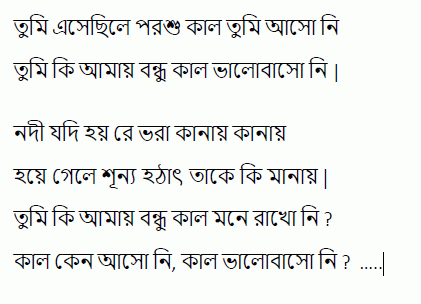
(1)
Dearest- you came to see me the
day before, you did not yesterday
Dearest, did you not, then, love me
the same yesterday?
Imagine, dearest, a river brimming
over with the tide-
Does it befit it, then, to abruptly
become parched and dry?
Did you not, dearest, remember me at
all yesterday?
Next Page 1 | 2 | 3 | 4 | 5 | 6 | 7 | 8
(Note: You can view every article as one long page if you sign up as an Advocate Member, or higher).