




rame>
It's hardly a surprise that the coalition of social-justice groups that held a press conference in Washington, DC, on December 10 had no influence on the latest lurch into austerity.
It's hardly a surprise that the coalition of social-justice groups that held a press conference in Washington, DC, on December 10 had no influence on the latest lurch into austerity.
The press conference in the Cannon House Office Building
demanded that Congress make deep cuts in the nation's military
budget, reject reductions in the Supplemental Nutrition Assistance
Program (SNAP), and redirect funds into sorely needed social
safety-net programs. Along with other political and community
leaders, members of the Poor People's Economic Human Rights
Campaign talked about how joblessness, hunger, foreclosures, and
economic distress were hurting their families.
After the press conference, they walked in the snow to the
office of Rep. Paul Ryan (R-Wis.), co-chair of the Budgetary
Committee, to present a "People's Budget" and supporting petitions
(see video).
Unfortunately, the austerity agenda, premised on the idea that
working Americans should shoulder economic losses caused by Wall
Street's criminal recklessness, required that Congress decree
otherwise. The bipartisan budget deal reached later on Tuesday
exempted the Pentagon from sequestration, while allowing proposed
food-stamp cuts to move forward and blocking unemployment
extensions.
For Republicans, austerity represents a step towards economic
freedom and ending the tyranny of Big Government. For Democrats,
austerity means responsible fiscal policy and deficit reduction. Or
so the usual media narrative tells us. Don't believe it.
Conservative politicians don't want smaller government. They
adore Big Government. For Republicans, moderate Democrats, and the
lobbyists who sustain them with fat campaign checks, the ideal is
powerful government that serves the One Percent more efficiently,
generously, and exclusively.
They favor massive government intervention that feeds the
corporate sector through taxpayer-funded subsidies, handouts,
bailouts, insurance to cover losses in the stock market, boondoggle
contracts (manna for the defense industries), privatization of
public resources and services, and international trade deals that
privilege big business at the expense of democratically enacted
labor, environmental, and public-health protections. In short, a
massive redistribution of wealth and power to the top.
We can discard the idea of an eternal struggle between
government intervention and freedom. The real choice is
intervention for the benefit of most of the population or for
wealthy elites. The pure no-government libertarian ideal is a
pipedream, existing only in places like Somalia. The U.S. came
close during the Gilded Age, a time of endless sweatshop drudgery,
poverty, and destitution for tens of millions of Americans before
the corrections of the Progressive Era. That's what conservativism
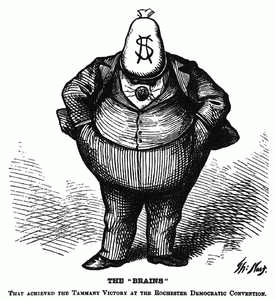
means now, a return to the Gilded Age and the reign of the Robber
Barons.
Food-stamp cuts represent a propaganda victory for this ideal.
Millions of Americans complain that the lady at the supermarket who
pays for groceries with food stamps is a drain on our tax dollars,
probably living in the lap of taxpayer-funded luxury. Meanwhile,
arms manufacturers, banks, oil companies, and other industries suck
up billions from the public coffers with hardly a peep.
The era of deregulation, globalization, privatization, slashed
safety nets, and bloated military budgets commenced with the Reagan
Era, with some precursors under President Carter, such as the relax
of airline industry regulations. It persists whether Democrats or
Republicans control the White House and Congress.
Ronald Reagan's administration made a special effort to enact
the anti-regulation economic theories of Friedrich Hayek and Milton
Friedman, even after the deregulation of the savings and loan
industry, inspired by these theories, inflicted a catastrophe that
ultimately cost the public over $370 billion. For all his rhetoric
about shrinking government, President Reagan expanded the federal
government's size and power and tripled the national debt.
The libertarian dogmas of Messrs. Hayek and Friedman don't
supply freedom as most of us understand the word -- the capacity of
all people to act and determine the course of their own lives,
without coercion. Instead, they provide a license for wealthy
elites to exploit, plunder, pollute, and commit crimes with
impunity.
Of course, corporations themselves don't care much about
academic theories and political ideologies. Their sole interest is
profit and power.
The State-Cartel Ideal
The capitalist libertarian model has two effects. First, it
allows big business to consolidate into a small number of
corporations (cartels) with the monopolistic power to control the
market, killing competition and turning the "free market" into an
illusion.
Second, it enables a merger of corporate boardroom and
government bureau, in which the main purpose of the state is to
serve the interests of wealthy business elites.
There are lots of names for this condition: plutocracy,
plutonomy, neoliberalism, neo-feudalism, the One Percent, corporate
royalism, robber-baron economics, even fascism. Let me propose a
more precise term: state-cartel capitalism. (The similarity to
state-monopoly capitalism that has taken hold in China isn't
accidental.)
State-cartel capitalism measures the health of the economy
according to corporate bottom lines and "competitiveness" (even
when business competition has been effectively eliminated), Dow
Jones, and the GDP, with little regard for the financial security
of working people or the well-being of society's most helpless.
Thus the top 1% enjoyed 95% of all income growth from 2009 to
2012.
The state-cartel ideology abolishes the principle that people
who work full-time jobs deserve the security of a livable wage and
benefits. It turns "No one owes you anything if you don't work"
into "No one owes you anything even if you work." It admits that
the U.S. economic system not only doesn't work for everyone, it
shouldn't work for everyone. It buttresses this admission with the
propaganda myth that poor people are lazy unemployed parasites,
despite the fact that most of the poor work.
The most notorious purveyors of the state-cartel ideal include
the Koch Brothers, the American Legislative Exchange Council
(ALEC), and Walmart. Walmart is a company whose idea of free-market
competition involves a mass extinction of locally owned businesses
and wages so low that employees can only afford to shop at
Walmart.
ALEC's hatred of regulation doesn't extend to homeowners who
install solar panels. ALEC is currently lobbying Big Government to penalize homeowners who
bypass the corporate grid in a quest for clean renewable
energy.
For a shining example of state-cartel ruthlessness, there's
Bain Capital, Mitt Romney's equity firm, which has reaped millions
by purchasing small and medium-sized businesses and then
dismantling them, destroying thousands of jobs. Mr. Romney's
election to the White House in 2012 would have surpassed his tenure
as governor of Massachusetts in sealing the state-cartel
deal.
The biggest mistake is to believe that the Democratic Party
represents the opposition to the state-cartel ideal. The discredit
that Obama-hating Tea Partiers and uncompromising GOP extremists in
the U.S. House brought on themselves during the recent government
shutdown shouldn't lull us into forgetting that the most effective
agents of state-cartel power are moderate Republicans and the
Democratic Party's centrist leadership.
Although Dems have opposed some of the grosser excesses, such
as the Republican legislative proposal to have Wall Street losses
incurred through high-risk derivatives trading insured with public
funds, the Obama Administration's agenda and accomplishments adhere
closely to the state-cartel ideal. Obamacare's individual mandate
(originally a Republican idea) requires every American
to subsidize the health-insurance industry and fails to rein in
skyrocketing medical costs.
The proposal to slash Social Security and delay eligibility
for benefits, promoted by President Obama's National Commission on
Fiscal Responsibility and Reform ("Catfood Commission"), will push
more of our retirement money into the risky Wall Street casino. His
"Race to the Top" enriches testing companies and other private
school contractors, rewarding municipalities that privatize public
education by funding charter schools.
And then there's the Trans-Pacific Partnership (TPP),
President Obama's secretly negotiated trade pact that has been
described as NAFTA on speed. Barack Obama and Mitt Romney didn't
bother to debate the TPP during their 2012 contest, because they
both support it. Congress is now mulling fast-track status to
conceal the TPP's intense assault on workers' rights, public
health, the environment, Internet freedom, and democratic
sovereignty from public scrutiny until it's too late.
The Obama Administration follows the pattern set by President
Clinton in enacting the Reagan state-capital agenda: expansion of
the for-profit prison-industrial complex, NAFTA, the Welfare Reform
Act, the Telecommunications Act (allowing consolidation of media
ownership), and the Commodity Futures Modernization Act and repeal
of the Glass-Steagall Act, both of which set the stage for the Wall
Street fraud that caused the 2008 economic crisis.
If the state-cartel trend continues, as it will whether we
elect Republicans or Democrats, the prosperity most Americans
enjoyed in the second half of the 20th century will be a distant
memory in a few years. And so will our rights and freedoms.
Another World is Possible
Freedom for all of us can't co-exist with the "corporate
freedom" paradigm of the state-cartel ideologues. Along with the
four that Franklin Roosevelt articulated (freedom of speech,
freedom of worship, freedom from want, freedom from fear), we can
add freedom from destruction of our environment.
Genuine freedom embraces a list of rights that the
state-cartel gang generally doesn't care about, such as the right
to live one's private life without surveillance, without going
broke because of a medical emergency, without being told what kind
of love life or family is acceptable, without getting busted for
smoking a certain kind of cigarette, without being targeted for
police harassment and arrest for no other reason than one's
ethnicity.
Three big threats to the American republic have emerged in the
21st century: social instability as the global climate grows less
stable, war without end (euphemized as the War on Terror), and the
theft of our democracy, rights, and freedoms by a plutocracy that
wants to restore a Gilded Age economy.
These threats are closely related. The wars without end are
fought for control over the fossil fuels that are causing climate
havoc, while feeding arms manufacturers, private security firms,
and other military contractors. Food-stamp and other safety-net
cuts enable Washington's state-cartel establishment to render
Americans helpless, in permanent debt, and focused on personal
survival, deflecting attention from the redirection of the nation's
treasury into the perpetual war machine.
There's a political opposition to the state-cartel paradigm,
but you have to look hard to find it, at least in mainstream news
media coverage. It reared its head for several months during the
Occupy Wall Street protests and encampments. Some of its
representatives were present at the Dec. 10 press conference and
delivery of the "People's Budget" to Sen. Ryan's office: the Poor
People's Economic Human Rights Campaign; the Green Shadow Cabinet,
which emerged from Green Party nominee Jill Stein's 2012
presidential run (Dr. Stein was a featured speaker); genuine
Democratic progressives who've been marginalized in their refusal
to go along with the Obama program.
There are many more small-d democrats around the U.S., but
they remain isolated and often focused on local or regional
challenges and single issues. Many of them continue to hope
unrealistically for a rehabilitation of the Democratic Party, or
they resign themselves to supporting Dems as a lesser evil without
illusions that doing so will hinder the country's slide into the
rightwing abyss.
It's clear now that the crises of the new Gilded Age won't be
solved under the two-party political status quo. The first step in
solving them is envisioning a Congress in which sponsors of the
"People's Budget" outnumber the state-cartel errand boys.
 3
3
 3
3
 2
2






