




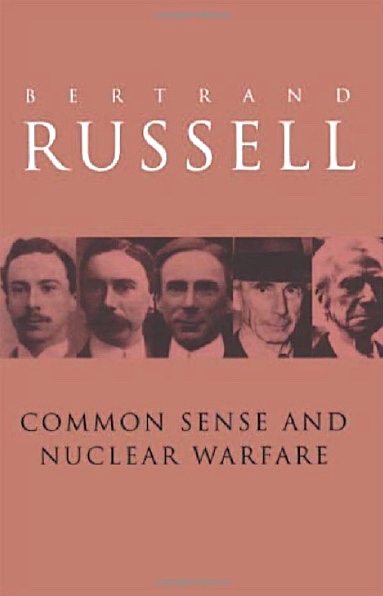
It's so long ago, I can't remember how it came to my attention. I was 13 years old and no one in my family or anyone in the blue-collar community we lived in had a clue who Bertrand Russell was or why he was taking on the military and political establishments of the world, trying to convince everybody that nuclear weapons and war itself must be abolished.
But I got my hands on a copy of Common Sense and Nuclear Warfare, and to say it changed my life would be a vast understatement.
Before the arms race had resulted in tens of thousands of nuclear bombs being built by the U.S. and Russia, decades before the possibility of nuclear winter was ever discussed, Bertrand Russell's keen insights into the destructive potential of a nuclear war drove him to campaign for the complete elimination of these weapons of mass horror. I remember seeing photos of him sitting alone in the middle of London, blocking traffic, holding a sign that said 'Ban The Bomb'. I remember reading stories of how this world-renowned philosopher, distinguished scholar and intellectual, took his commitment to the streets and was often arrested for his courageous work. As the anti-nuclear movement grew, Lord Russell quickly became an icon among anti-nuclear activists.
The Ban The Bomb movement that arose during the late '50s and early '60s was massive! The largest protests ever seen in the West were the result of this movement.
And because there were still a few sane thought leaders in the world at that time who had high visibility and enormous public respect, Lord Russell was not alone in his passionate appeals for ending the scourge of war.
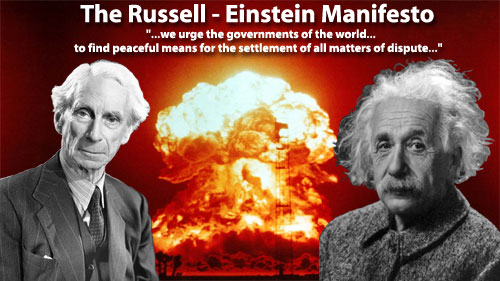
Mind you, this was back when the number of usable nuclear weapons was in the hundreds. The Soviets had nowhere near the number that U.S. intelligence was claiming, a deception intended to build support for what was coming. What was coming was an insanely dangerous and wasteful nuclear-arms race that had both the U.S. and the Soviet Union piling up tens of thousands of atomic and hydrogen bombs, holding the entire world hostage to a "peace plan" known as MAD -- mutual assured destruction.

Naturally, this was a green light for other countries -- England, France, China, India, Pakistan, Israel, and more recently North Korea -- to start stockpiling their own nuclear arsenals.
Recall how this started. The U.S. has distinguished itself to be the first and only nation to ever employ them. Moreover, it is clear now that one of the main reasons why we dropped the atomic bombs on Hiroshima and Nagasaki was to send a signal to the Soviets. We've got the bomb. We'll use it. Don't mess with us!
Well, they got the message and made the only rational choice. The only way to protect themselves was to develop the same capability, sending a clear and unambiguous reply. Drop nuclear weapons on us and watch your own cities and populations disappear in a nuclear fireball.
In reality, back in the '50s, the Soviet counter-threat was mostly huff-and-puff. Daniel Ellsberg, who was a military analyst at the time at Rand Corporation and had access to the most sensitive data on the Soviets, exposed the truth. While the U.S. had over a hundred and had long-range missiles and high-altitude bombers to deliver the lethal payloads, the Soviets had -- are you ready for this? -- six. And whether their ICBMs were actually capable of getting these six nuclear devices to U.S. soil was itself very much in question.
This didn't stop the U.S. military to constantly trumpeting the Soviet threat. Which meant we had to build more and more bombs. Couldn't let those Russkies get a leg up on us, could we?
(Note: You can view every article as one long page if you sign up as an Advocate Member, or higher).
 2
2
 1
1
 1
1






