

Count on this: were the U.S. now triumphant in an orderly Greater Middle East, the same Republican candidates would still be calling for a build-up of the U.S. military to maintain our victorious stance globally. If you want proof of this, you need only step into your time machine and travel back a quarter-century to the moment the Soviet Union collapsed. Thought of a certain way, that should have been the finale for a long history of arms races among competing great powers. What seemed like the last arms race of all between the two superpowers of the Cold War, the one that brought the planet to the brink of annihilation, had just ended.
When the Soviet Union imploded and Washington dissolved in a riot of shock and triumphalism, only one imperial force -- "the sole superpower" -- remained. And yet, despite a brief flurry of talk about Americans harvesting a "peace dividend" in a world bereft of major enemies, what continued to be harvested were new weapons systems. An arms race of one rolled right along.
And of course, it goes right on today in an almost unimaginably different world. A quarter century later, militarily speaking, two other nations might be considered great powers. One of them, China, is indeed building up its military and acting in more provocative ways in nearby seas. However, not since its disastrous 1979 border war with Vietnam has it used its military outside its own borders in a conflict of any kind.
The Russians are obviously another matter and they alone at this moment seem to be making an imperial success of warfare -- translating, that is, war making into power, prestige, and dominance. In Syria (and possibly also Ukraine), think of that country as experiencing its version of America's December 2001 Afghanistan or April 2003 Iraq moments, but don't for a second imagine that it will last. The Russians in Syria have essentially followed the path Washington pioneered in this century, loosing air power, advisers, and proxy forces on an embattled country. Their bombing campaign and that of the allied Syrian air force have been doing in spades what air power generally does: blow away stuff on the ground, including hospitals, schools, and the like.
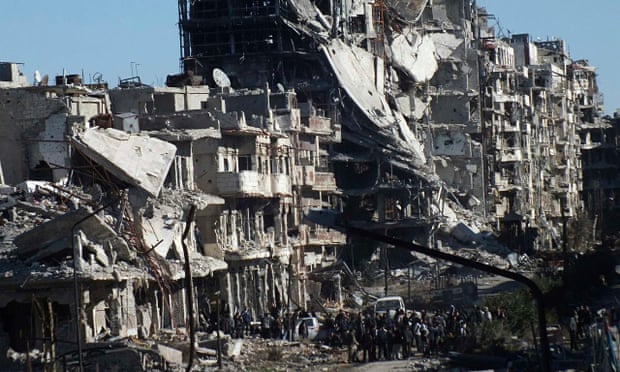
Right now, with the Syrian Army and its Iranian and Lebanese helpers advancing around the city of Aleppo and elsewhere, everything looks relatively sunny for the Russians (as long as your view is an airborne one), but give it a year, or two or three. Or just ask yourself, what exactly will such "success" translate into, even if a Bashar al-Assad regime regains significant power in a country that, in most senses, has simply ceased to exist? Its cities, after all, are in varying states of destruction, a startling 11.5% of its people are estimated to have been killed or injured, and a significant portion of the rest transformed into exiles and refugees (with more being produced all the time).
Even if the Islamic State and other rebel and insurgent groups, ranging from those backed by the U.S. to those linked to al-Qaeda, can be "defeated," what is Russia likely to inherit in the Middle East? What, in far better circumstances, did the U.S. inherit in Afghanistan or Iraq? What horrendous new movements will be born from such a "victory"? It's a nightmare just to think about.
Keep in mind as well that, unlike the United States, Vladimir Putin's Russia is no superpower. Despite its superpower-style nuclear arsenal and its great power-ish military, it's a rickety energy state shaken by bargain-basement oil prices. Economically, it doesn't have the luxury of waste that the U.S. has when it comes to military experimentation.
Generally speaking, in these last years, war has meant destruction and nothing but destruction. It's true that, from the point of view of movements like al-Qaeda and the Islamic State, the chaos of great power war is a godsend. Even if such groups never win a victory in the traditional sense (as the Islamic State has), they can't lose, no matter how many of their leaders and followers are wiped out. In the same way, no matter how many immediate successes Washington has in pursuit of its war on terror, it can't win (and in the end neither, I suspect, can Russia).
Has War Outlived Its Usefulness?
Relatively early in the post-9/11 presidency of George W. Bush, it became apparent that his top officials had confused military power with power itself. They had come to venerate force and its possible uses in a way that only men who had never been to war possibly could. (Secretary of State Colin Powell was the sole exception to this rule of thumb.) On the U.S. military, they were fundamentalists and true believers, convinced that unleashing its uniquely destructive capabilities would open the royal road to control of the Greater Middle East and possibly the planet as well.
About this -- and themselves -- they were supremely confident. As an unnamed "senior adviser" to the president (later identified as Bush confidant Karl Rove) told journalist Ron Suskind, "We're an empire now, and when we act, we create our own reality. And while you're studying that reality -- judiciously, as you will -- we'll act again, creating other new realities, which you can study too, and that's how things will sort out. We're history's actors... and you, all of you, will be left to just study what we do."
Ever since then, no small thanks to the military-industrial complex, military power has remained the option of choice even when it became clear that it could not produce a minimalist version of what the Bush crew hoped for. Consider it something of an irony, then, that the U.S. may still be the lone superpower on the planet. In a period when military power of the first order doesn't seem to translate into a thing of value, American economic (and cultural) power still does. The realm of the dollar, not the F-35, still rules the planet.
So here's a thought for the songwriters among you: Could it be that war has in the most literal sense outlived its usefulness, at least for the United States? Could it be that the nature of war -- possibly any war, but certainly the highly mechanized, high-tech, top-dollar form that the United States fights -- is now all unintended and no intended consequences? Do we need another Edwin Starr singing a new song about what war isn't good for, but with the same punch line?
In fact, give it a try yourself. Say it with me: Absolutely nothing.
One more time and really hit that "nothing": Absolutely nothing!
Now, could someone in Washington act accordingly?
(Note: You can view every article as one long page if you sign up as an Advocate Member, or higher).