





This piece was reprinted by OpEdNews with permission or license. It may not be reproduced in any form without permission or license from the source.
Or that Abraham Lincoln never joined a church, and once wrote a skeptical treatise, which friends burned in a stove, to save him from wrecking his political career.
Or that the motto of Margaret Sanger's birth-control newsletter was: "No gods, no masters."
Or that Clarence Darrow said, in a 1930 speech in Toronto:
"I don't believe in God because I don't believe in Mother Goose."
Or that President William Howard Taft said, in a letter declining the presidency of Yale University:
"I do not believe in the divinity of Christ, and there are many other of the postulates of the orthodox creed to which I cannot subscribe."
Or that Luther Burbank told a newspaper interviewer in 1926:
"As a scientist, I cannot help feeling that all religions are on a tottering foundation.... I am an infidel today. I do not believe what has been served to me to believe. I am a doubter, a questioner, a skeptic. When it can be proved to me that there is immortality, that there is resurrection beyond the gates of death, then I will believe. Until then, no."
Or that Bertrand Russell wrote in 1930:
"My own view of religion is that of Lucretius. I regard it as a disease born of fear and as a source of untold misery to the human race."
Or that George Bernard Shaw wrote, in the preface to one of his plays:
"At present there is not a single credible established religion in the world."
* * *
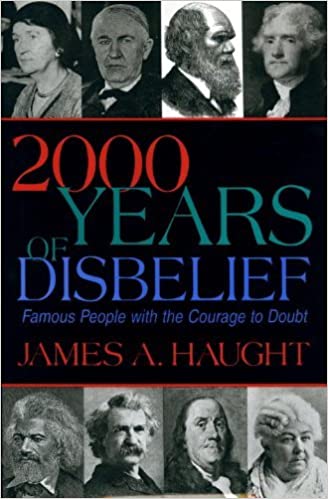
Many, perhaps most, of the world's outstanding thinkers, scientists, writers, reformers - people who changed Western life - have been religious skeptics. But this fact is little known in America. Why?
Because our nation has one last taboo, one unmentionable topic: religious doubt.
In the daily tumult, it's permissible to challenge any idea, save one. Supernatural religion - invisible gods and devils, heavens and hells - is off limits. It's acceptable to write that Elvis is alive on a UFO, but not that God is a figment of the imagination. A few "freethought" journals do so, but mainstream media mostly stay mum.
(Note: You can view every article as one long page if you sign up as an Advocate Member, or higher).
 2
2
 2
2
 1
1






