




Sarah (Sallie) Middagh Henshaw, around 1895.
(Image by Museum of Brooklyn Art and Culture archives.) Details DMCA
As an issue necessarily implies division of opinion and the existence of conflicting factions, it follows that no paper can take a determined stand on any burning issue without making enemies as well as friends, though if it stands for nothing it can expect neither.
Whether it makes more of one, or of the other, depends on how closely its opinions happen to coincide with those of a majority of the class from which it draws its readers; but if an editor is honest and fearless, he cannot afford to consider this.
He must write what he believes to be the truth whenever he believes it essential that the truth should be told, regardless of whom, or how many, it may please, or displease, else he is neither honest with himself nor with his readers.
Herbert was well versed on a broad range of issues, and fully able to articulate his views, often in a humorous or sarcastic vein. Among the issues of his day, he tackled repeatedly the evolution-creation controversy, the federal ban on consumption of alcoholic bevereges known as Prohibition, and the economic tumult of the times, all of which have parallels in our own day.
Having an uncle of such stature must have inspired Nancy, whose intellectual consciousness was just beginning to bud as she entered her mid-teens. But the notoriety of the Henshaws did not end with Herbert. Herbert's brother Frederick Valdemar Henshaw had risen to professional heights within his own field. After earning an engineering degree from Bishop's College, Montreal, Frederick entered the rapidly growing industry of electrification. Electric lighting had by then begun to replace gas light, opening up a new field of commerce. Although he worked as an electrical engineer for many years, and in fact took a keen interest in the burgeoning

Frederic Valdemar Henshaw, with the young George Henshaw Childs.
(Image by Museum of Brooklyn Art and Culture archives.) Details DMCA
field of radio wave transmission in the late 1890s, he eventually joined the investment house of Wood, Struthers & Co., where his professional duties became more closely aligned with banking than with engineering. Frederic would eventually help craft legislation that would enable banks to invest in utilities bonds. At the time of the passing of Nancy's father, F. V. Henshaw was living with his wife in Bellport, Long Island. The couple had no children.
Esther's elder sister, Sarah Middagh Henshaw, was named after their grandmother by adoption, Sarah Middagh Gracie. She was probably the first of her brothers and sisters to marry, and the courtship took place in seemingly far-away Minneapolis. As it turned out, matriarch Cornelia's biological mother, Ann Pettit Birdsall, who had given Cornelia up for adoption but with whom she ultimately re-established ties, moved to Minneapolis in the later 1800s with her other daughter and son-in-law. The Henshaws thus made frequent trips to that part of the world, and it was there that Maddie, as she was familiarly called, made the acquaintance of Clarence Childs, a rising attorney. When the two foresaw a more permanent bond on the horizon, they broke the news to Maddie's father, and a brief correspondence yielded the hoped-for permission to make their romantic affiliation permanent. Having learned their lesson of the effect of cold climate on the human psyche, the couple, after raising a son, George Henshaw Childs, eventually migrated to sunny and balmy Florida, where they spent their retirement years.
Esther's younger sister was Cornelia Gracie Henshaw, or Corrie. Herbert had taken Corrie onto the staff of Brooklyn Life, and as a writer, she found an avenue to express her ideas in a forthright and incautious manner that no doubt found its encouragement in her elder brother. A crisp, dark-haired woman with a strong intellectual character and a
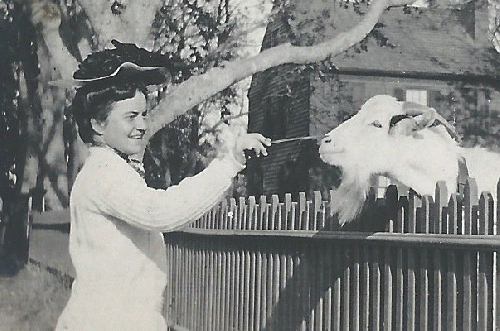
Cornelia Gracie Henshaw poking a cow with a stick in Bellport, Long Island, 1890s.
(Image by Museum of Brooklyn Art and Culture archives.) Details DMCA
mischievous countenance, Corrie, besides attending to many of the day-to-day details of the publication, penned a column about her beloved pet dog, Willie Winkie, which proved so popular that it was to run for three years until Winkie's untimely death. Corrie wrote the column in Winkie's voice, rather than her own. Thus, Winkie refers to his master, Corrie, as his "two-legged boss," and to Nancy as his "New York boss," as Nancy still living in Manhattan at the time. One can imagine that young Nancy got a kick out of reading her name in her aunt's weekly column, albeit in codified form.

Willie Winkie and his 'New York boss,' Nancy Middlebrook.
(Image by Museum of Brooklyn Art and Culture archives.) Details DMCA
Herbert managed to corral another relative into writing an even more ambitious and perhaps equally humorous column -- a spoof on the scientific and academic community. Dr. George Henshaw Childs, the aforementioned son of Clarence Childs and Esther's older sister, Sarah Middagh Henshaw, was born in Minneapolis in 1890, a year after his parents' marriage in Brooklyn's Grace Church. Distance never having been an impediment to the intercourse among the Henshaw syblings, the Childses would make frequent trips to New York, and during one such visit, the family took young George to the American Museum of Natural History.
Sarah (Sallie) Middagh Henshaw, around 1895.
(Image by Museum of Brooklyn Art and Culture archives.) Details DMCA
(Note: You can view every article as one long page if you sign up as an Advocate Member, or higher).
 1
1






