






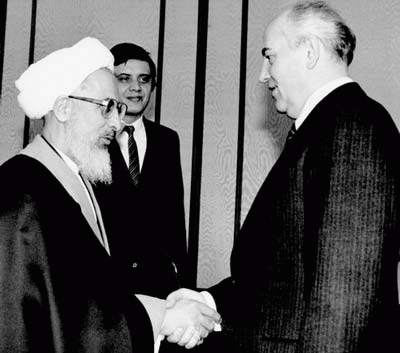
On January 1, 1988, just a year and a half before he passed away on June
3, 1989, Ayatollah Khomeini made a historic move, reaching out the
Soviet President Mikhail Gorbachev, in a gesture of anti-imperialist
solidarity, despite the long hiatus in relations with communist Russia.
This was at a time of war against Iraq and continued subversion of Iran
by the US and Israel. He sent President Gorbachev his only written message to a foreign leade r.
Ayatollah
Khomeini made other prescient gestures in his short and difficult
decade as the leader of the Islamic revolution in Iran; in the first
place, the transfer of the Israeli embassy to Palestinian
representatives, the canceling of recognition of Israel, and the
inauguration of al-Quds Day as an annual international holiday on the
last Friday of Ramadan. He met with Fidel Castro and other third-world
leaders, encouraging solidarity against the imperialist foe.
The
unprecedented visit of the Iranian delegation to Moscow was a sincere
offer of support to the faltering Soviet leader, who had rejected the
atheism of the Soviet past. It contrasts with the treatment of
Gorbachev's new friend, Reagan, who was at the same time conspiring to
subvert the Soviet Union, even as Gorbachev was sincerely reaching out
to the hawkish Reagan, offering a generous plan of world nuclear
disarmament.
The Ayatollah's warning not to trust the West was
being brought home to Gorbachev graphically as the last Soviet troops
were retreating into Uzbekistan in 1988. Despite the unilateral
withdrawal of Soviet forces from Afghanistan, the US was continuing to
arm the insurgents, killing those doomed soldiers as they crossed the
Afghanistan-Uzbekistan Friendship Bridge, built in 1982. Imperialism
takes no prisoners.
Iran played no part in the US-backed 'jihad'
in Afghanistan in the 1980s that brought the collapse of the Soviet
Union. Iranian leaders knew that nothing good would come from working in
alliance with America.
The Ayatollah knew this well, and was alarmed at the naivete' of
Gorbachev. The Ayatollah warned in his letter that the western world was
an "illusory heaven" that appeared seductive. But the truth lies
elsewhere. "If you hope, at this juncture, to cut the economic Gordian
knots of socialism and communism by appealing to the center of western
capitalism, you will, far from remedying any ill of your society, commit
a mistake which those to come will have to erase. For, if Marxism has
come to a deadlock in its social and economic policies, capitalism has
also bogged down, in this as well as in other respects though in a
different form."
Gorbachev was offended and objected. "This
invitation is an interference in the internal issue of a country.
Because every country is free for selecting its school of thought." He
took the Ayatollah's sincere advice as interference, rather than
friendly concern. "Imam Khomeini invited us to Islam; do we have to
invite him to our school of thought?"
History has proved the
fears that the Ayatollah expressed justified. Gorbachev was standing on
the edge of the abyss. Sadly, he scoffed at the ability of the Ayatollah
to see the danger and to want to help him. But it was too late by then.
Gorbachev had lost control, thinking he was handing power to the
people, not recognizing that such a wish was another illusion. The
disaster of the collapse of the Soviet Union will reverberate for
generations to come, as the Ayatollah predicted.
Gorbachev was
operating on a different wavelength when he received the letter from the
Ayatollah, trying to cozy up to Israel and the US, again, naively
thinking goodwill gestures would be reciprocated. He opened the doors to
the emigration of Soviet Jews in 1988 and prepared to renew full
diplomatic relations with Israel.
At the same time Gorbachev
promised Arafat during a state visit that year that the Soviet Union
would recognize an independent Palestinian state if proclaimed, naively
hoping that Israel would show gratitude for his generosity by
negotiating a genuine peace with the Palestinians. Arafat declared
independence in November 1988 and got Soviet recognition the next year,
but it was not much consolation. Israel was busy setting up consular
offices in Moscow and elsewhere, issuing eventually a million visas to
Soviet Jews to come to Israel.
Hundreds of thousands of Russian
Jews got instant Israeli citizenship and emigrated, many of them
settling illegally in the Occupied Territories, nominally part of a
Soviet-recognized Palestinian state. By the end of 1991 when full
diplomatic relations with Israel were restored, over 325,000 Soviet Jews
had emigrated. Gorbachev's hope to bring a quick peace to the Middle
East were dashed as he was ousted from power, leaving the PLO abandoned
and Israel stronger than ever.
Just as the Zionists had
hoodwinked Stalin into recognizing Israel, they once again hoodwinked a
Soviet leader into re-recognizing it. Instead of increasing
Soviet/Russian influence by this dual recognition, all influence was
lost, the Palestinians were hurt by the Soviet betrayal, while the
Israelis welcomed a million new Jewish immigrants.
Gorbachev's
trust was betrayed by both the US and Israel; the Soviet Union collapsed
as Soviet Jews fled to the illusory western heaven. The world logically
expected a new era free of the threat of war, a peace dividend that
would improve the lot of people everywhere, ensuring that the material
imperative behind war was eliminated. But the triumph of empire has
never led to an end to empire, and strengthening empire has never led to
improving the lot of the periphery.
This was clear in the
centuries of imperialism, where the periphery was impoverished at the
expense of the center. There was no reason to believe a new Great Game
of empire could be any different, even Bush I's postmodern variant, with
the US firmly in control. Indeed, the impoverishment of all who are not
part of the center/periphery elite has only accelerated.
Today,
the US continues to work with the Saudis to destabilize the Iran-Iraq
'Shia arc' replaying the endgame against the Soviet Union in
Afghanistan, this time with clandestine operations being carried out by
the US, Saudis and Israelis--all jealous of Iran's increasing influence
in the Middle East.
(Note: You can view every article as one long page if you sign up as an Advocate Member, or higher).






