




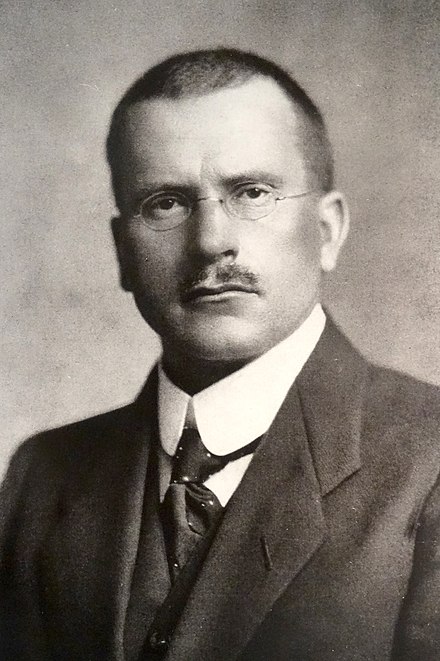
CGJung.
(Image by (From Wikimedia) unknown, upload by Adrian Michael, Author: unknown, upload by Adrian Michael) Details Source DMCA
Duluth, Minnesota (OpEdNews) September 1, 2020: How do we as individual persons embrace the creative universe? Perhaps we can imagine our own personal creative spirit as attuning us to the creative universe.
Dr. Henry Alexander Murray, Jr., M.D., Ph.D. (1893-1988) and his muse/lover for more than forty years, Christiana Drummond Councilman Morgan (1897-1967), imagined that through the extramarital love affair they were mutually cultivating not only their own individual creative spirits but also the combined creative spirit of their dyad, as they rather impersonally referred to their personal love relationship, as their way of attuning themselves to the creative universe.
Now, in 1970 and 1971, Forrest Glen Robinson (born in 1940; Ph.D. in English, Harvard University, 1967) started interviewing Dr. Murray, the retired director the Harvard Psychological Clinic, about his long but secret extramarital love affair with Christiana Morgan of the Harvard Psychological Clinic.
By 1970, Christiana Morgan was deceased, and so was Dr. Murray's first wife Josephine ("Jo") Lee Rantoul Murray (1894-1962). In 1969, Dr. Murray married his second wife Caroline ("Nina") Chandler Fish Murray (1920-2015).
Christiana Morgan's husband William ("Will") Otho Potwin Morgan (1895-1934), an anthropologist, had died earlier. They had a son named William Peter Councilman Morgan (1921-??).
For a major biography of Christiana Morgan, see the American Jungian analyst Claire Douglas' 1993 book Translate This Darkness: The Life of Christiana Morgan (Simon & Schuster). But also see my OEN article "Christiana Morgan on Creative Personal Transformation" (dated August 23, 2020):
Now, for a heterosexual man such as Dr. Murray, the anima archetype in his psyche was involved in his attraction, for example, to his first wife and to his second. The obvious involvement of the anima archetype in his relationships with his wives compounds the difficulty of explaining his projection of the anima archetype in his psyche onto Christiana Morgan. Clearly, the difference with her is a difference in degree, not a difference in kind. The difficulty of explaining what happened to him in relation to her is that she appears to have been ready, from her own previous sexual relationships involving anima projections onto her, to have been prepared to receive and respond and carry his projection onto her.
But whatever else may be said about their long personal relationship, in my estimate, their relationship did not involve what the now famous Jewish philosopher and theologian Martin Buber (1878-1965) refers as an I-Thou encounter in his now famous book I and Thou, translated by Walter Kaufmann (Charles Scribner's Sons, 1970; orig. German ed., 1923; first English translation, 1937; Buber added the postscript in 1957).
I would describe their so-called "dyad" as a romantic mutual admiration society between two (eventually, but not at the beginning) trained psychoanalysts that at times included candid and searching conversations about themselves and their relationship. As I will explain momentarily, their lives and their relationship also involved the American novelist and poet Herman Melville (1819-1891) and the Swiss psychiatrist and psychological theorist C. G. Jung, M.D. (1875-1961).
Next Page 1 | 2 | 3 | 4 | 5 | 6
(Note: You can view every article as one long page if you sign up as an Advocate Member, or higher).






