




The Cover-up Takes Shape
On Nov. 6, 1991, two days after the Beach memo, Beach's boss, White House Counsel C. Boyden Gray, convened an interagency strategy session and explained the need to contain the congressional investigation into the October Surprise case. The explicit goal was to ensure the scandal would not hurt President Bush's reelection hopes in 1992.
At the meeting, Gray laid out how to thwart the October Surprise inquiry, which was seen as a dangerous expansion of the Iran-Contra investigation where some of prosecutor Walsh's investigators also were coming to suspect that the origins of the Reagan-Bush contacts with Iran traced back to the 1980 campaign.
The prospect that the two sets of allegations would merge into a single narrative represented a grave threat to George H.W. Bush's political future. As assistant White House counsel Ronald von Lembke, put it, the White House goal in 1991 was to "kill/spike this story." To achieve that result, the Republicans coordinated the counter-offensive through Gray's office under the supervision of associate counsel Janet Rehnquist, the daughter of the late Chief Justice William Rehnquist.
Gray explained the stakes at the White House strategy session. "Whatever form they ultimately take, the House and Senate 'October Surprise' investigations, like Iran-Contra, will involve interagency concerns and be of special interest to the President," Gray declared, according to minutes. [Emphasis in original.]
Among "touchstones" cited by Gray were "No Surprises to the White House, and Maintain Ability to Respond to Leaks in Real Time. This is Partisan." White House "talking points" on the October Surprise investigation urged restricting the inquiry to 1979-80 and imposing strict time limits for issuing any findings, the document said.
In other words, just as the Reagan administration had insisted on walling off the Iran-Contra investigation to a period from 1984-86, the Bush administration wanted to seal off the October Surprise investigation to 1979-80. That would ensure that the public would not see the two seemingly separate scandals as one truly ugly affair.
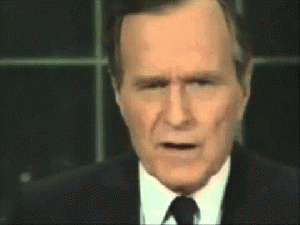
Meanwhile, as Bush's White House frustrated the congressional inquiries with foot-dragging, slow-rolling and other obstructions, President Bush would occasionally lash out with invective against the October Surprise suspicions.
In late spring 1992, Bush raised the October Surprise issue at two news conferences, bringing the topic up himself. On June 4, 1992, Bush snapped at a reporter who asked whether an independent counsel was needed to investigate the administration's pre-Persian Gulf War courtship of Iraq's Saddam Hussein.
"I wonder whether they're going to use the same prosecutors that are trying out there to see whether I was in Paris in 1980," the clearly peeved President responded. "I mean, where are we going with the taxpayers' money in this political year? I was not in Paris, and we did nothing illegal or wrong here" on Iraq.
At another news conference at the world environmental summit in Brazil, Bush brought up the October Surprise case again, calling the congressional inquiries "a witch hunt" and demanding that Congress clear him of having traveled to Paris.
(Note: You can view every article as one long page if you sign up as an Advocate Member, or higher).
 1
1
 1
1






