

In this way, the Obama administration has more than doubled the total whistleblower prosecutions of all previous administrations combined under the draconian World War I-era Espionage Act. It has also gone after Army Private Bradley Manning for releasing secret military and State Department files to WikiLeaks, not only attempting to put him away for life for "aiding the enemy," but subjecting him to particularly vindictive and abusive treatment while in military prison. In addition, it has threatened journalists who have written on or published leaked material and gone on expeditions into the telephone and email records of major media organizations.
All of this adds up to a new version of deterrence thinking in which a potential whistleblower should know that he or she will experience a lifetime of suffering for leaking anything; in which those, even in the highest reaches of government, who consider speaking to journalists on classified subjects should know that their calls could be monitored and their whispers criminalized; and in which the media should know that reporting on such subjects is not a healthy activity.
This sort of deterrence already seemed increasingly extreme in nature; the response to Snowden's revelations took it to a new level. Though the U.S. government pursued WikiLeaks founder Julian Assange abroad (while reportedly preparing to indict him at home), the other whistleblower cases might all be considered national security ones. The manhunt against Snowden is something new. Through it, Washington is now punitively expanding twenty-first century deterrence theory to the world.
The message is this: nowhere will you be safe from us if you breach U.S. secrecy. Snowden's will surely be a case study in how far the new global security state is willing to go. And the answer is already in: far indeed. We just don't yet know exactly how far.
How to Down a Plane to (Not) Catch a Whistleblower
In this light, no incident has been more revealing than the downing of the plane of Bolivian President Evo Morales, the democratically elected head of a sovereign Latin American nation, and not an official enemy of the United States. Angry Bolivian authorities termed it a "kidnapping" or "imperialist hijack." It was, at the least, an act for which it's hard to imagine a precedent.
Evidently officials in Washington believed that the plane bringing the Bolivian president back from Moscow was also carrying Snowden. As a result, the U.S. seems to have put enough pressure on four European countries (France, Spain, Portugal, and Italy) to force that plane to land for refueling in a fifth country (Austria). There -- again, U.S. pressure seems to have been the crucial factor -- it was searched under disputed circumstances and Snowden not found.
So much is not known about what happened, in part because there has been no serious reporting from Washington on the subject. The U.S. media has largely ignored the American role in the downing of the plane, an incident regularly described here as if the obvious hadn't happened. This may, at least in part, be the result of the Obama administration's implacable pursuit of whistleblowers and leakers right into the phone records of reporters. The government has made such a point of its willingness to pursue whistleblowers via journalists that, as Associated Press President Gary Pruitt recently pointed out, national security sources are drying up. Key figures in Washington are scared to talk even off the record (now that "off" turns out to be potentially very "on"). And the Justice Department's new "tighter" guildelines for accessing reporters' records are clearly filled with loopholes and undoubtedly little more than window dressing.
Still, it's reasonable to imagine that when Morales's plane took off from Moscow there were top U.S. officials gathered in a situation room (- la the bin Laden affair), that the president was in the loop, and that the intelligence people said something like: we have an 85% certainty that Snowden is on that plane. Obviously, the decision was made to bring it down and enough pressure was placed on key officials in those five countries to cause them to bow to Washington's will.
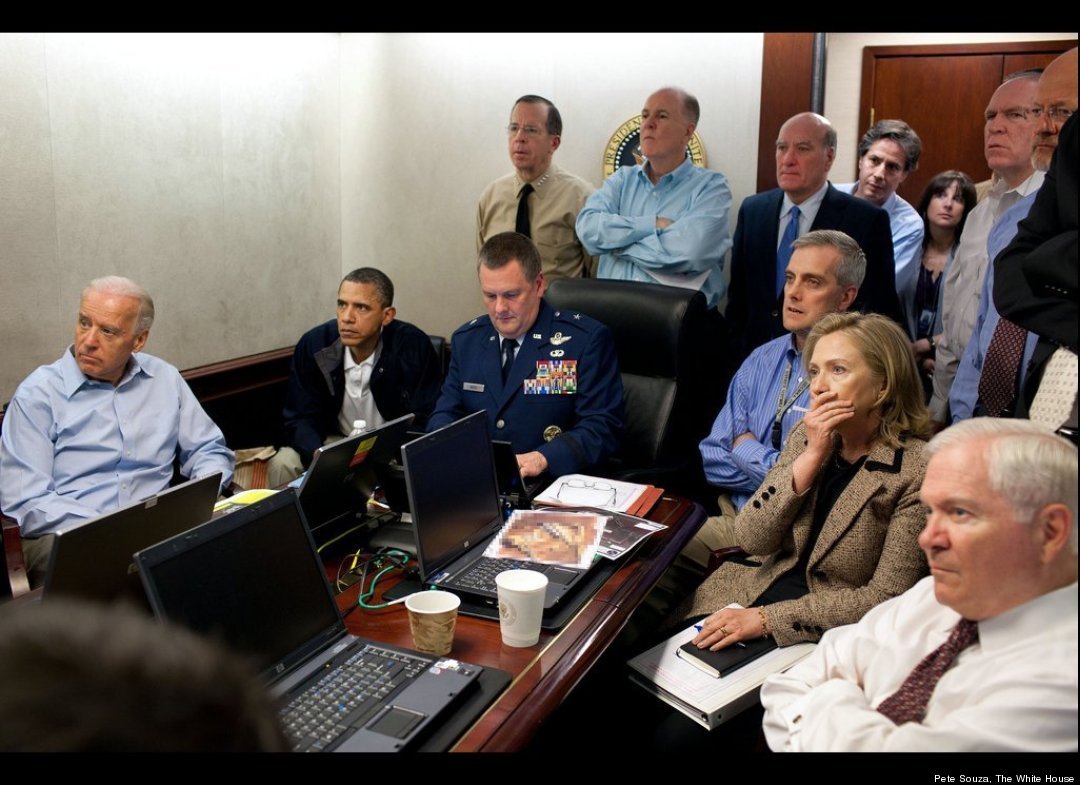
One can certainly imagine that, but know it? At the moment, not a chance and, unlike in the raid that killed bin Laden, a triumphant situation-room photo hasn't been released, since there was, of course, no triumph. Many questions arise. Why, to mention just one, did Washington not allow Morales's plane to land for refueling in Portugal, as originally planned, and simply strong-arm the Portuguese into searching it? As with so much else, we don't know.
We only know that, to bring five countries into line that way, the pressure from Washington (or its local representatives) must have been intense. Put another way: key officials in those countries must have realized quickly that they stood in the way of a truly powerful urge by the planet's superpower to get one fugitive. It was an urge so strong that it overrode any other tactical considerations, and so opened the way for Venezuela, Bolivia, and Nicaragua to offer asylum to Snowden with the support of much of the rest of Latin America.
Imagine for a moment that an American president's plane had been brought down in a similar fashion. Imagine that a consortium of nations pressured by, say, China or Russia, did it and that, with the president aboard, it was then searched for a Chinese or Soviet "dissident." Imagine the reaction here. Imagine the shock. Imagine the accusations of "illegality," of "skyjacking," of "international terrorism." Imagine the 24/7 media coverage. Imagine the information pouring out of Washington about what would no doubt have been termed "an act of war."
Of course, such a scenario is inconceivable on this one-way planet. So instead, just think about the silence here over the Morales incident, the lack of coverage, the lack of reporting, the lack of outrage, the lack of shock, the lack of... well, just about anything at all.
Instead, the twenty-first-century version of deterrence theory ruled the day, even though Snowden is the proof that deterrence via manhunts, prosecution, imprisonment, and the like has proven ineffective when it comes to leaks. It's worth pointing out that what may be the two largest leaks of official documents in history -- Bradley Manning's and Snowden's -- happened in a country increasingly under the sway of deterrence theory.
Slouching Toward Washington to Be Born
And yet don't think that no one has been affected, no one intimidated. Consider, for instance, a superior piece of recent reporting by Eric Lichtblau of the New York Times. His front-page story, "In Secret, Court Vastly Broadens Powers of NSA," might once have sent shock waves through Washington and perhaps the country as well. It did, after all, reveal how, in "more than a dozen classified rulings," a secret FISA court, which oversees the American surveillance state, "has created a secret body of law" giving the NSA sweeping new powers.
(Note: You can view every article as one long page if you sign up as an Advocate Member, or higher).
 1
1
 1
1