





The state is only a means to an end: Mein Kampf
What Chamberlain couldn't comprehend was the utter disdain and contempt that Hitler and Italian dictator Mussolini held him and his French counterpart Edward Daladier. The feelings were mutual. Chamberlain referred to Hitler as a half-mad dog and common housepainter. There wasn't a whole lot of difference between Hitler and Mussolini, and yet even as early as 1938 we see the first references to Hitler as mad. Anybody keeping up with the news will see Putin often referred to the same way. Simply put, the liberal democrats couldn't figure Hitler out; just like they can't figure out Putin except in the vilest terms. They saw Hitler as an ignorant housepainter but he had a mind like a steel trap. They thought he was driven by nationalistic impulses like Mussolini but he wasn't. For Mussolini, nationalism and patriotism meant allegiance to Italy as a nation-state in what is a culturally diverse country. The liberal west could understand this. But for Hitler, the nation-state was not an end in itself. It was a means to an end; and that end was the creation of a racially homogeneous Volksgemeinshaft (racial community) without national boundaries. Hitler didn't create this movement, or this idea. It was there before he was born. He represented Pangermanic interests that were intrinsic to but superseded German nationalism. Hitler knew very well that he might ignore those forces to his own peril. Outside the genteel norm, Hitler was demonized as a street fighter, or as Churchill would later say a gutter snipe. It's the same with Putin who is demonized as a KGB thug. Hitler was a street-fighter who packed his own heat. That was how he gained political power in a nation torn apart by war. Now though, he was Reichskanzler and head of the largest European state. For both Hitler and Mussolini, their opponents represented the utterly corrupt and contemptible political marketplace of commonality that routinely bought and sold votes, nations, and people to the highest bidder. For the British and French, Hitler and Mussolini were street gangsters who had gained power illegitimately. Neither side understood the other. The same can be said today.
Summitry
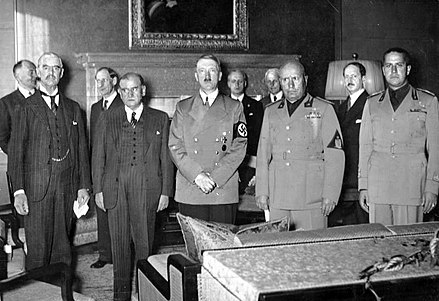
Hitler and Chamberlain met twice in hastily arranged meetings that we now call summits. Hitler came out on top because he was willing to risk war for the Pangermanic ideal while the west wasn't. How could the west go to war against something they didn't quite rightly comprehend? Even so, in August 1938 they were all close to war. England put the fleet to sea while France called up reservists and mobilized for war. Germany had men at the Czech border ready to invade. All of them, without Benes, met and held a meeting in Munich to decide the fate of the Sudetenland, and by implication, Czechoslovakia itself. Hitler told Chamberlain what he wanted to hear: that the Sudetenland would be Germany's last territorial demand in Europe. He lied. Danzig and a large portion of East Prussia had been given to Poland in 1919. They were next on the Pangermanic list. The Czechs were to be sold down river because the west couldn't understand Pangermanic motivations. What the Czechs themselves didn't grasp and should have, was that the peace faction in England didn't care about them. They wanted a stable border between France and Germany on the Rhine and German political ambitions directed east towards the Soviet Union through Poland if necessary. The British war party, centered on Winston Churchill, was in the minority. Chamberlain and the peace faction were willing to concede Sudetenland and wait out developments. So part of Chamberlain's play was a waiting game. Hitler's spell could be quite charming. He understood how to placate Chamberlain when he learned that the English fellow wouldn't back down on every issue. Chamberlain insisted that the territorial integrity of the Czech rump state be respected. Hitler assured him it would. He lied again. Finally, they both signed an agreement to avoid war with each other. That should have been Hitler's aim at all costs as it was the Royal Navy's embargo that had insured Germany's defeat in 1918. Hitler thought he had it all figured out but didn't.
Peace in our time
When the Munich Agreement was finally signed in September 1938, Neville Chamberlain was the most popular and revered politician in the western world. Cheering throngs adored him all over Germany. It was the same when he returned to England. He emerged from his aircraft and waved the paper that he and Hitler had signed. He proclaimed peace in our time. Everybody cheered. Two years later he would die in sorrow, all his dreams and accomplishments shattered when the planetary conflagration and catastrophe of world war began 12 months after Munich. Now he is presented as pathetic and forlorn, standing on a wet dreary runway waving a soggy piece of paper signed by Herr Hitler that guaranteed nothing at all. The larger tragedy was the mistaken assumption that any conciliatory diplomacy like this would inevitably and automatically lead to Armageddon as it did in 1939. In principle The Domino Theory was based on Munich. Fifty thousand American dead and three million Korean dead followed because of it. Then came ten years of slaughter in Vietnam. Dominican Republic, Lebanon, Panama, Granada, Haiti, Serbia, Kuwait, Iraq, Somalia, Afghanistan, Iran, Yemen, Libya, Ukraine; there is no end in sight.
1. Joseph P. Farrell, Reich of the Black Sun: Nazi Secret Weapons and the Cold War Allied Legend, Adventures Unlimited Press, 2004.
Robert Wilcox, Japan's Secret War: Japan's Race Against Time to Build Its Own Atomic Bomb, Da Capo Press, 1995
Edgar Meyer and Thomas Mehner, Geheime Reichssache: Thuringen und die deutsche Atombombe, Kopp Verlag, (Rottenburg am Neckar) 2016
Edgar Mayer, Thomas Mehner, Die Atombombe und das Dritte Reich: Das Geheimnis des Dreiecks Arnstadt-Wechmar-Ohrdruf (AWO), Kopp, 2002
Rainer Karlsch, Hitlers Bombe: Die geheime Geschichte der deutschen Kernwaffenversuche, Deutsche Verlags-Anstalt, Munchen, 2005
(Article changed on Mar 30, 2022 at 3:10 PM EDT)
(Article changed on Mar 30, 2022 at 3:32 PM EDT)
(Note: You can view every article as one long page if you sign up as an Advocate Member, or higher).
 2
2
 1
1
 1
1






