







DA: Demotivation is actually very simple. And it's enough to look at the world around us to see the many opportunities people have for demotivation and the way that they hate them. One of the examples for me was in a new approach a company was taking for cubicles. Where not only did they have the cubicles that signal temporary employment and substitutability but they actually went a step farther. They basically created cubicles that people could claim every day. Their idea for these cubicles was that people would come every day and they would come early to get the best cubicles available. And while that was true, another thing that happened in the process was that people became incredibly demoralized. All of a sudden, they couldn't even put their pictures up there, or anything about their kids or any other kinds of possessions. There was no name, there was nothing on the cubicles. Everything about it was just shouting "you're here temporarily. You're just like everybody else and we can replace you very, very easily." And so my lesson from exploring motivation has been that yes, we should try to motivate people and create environments that motivate people. But the reality is that the first thing we need to do is to stop demotivating people. And I worry that too many times -- not intentionally, not with the goal of demotivating people -- we do things that change people's sense of mission and connection and link to the company and, in the process, we demotivate people a lot.
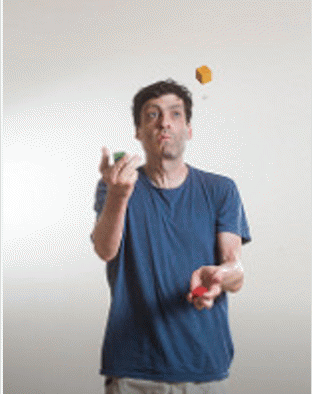
Dan's busy schedule makes it imperative to be the ultimate multi-tasker
(Image by courtesy of Dan Ariely) Details DMCA
JB: Beyond creating an environment that allows employees to personalize their space, there are other very simple do's and don't's that make perfect sense and yet are often overlooked. Please share a few of these tips, Dan.
DA: The main point, of course, is not personalized space. It's kind of nice but that's not it. The main issue is to transition the workplace from a place that focuses on short term to focus on the long term. So, anything that you could do to get people to think about the workplace in the long term is very helpful. So if you basically get people to think about their 3-year, 5-year, 10-year plan, if you get people to think about how long they've been working in a place and are proud of the duration, if you get people to realize that they have a voice in what is going to go with the company"
If you say, we want your advice on what to do with the corporate social responsibility, with the Christmas party, with product improvement and so on. If you ask people for their 3-year plan on improvement. So, all of those things are about that.
Then, of course there's autonomy. Which is to say, we appreciate your particular decisions and we give you some kind of flexibility. So, arranging your desk could be one of them. But the more important autonomy is fixing when you want to start and when you want to finish, when you want to work more and when you want to work less. And what projects you want to work on and so on. All of those things create more engagement, loyalty and care.
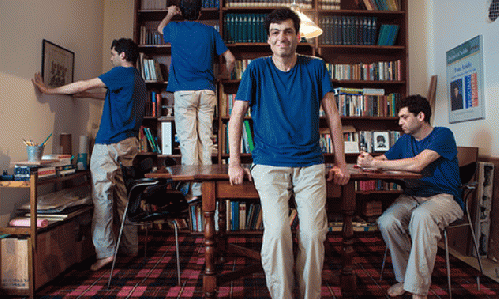
JB: So, a basic first step is for managers to acknowledge that their employees are individuals with skills, preferences and feelings, not just a set of interchangeable widgets. And for the employees to feel valued and heard. Last year, I attended a lecture by Tal Ben Shahar. The topic was 'How Great Leaders Create Great Places to Work.' He said something surprising: that research shows that if a manager can bump up positivity (aka praise) by as little as 2%, it will lead to a measurable improvement in individual and team performance and, therefore, productivity. It sounds like we employees are pretty cheap dates: treat us like human beings of some worth, make us feel heard and praise us from time to time. Can it be as simple as that? What am I missing?
DA: It is one of the simple steps we can take. But we also need autonomy, pride, etc.
(Note: You can view every article as one long page if you sign up as an Advocate Member, or higher).
 1
1
 1
1






