| Back OpEdNews | |||||||
|
Original Content at https://www.opednews.com/articles/Organizing-the-Women-s-Mar-by-Joan-Brunwasser-Activism_Activist_Chicago-Politics_Ecoactivism-170207-251.html (Note: You can view every article as one long page if you sign up as an Advocate Member, or higher). |
|||||||
February 7, 2017
Organizing the Women's March, Chicago
By Joan Brunwasser
I had originally planned to go with my wife and family, but it occurred to me that it might be better to work on the satellite march in Chicago. There were solid indications that the DC march was going to be huge. I ended up working on the organizing committee for the Women's 1/21 March on Chicago. It was a great experience....There never seemed to be any question about my "legitimacy." There was too much to do.
::::::::
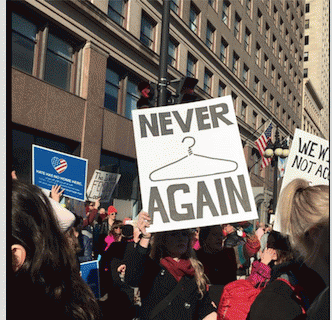
This is #6 in my ongoing series*, "Signs of Sisterhood" about the Women's Marches that took place on January 21, 2017, on the heels of President Trump's inauguration. I'm keeping this coverage of this historic event going in order to maintain that huge surge of positive energy from the march during these challenging times.
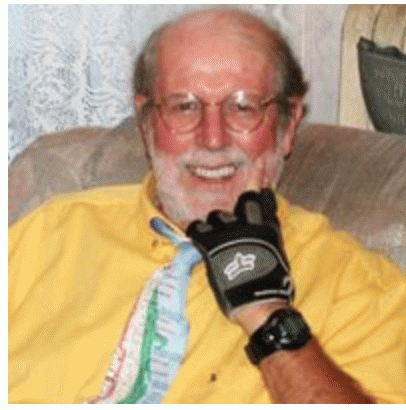
My guest today is J. Harry Wray, author and Professor Emeritus, DePaul University.
Joan Brunwasser: Welcome to OpEdNews, Harry. You were a professor of political science for many years and have remain engaged and involved. I'd like to discuss a very recent phenomenon: the Women's March on Washington, along with its sister marches across the country and throughout the world. Did you go?
Harry Wray: I had originally planned to go with my wife and family, but it occurred to me that it might be better to work on the satellite march in Chicago. There were solid indications that the DC march was going to be huge. I ended up working on the organizing committee for the Women's 1/21 March on Chicago. It was a great experience.
JB: Tell us more! How did you go about getting on the organizing committee for the Chicago march?
HW: That's a neat story that says a lot about the movement we are suddenly in. There was a story about the DC march in the Trib a couple of weeks after the election. Buried in that story was a sentence about a Chicago march that was also forming, with a person's name. No address or contact information, but she had an unusual name that I was able to track down.
About 100 people showed up at the first meeting. Of these, about 50 were furiously involved. Everyone was new to planning something like this but there was a lot of talent. About five or six women were really the central players, but there were no turf battles and everyone operated on the faith that they would do what they said they were going to do.
JB: That is a great story. Was the group predominantly female? Was your participation an issue in any way?
HW: It was about 95% female, and everyone shared a central belief that this was a women's march that was open to anyone who shared concern for women's issues. It is really pretty hard to think of any issue concerning social justice that is not a women's issue. There never seemed to be any question about my "legitimacy." There was too much to do.
JB: I bet! What did you work on?
HW: I worked on college and university outreach, trying to make sure campuses from the northern half of the state, up to and including Wisconsin-Parkside, were saturated with information about the March. Others were working on community outreach, and almost everything everyone did involved outreach in one form or another. We wanted a big crowd, and we were buoyed by the knowledge that people around the country were working on satellite marches and events as well. No one had ever been on the inside of planning something like this, and I think many of those planning this one had never even been at a big march previously. (I never could find the right time to ask that question.) We were hoping for a good crowd, but no one knew what to expect. About a week before the march we were hoping for 20,000, but then one could sense things were really breaking loose. You could feel it on the ground, and our website was suddenly being bombarded. On the Monday before the march, the estimation was raised to 40,000, and on Thursday raised again to 50,000. I was secretly hoping for 60,000, but I only told my wife and a couple of close friends this because I did not want people to be disappointed if we got a lesser number. I was well aware that a huge number of Chicagoans, including my daughter, would be in DC.
JB: What was it like working college outreach? What kind of response were you getting and were you surprised by it?
HW: It was fine and gratifying, but I'm wondering if we could talk a bit about the results of the march, which I think were historic. That's what I really feel good about.
JB: Sure, Harry. Take it away!
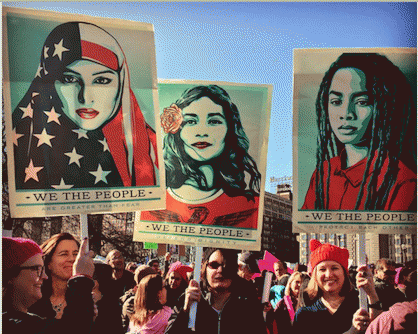
HW: Everyone who had anything to do with this was blown away by the response. The official estimate was 250,000. I spent a fair amount of time estimating the size and I think it was at least that. And of course the response from around the country, beginning in DC, was also huge. There are a couple of political scientists from New England who systematically sought to assess the size of the more than 600 events held in the United States on that day. They took every estimate they could get and printed them all up. (Many of these were fewer than 100, largely in rural, deep red, areas. That was very moving.) But their best guess was that between 3.2 and 4.6 million participated. So let's say there were about 4 million. This would make it a genuinely historic event. Never before in American history have more people marched in more streets on a single day. But it turns out that January 21 was significant in more important ways as well.
JB: Don't stop there; tell us more!
HW: In the course of my life I have been on quite a few big marches, and there are always two dimensions to them. The most obvious is what might be called the public dimension. A march seeks to change the trajectory of public events. This one certainly did that. January 21 offered tangible evidence--something that surveys could not do--that there is a huge army of people who feel very intensely about what Trump is trying to do to this country. This stiffens the spines of Democratic politicians, and unnerves quiescent Republicans. I believe that it has also affected the mass media coverage of Trump. We have a lively progressive news service in this country that is important, but it does not reach a mass audience. Mainstream media had never been sure about how to cover someone like Trump. Since the demonstrations however, there has been a marked change in the tenor of mass media coverage. It has been much more critical and now openly calls out at least some of Trump's more notorious lies. And the coverage of the Muslim ban, to cite but one example, has been much more critical. I'm not saying the marches were totally responsible for this change, but mainstream media--profit seeking institutions all--have to be mindful of the fact that there is a huge audience that wants more critical, which is to say more truthful, coverage of Trump.
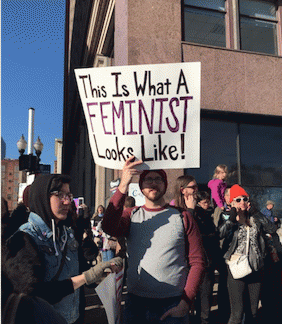
The second dimension of the march's impact is private, or internal. A march like this does something to the souls of marchers. A huge number of people who marched on January 21, if one can believe anecdotal reports, had never done so before. They probably thought they were simply marching for a cause, and were taken by surprise at the joyfulness such acts of solidarity generate. Everyone I have talked with about the marches, in Chicago, in DC and elsewhere--that includes scores of people--wanted to talk about how personal this very public experience was for them. And this turns out to be a second impact: This is not going to be a "one and done" deal. One week after the marches, people flocked to U.S. airports in outrage over the Muslim ban. Congressmen report that their email and phone contacts with constituents has increased five fold, and that it is overwhelmingly anti-Trump. Local citizen action groups are springing to life all over the country.
Obviously there is much work to be done and much evil that the Trump regime will be able impose. But think about how people felt three weeks ago compared to how they feel now. I believe the marches are significantly responsible for this change.
JB: I have definitely noticed this empowering phenomenon as well. Speaking of the private, internal impact, how has this changed how you feel, how you act going forward?
HW: I have long been familiar with the old Chinese curse, "May you live in interesting times," but I never fully grasped its significance until now. This is not exactly what I had in mind in retirement! On the other hand anyone who has a family, or who has been fortunate enough to have had contact with young people in their jobs, has little choice. I will remain politically active. There is no way I'm checking out so long as Trump is president.
JB: Good to know. Thanks so much for giving us a glimpse into the making of the Women's March in Chicago, Harry. This was fun.
***
*Others in the "Signs of Sisterhood" series:
Signs of Sisterhood: Inside the Women's March in Chicago 1.23.17
Women's March: Whidbey Island, WA 1.24.17
A Guy's View from Inside the Chicago Women's March 1.25.17
Women's March: Seattle 1.28.17
50,000 Turned Out for Austin Women's March 2.3.17
Authors Website: http://www.opednews.com/author/author79.html
Authors Bio:
Joan Brunwasser is a co-founder of Citizens for Election Reform (CER) which since 2005 existed for the sole purpose of raising the public awareness of the critical need for election reform. Our goal: to restore fair, accurate, transparent, secure elections where votes are cast in private and counted in public. Because the problems with electronic (computerized) voting systems include a lack of transparency and the ability to accurately check and authenticate the vote cast, these systems can alter election results and therefore are simply antithetical to democratic principles and functioning.
Since the pivotal 2004 Presidential election, Joan has come to see the connection between a broken election system, a dysfunctional, corporate media and a total lack of campaign finance reform. This has led her to enlarge the parameters of her writing to include interviews with whistle-blowers and articulate others who give a view quite different from that presented by the mainstream media. She also turns the spotlight on activists and ordinary folks who are striving to make a difference, to clean up and improve their corner of the world. By focusing on these intrepid individuals, she gives hope and inspiration to those who might otherwise be turned off and alienated. She also interviews people in the arts in all their variations - authors, journalists, filmmakers, actors, playwrights, and artists. Why? The bottom line: without art and inspiration, we lose one of the best parts of ourselves. And we're all in this together. If Joan can keep even one of her fellow citizens going another day, she considers her job well done.
When Joan hit one million page views, OEN Managing Editor, Meryl Ann Butler interviewed her, turning interviewer briefly into interviewee. Read the interview here.
While the news is often quite depressing, Joan nevertheless strives to maintain her mantra: "Grab life now in an exuberant embrace!"
Joan has been Election Integrity Editor for OpEdNews since December, 2005. Her articles also appear at Huffington Post, RepublicMedia.TV and Scoop.co.nz.