




We can thank the enlightenment for Independence Day, for, without it, it arguably may have never occurred. It was during that time many people questioned the merits of supporting a power structure that imbued itself with authority sanctioned by supernatural forces, and exacted that authority with an iron hand upon the sum of humanity. But that would change as a group of, albeit flawed, men began to make contributions towards intellectual thought, spreading it to the masses, and would inspiring thoughts that would change a whole order in time.
That "battleground", for lack of a better word, would begin in Europe, and eventually come to America. People began to question the wisdom of supporting an empire, a monarchy, church, and ideas that weren't, by their definition, fair. Why should people support a society that sought only to relegate them to the status of a mere serf, whilst taking their taxes, and offering nothing in return but rule?
Why should the Dutch East India Company be the only company able to exact profit over a continent simply because their trust was endorsed by a monarchy to do so? By what authority was all of this acceptable, and why shouldn't people receive in return the right to a redress of grievances with, at least a modicum of home rule?
This defiance was tantamount to questioning the very fabric of creation, in the view of an insane king, and when the sum of these philosophical questions were put to paper, shook the old order. The Declaration of Independence was the first effort of a collective of people to stand up and demand from power, not only a few meager benefits from a material perspective, but a demand of the people that their humanity is as important as that of any elite, that it is to be respected, and that it will tolerate, no longer, any treatment that will force them in a role of subject whose existence serves no purpose other than to be exploited by power at best dubiously sanctioned.
What arrogance! Who were they to demand these things, and by what right were they instilled with the authority to ask for them? Who were these people to demand the right to establish courts and institutions? They weren't imbued with these rights by God; only a king was.
As imperfect as Americans were, in that age, they demanded rights for themselves, by no authority other than themselves. They demanded that it was "their creator" to do so; whom that "creator" was was left obscure for a purpose, and considering the diversity of belief in the colonies, it is understandable as to why. Many of the contributors had different beliefs thanks to a new school of thought that had been slowly brewing since Sir Francis Bacon sought to unify the English language. It had beginnings in social clubs in Britain itself that led to Thomas Paine immigrating here to start a publication, Common Sense, in Pennsylvania that would call for such revolutionary ideas as separation from the mothercountry, women's rights, and one of his more unpopular views, the abolition of slavery. Up until that point the prevailing wisdom was taught by the church, but during the enlightenment, people began to reembrace themselves with the ideas of Ancient Greece and from France and Germany. It was the expanse of diverse thought that would bring down an old order. It would be those very messages that Martin Luther King would deliver during the battle against Jim Crow to liberate a population right here in the country where revolution against the "yoke of abusive power structures" began.
The Declaration of Independence was not penned by stupid men. They were people who saw the fruit of the "Tree of Knowledge", so to speak, took from it, ate it, and saw society for what it was. The fact that they saw the need to change it, rather than try to support it deriving what little benefit they could get in the process, is to their credit despite their flaws. It was certainly much more than nationalism, worship, or enterprise; it was the revolutionary idea that people, themselves, could too be masters and are, themselves, entitled to a share in humanity. It is a shame that deeper meaning will probably always get lost within the trivialities of a national holiday.
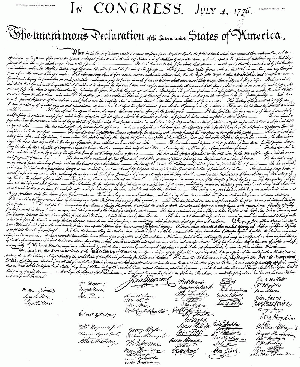
US Declaration of Independence
(Image by (From Wikimedia) Original by Thomas Jefferson et al.; Engraving & fascimile by William J. Stone (1798-1865) / Library of Congress, Author: See Source) Details Source DMCA
 1
1
 1
1
 1
1






