







Authors, Barbara MacLean and Bruce Lerro at Socialist Planning Beyond Capitalism
Why Sylvia Matters
How many of you about to read this have heard of Sylvia Pankhurst? Our guess is, not many. She seems to have fallen through the cracks of socialist and suffragette movement literature. Her mother, Emmeline Pankhurst and sister, Christabel Pankhurst are still looked up to as leaders in the suffragette movement. What is overlooked is the fact that they only supported suffrage for women who had property. This, of course, completely eliminates women in the working class and women who are poor. Sylvia, on the other hand, devoted her life to supporting those women and giving them a voice. We find it ironic that Emmeline and Christabel were considered rebels even though later in life both became pro-war, conservative and religious fundamentalists. However, it was Sylvia who was the true revolutionary. Her name and work should become familiar to all socialists, and especially feminist socialists. Sylvia is an important woman to know about for all women - and men - who want to learn about the history of significant women in the struggle for socialism and women's equality.
Sylvia lived a life of courage, strength, and conviction. Born in 1882 into an upper middle-class family in Manchester, England, her parents were founding members of the Independent Labor Party. Both Richard and Emmeline Pankhurst were firm supporters of women's rights. Sylvia grew up attending public talks, demonstrations and was surrounded by friends of her parents who were considered radicals.
We learned all this from reading Rachel Holmes's book Natural Born Rebel: Sylvia Pankhurst.
Political Work
In her long years as a socialist and feminist she never stopped working, whether in the arts or in politics. Her early years until the Russian revolution were dominated by the Suffrage movement. After the Russian revolution she devoted herself strictly to socialism and supported the Russian Revolution for the first four years. However, she ultimately split with Lenin over his reinstitution of a partly capitalist economy. Sylvia became associated with the soviets, or workers' councils, and advocated for them as political bodies over parliaments. She opposed fascism in both the 1920s and 1930s and supported Ethiopia against both Italian and English imperialism.
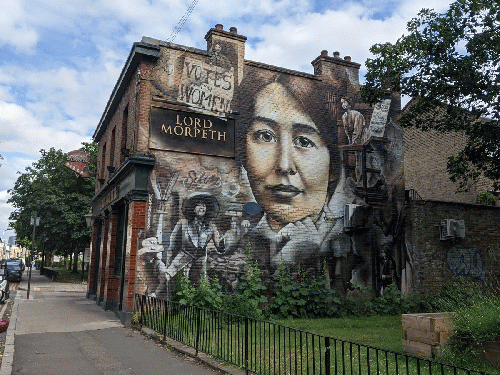
Sylvia moved to Bow in the East End of London in 1912 when she was 30, a traditionally working-class neighborhood. It was here that she set up the Women's Social and Political Union (WSPU). Emmeline and Christabel did not approve. She did many things to support working women and women whose husbands were away at war. She established a cafe' that was free, called Cost Price Restaurant. She also put women to work by organizing a cooperative toy factory. She established The Mother's Arms, a school for toddlers whose mothers were working. At this school the children were taught according to the Montessori method. When the children arrived in the morning in dirty and torn clothing, they would be given uniforms to wear while their clothes were washed and mended.
Sylvia was extremely imaginative in her strategies and tactics in agitating and organizing as a suffragette. She regularly gave public talks and handed out pamphlets, often on the streets, agitating and encouraged women to fight back against the oppressive system in which they lived. She marched in more demonstrations than she could count. In fact, she said later in life that she didn't like to go on walks unless they were marches of protest. She constantly outfoxed the police who tried to shut these events down and arrest her, smuggling herself into meetings where she was banned. She hide inside furniture, and impersonated a pregnant woman by stuffing newspapers down her dress. She was full of surprises.
Sylvia was arrested 15 times in her life campaigning for the rights of women. It's been said that the 19th century - extending into the early 20th century - was the century of the penitentiary. Over one 18-month period she was imprisoned 13 times. This had adverse effects on her health throughout her life. In fact, it's remarkable that she lived to be 78. The first time Sylvia was arrested, for yelling and causing a ruckus in court in defense of other women being sentenced in 1906, when she was only 24, she was placed in the harshest division, the third division. In the third division the women were denied their own clothing, reading, and writing materials, and were fed rotten food. She endured torture through force-feeding because of her fasting as a means of rebellion. All of this changed her life - physically and politically.
She took part in demonstrations where women were dragged down side streets, beaten up, and sexually assaulted by the police, as they were on Black Friday, Nov. 18, 1910. In 1913 the government passed a bill called Temporary Discharge for Ill Health because they feared that too many women would die, turning the public against them. The suffragettes called this bill "The Cat and Mouse Act". They were released on the terms that they would be returned to prison when they had regained their strength. However, most of them went to "safe houses" till they were stronger, then promptly returned to militancy. They were awarded medals by other suffragettes when they were released which they wore with pride. Emmeline was never subjected to force-feeding because she was too high-profile among the middle and upper-middle classes. Sylvia was subjected to it repeatedly.
Sylvia had constant fights with her mother and sister over her desire to combine feminism with work in the Labor Party. As a result, she was driven to the margins of the suffragette movement in Britain. The gap between she, her sister and her mother widened when she campaigned against British involvement in World War I. The differences became an abyss when Sylvia supported the Bolsheviks in the Russian Revolution.
As early as 1921, Sylvia understood the dangers of fascism and though her involvement in socialist parties waned, she was a life-long fighter against fascism. During the 1930s she became involved in the cause of Ethiopia and its fight against Italian fascism. She defended Ethiopia against all imperialist stirrings, including that of Great Britain. By the end of 1950s, with her 30-year soulmate Silvio Corio dead and constant harassment from the British government, there wasn't much left for her in England. She was invited by the Ethiopian emperor Haile Selassie to move to Ethiopia. She spent the last four years of her life there involved in plans for improving their educational and health care systems. She was beloved by Ethiopians and when she died in 1960 she was honored and buried along with all the other Ethiopian fighters against fascism.
Skill in the arts
(Note: You can view every article as one long page if you sign up as an Advocate Member, or higher).






