




This time last year, she and her husband made their living shucking oysters. Now they are out of work, their industry crippled indefinitely by the millions of gallons of crude oil and toxic dispersant dumped into the Gulf of Mexico by BP.
They've been receiving checks from BP that partially compensate their lost income, but it is not enough to pay the bills. Ana says they can afford food, but not school books for their three children.

Ana Chau in her kitchen. Photo by Ada McMahon.
In the midst of all this new uncertainty, stress, and growing domestic strain, Ana and her family are still trying to recover from the Gulf Coast's other disaster, Hurricane Katrina.
Five years ago, the storm ripped a hole in their roof and lashed their house, inside and out, with wind and rain. After Katrina, they applied for government assistance to repair their home. But they did not qualify because they didn't have the title to their house. By the time the previous homeowner wrote a letter confirming she had sold it to the Chaus, the two-week window to apply for funding had closed.
Now the Chaus are one of hundreds of families along the Alabama Gulf Coast who, excluded from government assistance and without the means to finish repairs on their own, continue to live in or wait to return home to sub-standard, storm-damaged housing.
Watch: Ana Chau shows her home's Katrina damage
Disparities in Government Assistance
Ana's challenge of proving home-ownership is common here, where many low-income people own "heir property" that's been passed down through families without a paper trail. This is just one of the barriers that have disproportionately excluded low-income communities and communities of color from government rebuilding assistance.
In 2005, Congress appropriated $11.5 billion in Community Development Block Grants (CDBG) for the Gulf Coast to rebuild after Katrina. But many did not qualify for grants because they rented their homes; missed the two-week window to apply; didn't have the English proficiency or literacy to fill out the paperwork; were told by government officials, incorrectly, that they weren't eligible; or simply never knew about the grants.
Documentation of which individuals received CDBG funding is not publicly available, but residents here say you can see the discrimination in their communities.
Minh Van Le, a commercial shrimper in Bayou La Batre and board member of the South Bay Communities Alliance, says of CDBG allocation, "You've got like three houses in a row that have damage in the same condition, but why does one house get it and the other two or three didn't get it?... It's a lot of unfair practice."
In Snow's Quarter, Bayou La Batre's historic African American
neighborhood, several residents say only three houses have been rebuilt
in their community. Meanwhile Barbara Robbins worries that her 85
year-old-mother Gertrude will fall through rotting floorboards, which
soften every time it rains and water floods the underside of their
home. Robbins did not know about CDBG funding until the deadline had
passed, and said the same is true for many of her neighbors.
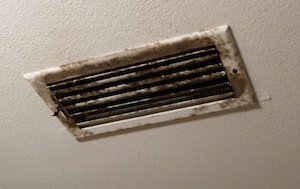
Black mold growing on Rosie Robbin's vents. Photo by Ada McMahon.
Meanwhile, her sister-in-law Rosie, just down the block, has black mold growing on vents in her ceiling, exacerbating her son's asthma. According to local housing codes, rebuilding their homes in this flood-prone area would require elevating them as well, at an estimated $20,000 cost. Neither Rosie nor Barbara, who are on disability, have the money.
(Note: You can view every article as one long page if you sign up as an Advocate Member, or higher).





