




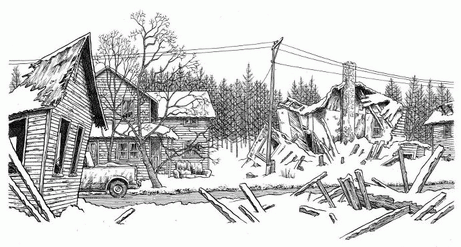
You know, corporations know only one word, and that's "More." And they are going to push and push and push until there is a backlash. Now, a rationale response would have included, at a minimum: a serious jobs program specially targeted at people under the age of 25, a moratorium on foreclosures and bank repossessions, a rational health care system, Medicare for all, forgiveness of student debt, that's a minimum. And we didn't get that. We got "The Iron Fist." We got the physical erasement of the encampments, the closure of the encampments, and absolutely not one piece of legislation that responded to the grievances that pushed people into those encampments. So, something's coming, but you know, as a reporter I've been in the midst of these movements, and I can tell you that absolutely nobody knows. There's a kind of mysterious life force to these movements, and they take on a kind of life of their own once they start. But, you know, that it's coming, I know. But ,when it comes, what triggers it, will it be called Occupy, what will it look like, I don't know.
Rob Kall: You talk in your book, you use a couple of phrases that I just want to throw out there for you to discuss a little bit: violence of poverty, internal colonies, sacrifice zones, and contemporary slavery in America that exists now. You talk about how there are more blacks under control now in the U.S. between prisons, parole, and probation than there were slaves ten years before the civil war.
So, violence of poverty, internal colonies, sacrifice zones, slavery, can you talk on some of those?
Chris Hedges: Yeah, I mean this is not anything that comes as a surprise to African Americans, but once African Americans especially in the South were enfranchised, meaning they could vote, you created, starting in the 70's, this prison system, and we now have twenty-five percent of the world's prison population, that essentially disenfranchised them once again: the same kind of techniques under Jim Crow. So, I was just in Alabama; thirty-four [34] percent of black males in Alabama do not have the right to vote because they have been in prison, and that becomes a mechanism by which you keep people trapped in these "internal colonies;" they can't get a decent education, they can't find meaningful employment, and they can't leave! They don't have access to credit, and if they become too restive they get hauled off to prison. These are visible and invisible walls that hem these people in. Both Martin Luther King and Malcolm X spoke about this. Both of them understood that if there was not economic justice, there would never be racial justice, and while the upper third, at best, of African Americans were integrated through a kind of legal victory, as a result of the Civil Rights movement, into the economy, for the bottom two-thirds, life is worse than when King marched on Selma, and King was very cognizant of that, and his language toward the white liberal class became very bitter toward the end of his life. He, like Malcolm, was calling the "good whites" unconscious racists for refusing to provide the resources to those in the inner cities to help them live a life of dignity, and break, again, this culture of dependence that we saw on Pine Ridge and that we saw in Southern West Virginia. So, yeah, that's where these terms come from.
(Note: You can view every article as one long page if you sign up as an Advocate Member, or higher).
 4
4
 4
4
 2
2






