







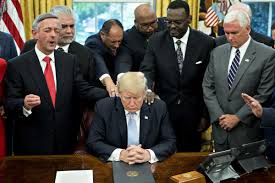
Last Sunday (July 19th), the far-right Christian Post published an article by John Wesley Reid entitled "5 Reasons why Christians should feel comfortable voting for Trump in 2020." Two days later, the same publication reported an international survey implicitly lamenting the fact that "most Americans don't believe they need God to be good."
In this time of Black Lives Matter (BLM) uprisings across the country and across the world, the two articles take on particular importance. Together, they not only highlight stark differences between right and left-wing understandings of Christianity. They also point up differences between the faiths of white evangelicals and their black counterparts in the street.
Additionally, both articles' identification of Christianity exclusively with far right Caucasian politics goes a long way towards explaining the disconnect between morality and belief in a God. The explanation is found in the Christian right's severely limited understanding of God, of goodness, and of the connection between morality and politics in this polarizing era of Donald Trump.
In tandem, the two articles also invite readers to be more thoughtful about their faith (or lack of same) and the ballot they'll cast come November 3rd.
God & Goodness
Begin with the survey. According to Pew Researchers, 54% of Americans hold that you don't need God to be good. Meanwhile 44% (a large majority of them on the ideological right) hold the opposite opinion. Only 24% on the ideological left believe God and morality are necessarily connected. (Left respondents in the survey typically had more years of formal education.)
The Reid article shed light both on the identity of the sidelined God and on survey respondents' likely understanding of "goodness" closely connected with that supposed deity. As will become clear below, Reid's God is primarily concerned with specifically Christian welfare and with unborn life. Goodness is overwhelmingly connected with what the author referenced as "non-carnality." Consequently, Christian political concern focuses on matters of specifically Christian liberty, on sexuality and reproduction - especially on abortion (which btw is not even mentioned in the Bible as a moral concern).
Such limited understanding reflects the huge gap between white evangelicals and their black counterparts - for instance, the ones demonstrating against police brutality in our city streets. Their actions, of course, cannot be adequately explained without reference to the religiously based history of the Civil Rights Movement.
In the light of that history, BLM demonstrators have inherited an understanding of God biblically founded on God's very first revelation, viz. in the liberation of slaves from captivity in Egypt. It is linked besides to concern for widows, orphans and resident immigrants and refugees frequently reiterated in both the Jewish and Christian Testaments. In other words, goodness for black evangelicals is inseparably connected with social justice. Meanwhile, Reid's article suggests ignorance of, and even hostility towards such linkage.
Morality & Voting for Trump
Setting all of that aside, Reid admits that he had doubts about Trump in 2016. But now, he says, those reservations have completely disappeared. Instead, he recommends that all Christians should confidently vote for 45's reelection in November. He advances 5 reasons for doing so:
- You're not voting for Donald Trump; you're voting for the Trump Administration.
- You're not voting simply for a person; you're voting for an agenda.
- Policy outweighs character because policy outlasts character.
- If for no other reason than abortion, vote for Donald Trump.
- Voting for Trump is a tangible way of keeping Biden out.
Closely read, those reasons indicate that the author is still holding his nose. They all end up distancing themselves from a morally challenged candidate while cozying up to supposed paragons of Christian virtue such as Vice President Mike Pence and Secretary of State Mike Pompeo, to Trump's agenda favoring "religious liberty," "life of the unborn," and resistance to volatile attacks on America (standard dog whistle for African Americans).
More specifically, Reid's 5 reasons claim that:
- Trump may be carnally questionable, but people like Mike Pence and Mike Pompeo are "committed non-carnal Christ-followers."
- Doubts about the president's moral character should be "trumped" by his agenda which the author finds favoring "religious liberty," "life of the unborn," and resistance to those explosive attacks on America.
- Sure, Trump's character is highly debatable. However, appointments of "constitutional originalists" to the judiciary are more important. So are "our children's futures," religious liberty, the lives of the unborn, and the economic advancement of low-income communities.
- Christians can conscientiously identify as single-issue voters, because the abortion issue is powerful enough to overwhelm all other policy considerations.
- Joe Biden is no Donald Trump.
Voting against Trump
(Note: You can view every article as one long page if you sign up as an Advocate Member, or higher).
 4
4
 2
2
 2
2






