





Everything has meaning.
This is not a game.
Learn to play the game.
[ Q Drop # 885, March 8, 2018 ]
In the early nineties, I was writing a novel about a young US military photographer in Honduras during the Contra War. I wanted one of the characters to be a science fiction reader. Since I don't care for, or read much, science fiction, I felt I had to read at least one sci-fi book. So I read William Gibson's 1984 novel Neuromancer, a thriller about a young man having adventures in a totally artificial, computer world that Gibson dubbed "cyberspace." The question whether or not cyberspace was a real place hovered over the story.
Fast forward 30 years to last week and I'm watching the documentary Q: Into the Storm on HBO. Fredrick Brennan is one of the three protagonists in the film, which is nominally a search for Q's identity. Brennan was born with a severely disabling disease that involves very brittle bones. Still, he buzzes around, sometimes a bit headlong, in a motorized wheelchair with his little pomeranian aboard. He was a player at the website that ends up channeling the secretive Q's "droppings." Q is named for his "Q level" security clearance. Rumor has it, Q is close to the president and is tight with the highest-ranking military men. Q speaks in riddles like the Oracle at Delphi. Q is cool. Q is the game.
Brennan is an amazing character. He got his first computer at age six and soon taught himself code. He's clearly incredibly intelligent. The idea of engaging anonymously with other people in cyberspace and engaging in power struggles must be, for someone as disabled as he is, to literally accept your cyborgian reality. He's a rolling example of humanity melding with technology. Watching Brennan like this made me flash back on Neuromancer. As a child, Brennan was literally weaned into cyberspace and immersed himself totally in that new and ever-expanding a place, a place where he could be as powerful as anyone else. Even he could pursue his very own Nietzschian Will To Power in a world assembled not out of atoms and cells but out of ones and zeros tricked out in codes and algorithms.
At one point, Brennan responds to a question from filmmaker Cullen Hoback by saying: "At first I thought the world and the internet were separate; now I don't." Later, he says: "The internet leveled the playing field."
Not only is the six-part series Q: Into The Storm by Cullen Hoback a must-see for anyone interested in understanding this fraught moment in history, HBO followed it up with the four-part Exterminate All the Brutes by Raoul Peck. As someone who has spent decades traveling, reading, searching for and enjoying films on the abuses of European Colonialism and US Imperialism, Peck's film is top-of-the-line magnificent. And due to its timing, it's the ideal antidote for the simple-minded, white supremacist ideas embedded in the idea Make America Great Again.
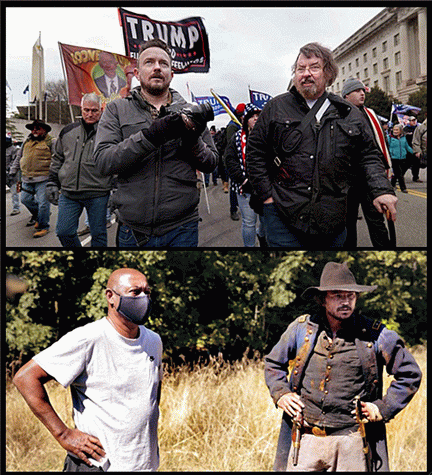
[ Top, Cullen Hoback with subject Jim Watkins walking to the Capitol on January 6th; and Raoul Peck with actor Josh Harnett, who plays various roles, such as a US cavalry officer involved in massacres. ]
Peck is Haitian and has made many fine films in his career, including Lumumba, Sometime In April and recently a documentary about James Baldwin called I Am Not Your Negro. In the '90s, he was briefly Minister of Culture in Haiti. The title Exterminate All the Brutes is a reference to Joseph Conrad's Heart of Darkness and its character named Kurtz. It's also the title of a book by the deceased Swedish writer Sven Lindqvist, who Peck cites as a friend and an inspiration for the film. Peck utilizes a host of techniques to tell his story. There's personal elements from his childhood, one incredibly interesting historic photograph after another, many interviews, scenes from Hollywood movies and fictional scenes he's directed using actors like Josh Harnett, who gets to represent the archetypal European and American son-of-a-b*tch as seen through the eyes of the colonized.
Peck can be quite subtle in the midst of all the horror, and the scenes with Harnett playing a US cavalry officer with a thousand-yard-stare really work. Some of them really got to me and made me think of my service in Vietnam. In one scene, looking very disturbed, he walks toward the camera through the smoking, moaning human carnage of a massacre and begins to remove his coat, then his shirt. He steps into a brook, and the scene ends. As a member of Veterans For Peace for 36 years, I felt the filmmaker was suggesting the possibilities of forgiveness and repentance. But it was the subtlest of suggestions. These scenes add heft to the argument as mythic evidence. They reminded me of the Vietnam vet poet W.D. Ehrhart's great poem, "Making the Children Behave."
The timing could not be better for a frank film history from the point of view of the darker-skinned people of the world who were conquered and colonized by the West. After four years of Donald Trump that, incredibly, culminated in the provocation of a violent mob that trashed Congress, now there's crazy shooters are suddenly popping up like daffodils and a polarized citizenry is watching the public trial of a white police officer for the flagrant murder of an African American male in Minneapolis -- all thanks to a 17-year-old girl with an iphone. Then there's the really big fear: whether the current virtual civil war will turn into a real, shooting civil war.
Let's not kid around; Raoul Peck's film is radical. I shouldn't have to say this, but this radical is a good, constructive radical. We misuse the term radical all the time. Since 9/11, we've been groomed on the verb to radicalize, as in "he or she was radicalized by this or that." The issue with terrorist violence is the encouragement of extreme action, not whether someone's history sees past events differently than the consensus. Radicals like to look for the roots of things. It would be better to say: "He or she was extremicized by this or that." But there doesn't seem to be such a word, and "he was radicalized" just seems to roll off the tongue. People who strongly defending the status-quo certainly have a motive for demeaning and even criminalizing the idea of thinking radically.
Peck likes to use terms like "indisputable" and "irrefutable" when discussing certain horrific statistics. To me, he's saying the reason the nation is in such troubled waters has to do with all this mechanized death and horror you rich white Europeans employed to get where you are, and now you want to shove it under your ornate four-poster beds because it's not how you wish to see yourself. But one person's nostalgia can be another person's nightmare.
(Note: You can view every article as one long page if you sign up as an Advocate Member, or higher).





