




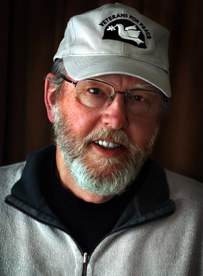


The author with Frank Corcoran and at Maine International Film Festival
(Image by John Grant) Details DMCA
Memories like this only reinforce my disgust for the Vietnam War and the unnecessary evil it represents. Again, I challenge anyone to tell me what the Vietnamese ever did to us. The historian Mark Moyar recently suggested in an essay in The New York Times series Vietnam 1967 that the Vietnam War was "winnable" -- if only we had done this or that differently. To me, that kind of what-if, alternative history is an utter waste of time that amounts to fiction like Phillip K. Dick's famous novel The Man In The High Castle, an alternative history that imagines the Nazis winning World War Two. Rambo was that kind of alternative history as pop cinema entertainment. A malaise-ridden nation was presented with the macho Hollywood hero Sylvester Stallone -- a man who spent the Vietnam War teaching in a girls school in Switzerland -- giving us his trademark sneer all decked out in greased-up pectoral muscles. Brandishing a huge Bowie knife and hand-held M60, John Rambo did what the United States Army, the Marine Corps, the Navy and Air Force could not do. He emotionally won the Vietnam War inside a darkened theater inside our hermetically-sealed, exceptional minds. It's the same thing Donald Trump is trying to do with the collective American mind as it feels the haunting reality of decline gnawing at its perceptions of greatness.
Nursing our moral loss in Vietnam as if it were an insult doesn't help. The Vietnamese beat us fair and square. They didn't beat us in the capacity for mass, hi-tech slaughter; there's no question we could have "won" if life was only about the ability to kill people by the thousands or millions. They beat us on moral grounds. They were right; we were wrong. As Ho Chi Minh reportedly said: "We can lose longer than you can win." Or another famous line told to Robert McNamara by a Vietnamese diplomat in the 1990s: "We knew you would eventually leave. You Americans could leave; we lived here and we could not leave." Or as Ward Just put it in a great little book written in 1968 called To What End: "Of course the war was unwinnable. It was useless to fight the Vietnamese. They would have fought for a thousand years."
Revisionist "winners" like Mark Moyar should surrender and find another, more productive topic to research. It should be clear that such alternative histories on the Vietnam War are purely political and meant to reinforce our contemporary militarist class and its future options. There's a reluctance to give the Vietnamese credit for their talent for suffering and survival, which is what beat us. There's so much we could learn from the Vietnamese in the area of humility, resilience and forgiveness. But we prefer to see those traits as the characteristics of a loser and a patsy. We insist on being winners even if, to borrow the famous Eastwood line, it requires us to be "legends in our own minds."
Truth and Fact are at the core of all this. It's interesting that the Vietnam war correspondent Ward Just wrote his eloquent 1968 memoir To What End and, then, shifted his career to fiction and novel writing. Dealing purely in reality was not enough. Just was ahead of his time in this respect, anticipating the fact-free, truth-phobic Age of Trump where the art of bullshit prevails. Just quotes the playwright Harold Pinter as an epigram in To What End: "There is no hard distinction between what is real and what is unreal, nor between what is true and what is false. The thing is not necessarily either true or false. It can be both true and false." A writer's mind is unlike a lawyer's mind, which is always dependent on a citation from some governmental legal book. A writer's mind is free and, accordingly, dangerous. The philosopher/longshoreman Eric Hoffer in the 1950s said: "We're geniuses at six, and it's all downhill from there." Today, we're drowning in information, data and stories. Ironically, surveillance, secrecy and power dominate our lives like never before. Violence becomes a cynical tool like never before. Still, human connection is the key to getting anywhere, leading to the disaffected left's cry-in-the-street, "The people united will never be defeated." Trouble is, that kind of unity is much easier said than done, given all the distractions of culture and technology.
The author with Frank Corcoran and at Maine International Film Festival
(Image by John Grant) Details DMCA
In 2002, I made a film in Vietnam and motor biked west of Hanoi with two friends, a seriously wounded Marine veteran named Frank Corcoran living and working in Vietnam, the subject of the film, and a Vietnamese woman who did translating. In 1968, Frank, also a kid, was in Vietnam 45 days when he was seriously shot in the stomach. As he lay bleeding-out under fire, two men crawled out to help him. Between them, these men managed to bandage him up, before they were both shot and killed. Frank healed physically but still deals with classic PTSD. In the 84-minute film called Second Time Around, he speaks eloquently about the humanity -- the human love! -- that drove these more experienced men to save his young life. It's a tale that will make you shake your head in admiration for the sacrifice and bravery under fire of infantrymen in Vietnam. As Frank emphasizes, their actions had nothing -- zero! -- to do with country and patriotism.
As we drove our motorbikes westward out of Hanoi, we really had no idea where we were going, but we trusted the Vietnamese. We ended up in a village talking with a man our age who had been an NVA soldier along the DMZ between North and South Vietnam. In his little store he had a crude tin tank about eight feet high full of fermenting beer that he dispensed from a garden-style faucet sticking out of the bottom of the tank. It was probably the worst beer I've ever tasted, but that didn't seem to matter. It had been a long, hot day and we were all delighted with each other's company. As we drank his beer and began to get a buzz on, we told stories through our translator about our relative roles in the war. We all agreed that was then; this is now -- and now is different. There were no recriminations either way; just a mutual respect and joy in telling stories and laughing together. In the back of our minds, we all knew that, in years past, we would have had to think about killing each other. My friend and I made it clear we were disgusted with our government and its policies, during the war and now. We then learned that this man felt the same way about his government, then and now. We toasted each other and cursed all governments, drank more bad beer and laughed. I forget the details, but he had been disgusted with some policies the government of the North had initiated along the DMZ. I concluded it was the North Vietnamese version of what is known in our military as "chicken sh*t." The NVA soldiers we were fighting back in the 60s were just as trapped as many of us were; they had their own version of FUBAR: Fucked Up Beyond All Recognition. What our World War Two fathers called SNAFU: Situation Normal, All Fucked Up. When we left the man's shop, it was amazing we could stay up on our motorbikes. I recall it as a wonderful moment of human solidarity that transcended the self-perpetuating crimes of militarism and patriotism.
Next Page 1 | 2 | 3 | 4 | 5 | 6 | 7
(Note: You can view every article as one long page if you sign up as an Advocate Member, or higher).
 4
4
 4
4
 3
3





