




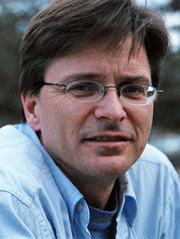

"The world simply has to be refashioned," both in the Third World and in advanced capitalist countries, and specifically in the United States, Patnaik said, which means experiments in alternative ways of living that are not based on material measures.
"This really is a spiritual/cultural question, about what it means to live a good life," he said, which should not be seen as foreign to socialism. "Marxism shouldn't be reduced to productionism. The goal of socialism has always been human freedom, which is about much more than material wealth."
"Gandhi talked about the ethical demands of nature, but I
don't like that phrase, being a socialist and anthropocentric," Patnaik said
with the hint of a grin. "But we do have to live within the limits of nature."
The role of Marxism
It is easy to misjudge Patnaik from first impressions. Unlike many intellectuals, Patnaik does not immediately thrust himself into a discussion, and he's soft-spoken both in conversation and from the podium. But when he does speak, his passion for justice comes through loud and clear. And, while Patnaik identifies very much as a communist, he also is quick to poke at some of the tradition's platitudes.
"I just came from the (Communist) Party Congress, and I keep reminding everyone that they have to give up notions of a one-party State, of democratic centralism (the Leninist notion that party members are free to debate policy but must support the final decision of the party)," Patnaik said. "Democratic centralism always leads to centralism."
If leftists reject the current dominance of finance in the world, Patnaik said it's important to reject any suggestion that a single perspective or party should dominate.
"The hegemony of finance throttles democracy. The hegemony of finance beats you into shape," he said. If the goal is to resist that kind of hegemony, then the approach of the old communist movement simply isn't relevant, Patnaik said, but socialist principles are more relevant than ever.
"Any resistance has to be about opening up alternatives, opening up critical thinking to imagine those alternatives," he said. "The only way to challenge that global regime is mass mobilization."
Patnaik has no off-the-shelf solutions to offer, and it's difficult to reduce his thinking to slogans. At the age of 66, when many people hold on tightly to what they believe will work, Patnaik doesn't hesitate to say, "It's time to invent."
------------------------
Robert Jensen
is a journalism professor at the University of Texas at Austin and board member
of the Third Coast Activist Resource Center in Austin, one of the partners in
the community center "5604 Manor," http://5604manor.org/ .
He is the
author of All My Bones Shake: Seeking a Progressive Path to the Prophetic
Voice, (Soft Skull Press, 2009); Getting Off: Pornography and the End of
Masculinity (South End Press, 2007); The Heart of Whiteness: Confronting
Race, Racism and White Privilege (City Lights, 2005); Citizens of the
Empire: The Struggle to Claim Our Humanity (City Lights, 2004); and Writing
Dissent: Taking Radical Ideas from the Margins to the Mainstream (Peter
Lang, 2002).
Jensen is also
co-producer of the documentary film "Abe Osheroff: One Foot in the Grave, the
Other Still Dancing," which chronicles the life and philosophy of the longtime
radical activist. Information about the film, distributed by the Media
Education Foundation, and an extended interview Jensen conducted with Osheroff
are online at http://thirdcoastactivist.org/osheroff.html .
Jensen can be
reached at Email address removed and his articles can be found online at http://uts.cc.utexas.edu/~rjensen/index.html . To join an email list to receive
articles by Jensen, go to http://www.thirdcoastactivist.org/jensenupdates-info.html .
(Note: You can view every article as one long page if you sign up as an Advocate Member, or higher).






