




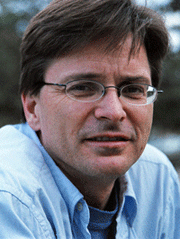

Rigby anchored Last Sunday with talks that always managed to bring together the disparate threads of each event. Drawing on secular philosophy and theology – avoiding dogma and doctrine – he came back, over and over, to a basic point: We may be decent people, acting compassionately in our daily lives, but when we live in unjust hierarchical systems, being decent day to day isn't enough.
No matter what the specific topic of any Last Sunday, we tried to keep this in the foreground: We live in an imperial society structured by a predatory corporate capitalism, with identities shaped by white supremacy and patriarchy, in a technological fundamentalist society dominated by the faith that we can invent our way out of an ecological crisis.
Rigby provided Last Sunday's prophetic voice, in the Old Testament sense of the term, not predicting the future but calling out the corruption of the society while maintaining faith in humans' ability to reach down to the better part of our nature, past the greed to the core of a common humanity. Individual responsibility means not simply doing the best one can in the world we're given but being willing to take risks to change that world.
This kind of political and spiritual program attempts to suggest a general direction, not dictate a specific destination. Once we grasp that capitalism is an unsustainable system, inconsistent with our desire for democracy and our struggles for solidarity in community, what's the next step? The Last Sunday answer was: forward. We don't need a fully formed alternative to capitalism to take steps to create an alternative. Strengthening unions and fostering cooperatives, challenging corporations' right to define not only our economy but our identities, demanding a more just distribution of the world's resources, and reducing our own addiction to the cheap toys dangled in front of us – all are ways we can act.
And we must keep talking. One of the clearest lessons from Last Sunday is that many people lack a place to listen, learn, and talk about new ideas. That was Last Sunday's clearest failure – we never found a formula for making the gathering more of a conversation than a series of lectures and performances. Out of a fear of seeing the program devolve into unstructured talk, we erred toward tight control. But many said the most successful program was the one that opened up that format for more interaction in the discussion of climate change. Future efforts have to better balance people's desire to react and engage with the need to control a program so that the loud and long-winded don't take over.
The consensus at the end of April's gathering was that Last Sunday should continue. Less clear was how that will happen, how the gathering should be structured, and toward what end a permanent Last Sunday might be directed. There are difficult questions unresolved, most notably whether the event could become more inclusive. Although the program from the stage was diverse in racial, ethnic, and gender terms, the audience was disproportionately white, middle-class, and older. Could Last Sunday become a space that reflects all of Austin? Can we go beyond the groups in which we feel comfortable?
Last Sunday was an ad hoc project that remained fluid; various people pitched in to handle the organizing tasks. We deliberately didn't create a new organization or build a new web site, opting instead to use the communication tools of the Third Coast Activist Resource Center (www.thirdcoastactivist.org and the NoWar e-mail list). Decision-making was collaborative, in a small group.
The options? Last Sunday could remain ad hoc but with broader participation, or a formal group could be created to run the event. Or, of course, the event could end its run, giving way to other forums. The original conveners don't claim to know the best route, nor do we want to claim ownership. The event demonstrated people's interest, and now the task is to figure out whether that interest can be translated into ongoing community.
For more information on Last Sunday, go to http://thirdcoastactivist.org/lastsunday.htmlFor a PDF file with the five talks Jensen gave at Last Sunday, go tohttp://uts.cc.utexas.edu/~rjensen/freelance/lastsunday.pdf
(Note: You can view every article as one long page if you sign up as an Advocate Member, or higher).






