







Later when I taught developmental psychology at Brooklyn College in a field-based program that brought me and my students to preschool through second-grade classrooms in public and private schools throughout Brooklyn New York, I collected hundreds of drawings from children in the preoperational stage (Piaget's stage 2) and the concrete operational Stage (stage 3). The drawings were invaluable for helping my students understand Piaget's principles of cognitive development.
I noted features in the drawings that were at first puzzling but then clarified by applying Piaget's stage theory. I now see those same features reflected in the thinking of deniers and conspiracy theorists.
The instructions for the drawings were simple: "Draw a picture of a person. Draw a picture of a man or a woman, or a boy or a girl. And draw all of the person."
In the early years of the preoperational stage (ages 2-4) the drawings tend to be amorphous renderings of circles and lines. Later drawings in this stage, ages 5-7, are better executions of circles and lines and include details like eyes, ears, and fingers, although these features might not be placed properly and major body parts may be absent.
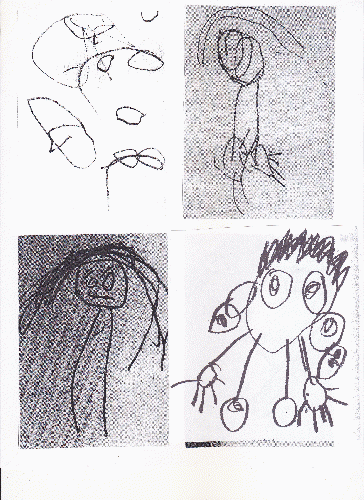
Most noteworthy, these drawings are not accurate representations. What accounts for the distortions?
Most puzzling is the absence of parts, distortions (misplacement of parts), and that the children do not appear to recognize their drawings as distorted or incomplete. They are typically satisfied with their drawings and execute them speedily. Rarely do they erase, redo, or copy from neighboring children. And most notably, they don't engage in self-criticism. On the contrary, they are almost always proud of their productions and will enthusiastically say things like "This is mommy, this is daddy, my sister, my friend Brad," or other people in their lives. And they usually are pleased to see their drawings displayed in the classroom or at home. (this observation will become more significant when I report how children respond to their drawings in the concrete operational stage (ages 7-11).
Yet one would think that they know from viewing the adults and children around them that a circle is not a complete person or that arms and legs don't protrude from the head. When asked about these distortions they might laugh, and agree that "No, arms don't come out of the head." But they will not show embarrassment or change their drawings.
Similarly, deniers and conspiracy theorists distort reality and do not question or examine their conclusions against a broader context of information or an external standard. They will ignore facts, make up contrary facts, and other claims with no substantial evidence offered as in denial responses to climate change: "It's natural and normal and happened before; There is no consensus among scientists [thousands of scientists have signed petitions and have protested]; Plants and animals can adapt [Species are becoming extinct faster than ever]; There's nothing to be done, it's too late [scientists say there is still time]."
What accounts for the certitude of preoperational children and adults who embrace similar thinking when they are so off the mark? More importantly, what principles enable their self-assurance?
Insight into those principles emerges when we examine the markedly different drawings of children in the concrete operational stage (ages 7-11). In contrast these drawings display a dramatic shift. They reflect a significant cognitive game change and improved skills in relating to reality. The drawings and the children's comments about them punctuate the distortions of reality in preoperational thinking as can be seen in these typical concrete operational stage drawings.


Although there are differences in details and artistic ability, the concrete operational stage drawings all show one striking overall change. They include all the major parts of a person, with more accurate placement of the parts--even if they are crude stick figures. Drawings are no longer just a few features. That a dramatic shift in cognition has taken place is also reflected in the children's reactions to their drawings and the task itself. Despite their accurate representations they often resist the task. Many say "I can't draw." This is a sharp contrast to children's reactions in the earlier preoperational stage, when "can't" was not in their vocabulary. Now, some children repeatedly erase parts of their drawings before completing the task and will look at the drawings of their neighbors sometimes copying features. And many express embarrassment and are critical of their drawings. Some resist submitting their work and ask if they can do it over. Others may even appear obsessive-compulsive in their attention to detail, and some criticize or ridicule their classmates' drawings. Even children who have obvious artistic skills and produce outstanding drawings are prone to criticize their work. They might say "the head is too big," or "this arm is too long." If you show these concrete operational-level children pre-operational drawings they are likely to laugh at them. And few are eager to have their drawings displayed
(Note: You can view every article as one long page if you sign up as an Advocate Member, or higher).
 2
2
 2
2
 1
1






