




Science Moved Forward
My theory mathematically and experimentally proved that equivalent failure pressures in piping due to water hammer approached four times the excessive water hammer pressures commonly assumed by industry professionals (" Fluid Mechanics, Water Hammer, Dynamic Stresses, and Piping Design", click here ). In other words, pipelines are woefully under-designed for water hammers.
Science is Ignored
As another example, I taught water hammer courses through the American Society of Mechanical Engineers ("PD691, Fluid Mechanics, Piping Design, Fluid Transients and Dynamics", click here). In those courses, oil pipeline operators informed me that my Leishear Stress Theory was not used for their pipelines.
Herein lies the problem. Oil pipelines are improperly designed for water hammer pressures, which exceed oil pipeline maximum operating pressures, where Leishear Stresses further exceed design pressures by even more.
Previous Keystone Oil Spill Research
Concerns and research were documented in my previous Op Ed ("The Keystone Pipeline Oil Spill in Kansas - The Mushroom Theory - Stop the Oil Spills"), and I forwarded that Op Ed to PHMSA, but they ignored this crucial evaluation. Apparently, RSI was not provided this water hummer information.
Water Main Explosions / Oil Pipeline Explosions
Water hammer explosions - or oil hammer explosions - release less energy than gas pipeline explosions or steam piping explosions, but the energy release is similar. While a crack in a pipe forms from water hammers or gas hammers, leaks at crack sites are small and are driven by the pressure in the piping. However, when the pipe finally shears in two at critical crack length, the liquid or vapor in the pipe suddenly drops in pressure to atmospheric pressure and massive energy is released in the form of explosions. Not considered further here, gas pipeline explosions also ignite to form gas detonations and craters in the ground ("Lincoln County, Kentucky, Gas Pipeline Explosion Coverup by the NTSB"). For this work, the explosive energy from cracking and separating the pipeline due to fatigue, or cyclic failure, explains the pipeline failure.
PHMSA and RSI Keystone Reports
All in all, the PHMSA and supporting reports were extensive and obviously expensive but incorrect overall. Pertinent information from the flawed PHMSA report follows.
The Keystone Failure
Although water hammer information for the pipeline has been withheld from the public, and technical reports are heavily redacted, sufficient information is available to explain the failure cause. Contributing factors were high stresses at a weld and lack of fusion for that same weld. In Figure 5 a weld is shown that connects two different diameter pipes. When the weld material pipe is welded, the molten metal joins the weld material to the two pipes, and when the materials are not melted together lack of fusion results.
RSI performed several computer models, and the highest stresses were determined to be those caused by soil loading with or without an assumed heavy equipment operations at the pipeline, where the equipment was assumed to weigh 120,000 pounds (Figure 6). The driving factor for an assume theoretical failure was an assumed and unproven one foot soil settlement.
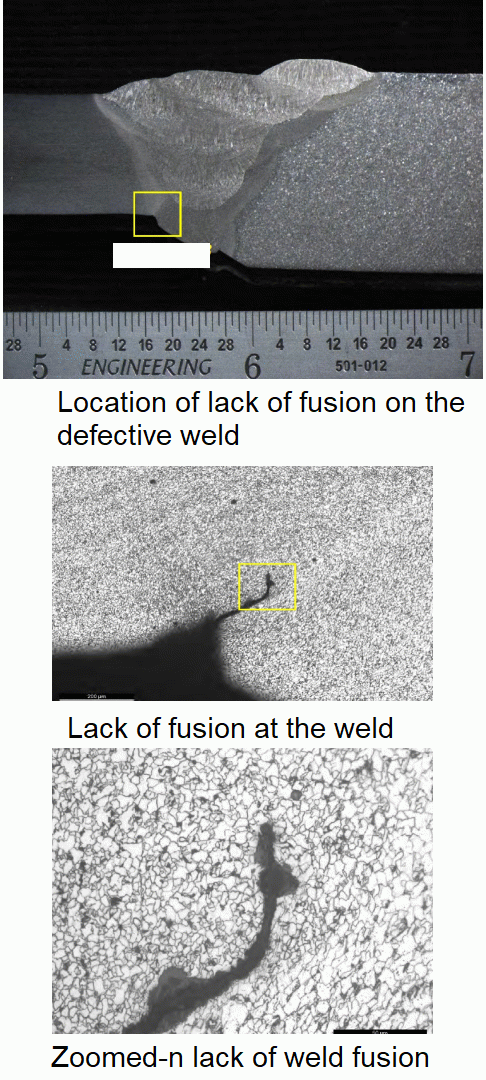

Figure 6. Hypothetical soil load calculations by RSI, assumng that a one-foot deep pipeline deflection occurred.
(Image by PHMSA) Details DMCA
(Note: You can view every article as one long page if you sign up as an Advocate Member, or higher).






