







JB: It's wild the way you randomly ran into your daughter amid the throngs. How does the march fit into your own traditional level of civic participation? Was this par for the course for you or something more unusual?
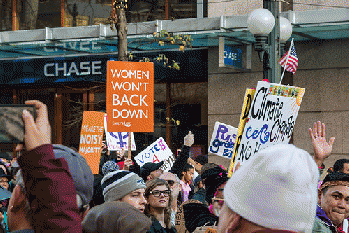
CC: I have not prioritized going to many demonstrations recently, though I have been volunteering to support the Water Protectors at Standing Rock, and attended a couple of marches and protests to encourage the Seattle City Council to stop banking with institutions that support the Dakota Access Pipeline project. I called my representatives and senators at least every few weeks for much of the past year, but the swing to a GOP regime that seems to have its sights set on denying climate change, ignoring the Paris Accords, crippling or dismantling the Environmental Protection Agency, dismantling the Department of Education, accelerating the disenfranchisement of non-white voters, all has gotten me very committed to not going along quietly.
I really do believe that anthropogenic climate change is an existential threat. I don't want to live in a world where almost every coastal city, and many low lying nations, have to be evacuated. Climate change is in fact partially responsible for the Syrian civil war, due to an extraordinary run of drought years which made it difficult for the Assad government to deliver basic supplies to the citizens. Look at what the refugees from that one nation are doing to international politics. I guess what I'm saying is these are desperate times, and they call for more aggressive measures to pull civilization back from the brink of destruction.
JB: I think there are a lot of people out there who agree with you completely. You have an interesting background. You were a child of a State Department employee and spent some of your early years in Vietnam. Do you think that experience has colored your world view?
CC: I'm certain it has. My first languages, long forgotten, were Vietnamese and French. My father, after divorcing my mom, went on to work in Bangkok, Seoul, Lahore, and Kinshasa, so I was always aware there was a lot of the world outside of the US. My parents divorced when I was three, and I was raised in my mother's house after that. My mother and stepfather took me to anti-war marches in the late 1960s and early 1970s. I think that knowing I lived in Vietnam, and knowing my first friends were still in Saigon and Hue/Ho Chi Minh city, always made me curious as to the Vietnamese position in the conflict with the US. Odds are my first friends were killed in the war.
I still remember the assassinations of President Kennedy, Martin Luther King Jr., and Bobby Kennedy. I remember the pain I felt even as a child. I was crestfallen when my high school campaign to champion George McGovern failed to elect him as the US president. By the mid 1970s, I had joined a political study group in my high school and we marched in Washington DC to put pressure on Nixon to end the Vietnam war and resign. I've always believed in democracy, and specifically that it can't fulfill its greatest promise until all citizens have an equal voice. Since we're a nation of immigrants, and since I'm in the most privileged position as a white male in the US, I've always been curious to understand minority communities.
JB: You worked at Microsoft for twenty years. That chapter's over. Of late, you've been focusing on your music. Sounds like you're now utilizing the other side of your brain! What are you working on?
CC: I have a strong affinity for music based in hand percussion. The last time I made a very meager living as a musician, I was playing congas. At that time, which was 25 years ago, I gained a deep respect for, and love of, Cuban rhythms. I found over the years that I tend to mark time using that vocabulary. The last couple of years I've committed myself to focusing almost exclusively on Cuban and Puerto Rican styles of bass playing, although I still work the occasional jazz gig. What that entails is listening to lots of recordings, transcribing performances that move me, seeking out and learning from masters, and increasing my knowledge of the repertoire in that tradition. I'm in a couple of project bands which are getting closer to launching. One is a latin jazz band with a drummer, keyboard, sax, trumpet, and my bass.
The other is a experimental folkloric group with three percussionists, a guitarist, and my bass, and we all sing. Your observation is spot on, in that I'm finding the real work is to approach everything I play with greater integration between my thinking and feeling. I was handsomely rewarded for thinking for so long that it's easy for me to over-intellectualize things. That's at once the greatest gift and my greatest challenge in performing music.
(Note: You can view every article as one long page if you sign up as an Advocate Member, or higher).
 1
1






