




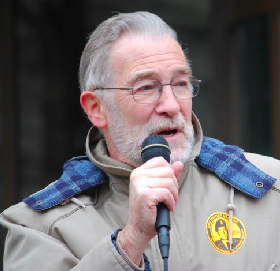

This piece was reprinted by OpEd News with permission or license. It may not be reproduced in any form without permission or license from the source.
Editor's note: With attention to President-elect Obama's staffing of the intelligence community, we post this article written by Ray McGovern in 2004 that highlights the qualities necessary in a Director of Central Intelligence (DCI). As some readers will be aware, a major reorganization of the intelligence community was implemented shortly after McGovern penned his essay on the qualities needed in a DCI. A new law gave most of the DCI's intelligence-community-wide responsibilities and authorities to a newly established Director of National Intelligence, with the Director of the CIA retaining the CIA-specific duties and responsibilities. The integrity/courage/independence attributes mentioned as prerequisites for a DCI now apply, just as much, to the DNI and D/CIA.
_________________________The Director of Central Intelligence (DCI) must be a person whose previous professional performance has been distinguished by unimpeachable integrity and independence. The director must have the courage of his or her own convictions.
Without integrity and courage, all virtue is specious, and no amount of structural or organizational reform will make any difference.
Instructive lessons can be drawn from the performance of George Tenet, the sixteenth director since the establishment of the Central Intelligence Agency in 1947, and from his predecessors regarding what attributes a director needs to discharge the duties of the office as the National Security Act of 1947 intended.
The director should have already made a mark on the world by excelling in a field unrelated to intelligence work - business, the military or academia - bringing a well-established record of honesty and competence.
If he comes from more humble circumstances than most top administration officials, it is essential that her or his strength of character and self-confidence be such that there is no need to depend on the anointing of Washington hoi aristoi for reassurance of self worth.
These qualities are all the more essential because of the mismatch of responsibility and authority in the Director of Central Intelligence's position.
As the chief foreign intelligence adviser to the President, the director has broad responsibility for coordinating the intelligence effort of a dozen agencies of government, but has little operational or budgetary control over most of them. As a result, the director's authority is essentially ad referendum to the President.
Too many Directors of Central Intelligence, out of a desire to be good team players, have been reluctant to seek and invoke that authority. A notable exception was Admiral Stansfield Turner, whose military background instilled in him an acute appreciation of the need for command authority to match responsibility.
Turner knew he had to take determined steps to dispel the ambiguity - and did. Thus, when the parochial interests of, say, the Federal Bureau of Investigation or the National Security Agency got in the way of his intelligence community coordinating responsibilities, Turner would simply meet with President Carter and lay it on the line.
"If you want me to be able to discharge my responsibilities as your principal intelligence adviser," he would say, "you need to tell the Attorney General to instruct the Federal Bureau of Investigation to be more responsive, and the Secretary of Defense to tell the National Security Agency to do the same."
In other words, there is a way to deal with the anomalies inherent in the director's portfolio, but it takes a DCI who is willing to put noses out of joint in order to assert the necessary authority to do his job. Such directors have been few and far between.
What Tenet Should Have Said
To be concrete, let's take the experience of George Tenet as an example. Here are a few of the things he should have told the President:
* The FBI is not sharing with my people the information they need. Would you instruct the Attorney General to tell the bureau to cooperate?
* The Vice President and Secretary of Defense have each established, in their offices, mini-CIAs to push their own agendas. They are using their privileged access to you to promote intelligence judgments with which my analysts and I do not agree. If you wish me to be able to discharge my statutory duties effectively, please make it clear to them that they are required to vet such analysis with the Central Intelligence Agency so that we can put it into perspective before it is given to you.
(Note: You can view every article as one long page if you sign up as an Advocate Member, or higher).
 1
1
 1
1
 1
1






