


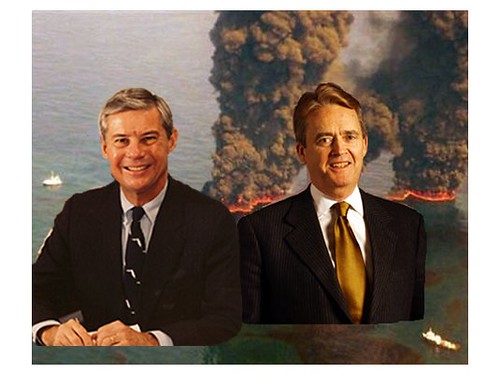
In his weekly radio address on Saturday, May 22nd, President Obama selected the two men that will be leading an independent commission that will examine the Gulf of Mexico oil spill, find the "root causes" of the disaster, and produce a report in six months. Those men were former Sen. Bob Graham (D-FL) and former head of Environmental Protection Agency (EPA) under George H.W. Bush, William K. Reilly, a Republican.
President Obama said in his address, "If the laws on our books are inadequate to prevent such an oil spill, or if we didn't enforce those laws -- I want to know it...I want to know what worked and what didn't work in our response to the disaster, and where oversight of the oil and gas industry broke down."
BP has been hiding reports and video on the disaster, low balling estimates on the amount of oil that has leaked into the Gulf, and ignoring orders or requests issued by federal agencies dictating recommendations and guidelines for the cleanup. The government has allowed BP to continue to handle this disaster in this manner, which might lead one to believe this commission might simply be one where oil & gas companies involved in offshore drilling (especially BP) could use the disaster to re-brand their company's image, regain the confidence of politicians, up their contributions to key political leaders, and continue to obstruct movement toward clean, renewable energy in America. With Graham and Reilly on the commission, it's far more likely that this commission will advance a much different agenda---a nuclear energy agenda.
Both Graham and Reilly have records that show each possesses some level of interest in confronting environmental issues. Graham developed a reputation for being outspoken against offshore drilling in the early 1990s. Reilly was a leader of the World Wildlife Fund and has the distinction of being the first head of the EPA to actually "come from a job in the environmental community."
In addition to being involved in policymaking related to oil energy and offshore drilling, both Graham and Reilly have supported the nuclear industry financially and politically.
Obama said of the two in his address, "I can't think of two people who will bring greater experience or better judgment to the task at hand...In the days to come, I'll appoint 5 other distinguished Americans including scientists, engineers, and environmental advocates to join them on the commission."
Those who would like to see individuals without business ties to an industry that could benefit from this commission might be able to think of two better people.
Fmr. Sen. Bob Graham (D-FL) Opposed to Offshore Drilling,Very Much for Nuclear Energy
Upon becoming the chairman of the Senate Nuclear Regulation Subcommittee in August 1990, Graham began to give speeches suggesting "nuclear energy should play a "significant role" in meeting America's long-term energy needs." (St. Petersburg Times - Tuesday, February 12, 1991)
In a speech given in February 1991, Graham remarked to the American Nuclear Energy Council, a Washington-based trade group, "There are no black-and-white courses in a national energy policy...Every option has both assets and liabilities." He acknowledged that nuclear energy had cost and environmental drawbacks but also said that it could be a key way to solve the country's energy problems.
Graham recommended plant licensing procedures be streamlined to make it "no more difficult to permit a nuclear plant than it is [to permit] an electric plant."
Graham suggested dealing with the question of how to dispose nuclear waste was just as significant as figuring out a way to handle the environmental and health issues that carbon dioxide and sulfur dioxide from fossil fuels presented Americans and he cited the war in the Persian Gulf as even more reason to pursue nuclear energy.
In November 1990, Graham said on CNBC that America was "too reliant on petroleum as our source of energy" and he noted while 75 percent of all energy in France is nuclear, only 15 percent of U.S. energy is nuclear. He also added that Florida's energy consumption was 20 percent nuclear, which was above the national average. (The Tampa Tribune - Monday, November 19, 1990)
The same month he visited a nuclear power plant owned by Florida Power & Light Co. and argued that rising oil cost and clean air legislation would make nuclear energy more important, practical by 2010. He claimed nuclear power was no longer a source of "environmental anxiety" and had become an "environmental asset" because it does not dirty the air like coal does. (The Palm Beach Post - Friday, November 2, 1990)



