| Back OpEdNews | |||||||
|
Original Content at https://www.opednews.com/articles/Conservative-Author-Leah-L-CONSERVATIVE-CATHOLICS_Catholic_Conservative-Christian_Feminist-260124-222.html (Note: You can view every article as one long page if you sign up as an Advocate Member, or higher). |
|||||||
January 24, 2026
Conservative Author Leah Libresco Sargeant's Feminist Manifesto (REVIEW ESSAY)
By Thomas Farrell
In the present 2,825-word OEN article, I discuss the conservative American Catholic convert Leah Libresco Sargeant's 2025 book The Dignity of Dependence: A Feminist Manifesto (University of Notre Dame Press) -- in which, among other things, she discusses Pope Francis (1936-2025). I conclude that liberals and progressives might find the conservative American Catholic convert's book thought-provoking to read.
::::::::
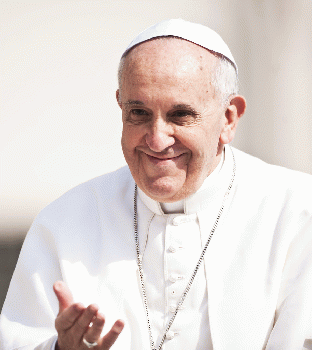
General Audience with Pope Francis
(Image by Catholic Church (England and Wales) from flickr) Details DMCA
Duluth, Minnesota (OpEdNews) January 23, 2026: In the present wide-ranging and deeply personal 10,506-word OEN article, I set forth here my interpretations of Leah Libresco Sargeant's 2025 book The Dignity of Dependence: A Feminist Manifesto (University of Notre Dame Press).
Now, in 2023, the Oxford-educated British conservative Mary Harrington published the though-provoking book Feminism Against Progress (Regnery Publishing).
In Mary Harrington's Chapter 3: "Sex and Market" in Feminism Against Progress (pp. 52-71), she quotes "the [Canadian] communication theorist Marshall McLuhan" (1911-1980; Ph.D. in English, Cambridge University, 1943) and then uses that quote as a springboard for her own lengthy commentary: "But as the [Canadian] communication theorist Marshall McLuhan put it in 1964, at the dawn of the information age, 'The medium is the message.' That is, in McLuhan's formulation '[T]he personal and/ social consequences of any medium - that is, of any extension of ourselves - result from the new scale that is introduced into our affairs by any extension of ourselves, or by any new technology' [she is here quoting from Marshall McLuhan, Understanding Media: The Extensions of Man: Critical Edition, edited by W. Terrence Gordon (Gingko Press, 2003, p. 19; original edition published 1964]. And the message delivered by the internet [long after McLuhan's death in 1980] of 'online marketplaces' and social media platforms that emerged in my early adulthood is as follows: everything is a marketplace, including - thanks to social media - those 'moral sentiments' Adam Smith ring-fenced as distinct from the marketplace. Inasmuch as we 'connect' with others [via social media], we do so while reserving the right to disconnect again: metaphorically speaking, to log off again or leave the platform if it's not working for us. The 'marketplace of everything' invites us to be together, at scale, but to do so without obligation: always in perfect individual freedom. And this includes - or perhaps especially concerns - sex and relationships" (pp. 67-68).
Now, I discussed Mary Harrington's thought-provoking 2023 book Feminism Against Progress in two OEN articles:
(1) "Mary Harrington on Feminism, Legalized Abortion, and the Pill" (dated December 20, 2023; viewed 1,295 times as of January 21, 2026):
(2) "C. G. Jung on Fantasy Thinking versus Directed Thinking, and Walter J. Ong's Thought" (dated August 3, 2025; viewed 565 times as of January 21, 2026):
In addition, I published the 3,500-word review essay "Mary Harrington's 2023 Book Feminism Against Progress, and Walter J. Ong's Thought" (dated December 2023; viewed 107 times as of January 21, 2026) through the University of Minnesota's digital conservancy:
https://hdl.handle.net/11299/259178
Now, like Leah Libresco Sargeant, young Marshall McLuhan, mentioned above, was a convert to Catholicism - on March 30, 1937. Just as young Leah Libresco Sargeant's conversion to Roman Catholicism was influenced by the writings of the prolific English convert G. K. Chesterton (1874-1936; conversion to Catholicism in 1922), so too young Marshall McLuhan's conversion to Roman Catholicism in 1937 was influenced by Chesterton's writings. Young Marshall McLuhan published "G. K. Chesterton: A Practical Mystic" in the Dalhousie Review in January 1936, pp. 455-464 - when he was 24 years old. It is reprinted in The Medium and the Light: [Marshall McLuhan's] Reflections on Religion, edited by Eric McLuhan and Jacek Szklarek (Stoddart Publishing, 1999, pp. 3-13). Marshall McLuhan's widely translated books The Gutenberg Galaxy: The Making of Typographic Man (University of Toronto Press, 1962; for specific page references to McLuhan's references to Ong's publications about the French Renaissance logician Peter Ramus [1515-1572] and Ramist logic, see the "Bibliographic Index" [pp. 286-287]) and Understanding Media: The Extensions of Man (McGraw-Hill, 1964) propelled the Canadian English professor at the University of Toronto to unprecedented notoriety in his lifetime. Two major biographies of Marshall McLuhan have been published: (1) Philip Marchand's Marshall McLuhan: The Medium and the Messenger (Ticknor & Fields, 1989); and (2) W. Terrence Gordon's Marshall McLuhan: Escape into Understanding: A Biography (BasicBooks/ HarperCollins Publisher, 1997). Also see Letters of Marshall McLuhan, edited by Matie Molinaro, Corinne McLuhan, and William Toye (Oxford University Press, 1987).
Leah Libresco Sargeant's 2025 Book The Dignity of Dependence: A Feminist Manifesto
Now, in the present OEN article, I discuss the conservative American Catholic convert Leah Libresco Sargeant's 2025 book The Dignity of Dependence: A Feminist Manifesto (University of Notre Dame Press).
Leah Libresco Sargeant is also the author of two previous books: (1) Arriving at Amen: Seven Catholic Prayers That Even I Can Offer he memoir about how she learned to pray as an atheist-to-Catholic convert (Ave Maria Press, 2015); and (2) Building the Benedict Option: A Guide to Gathering Two or Three Together in His Name, a combination spiritual memoir and practical handbook (Ignatius Press, 2018).
In November 2025, Leah Libresco Sargeant and Helen Andrews were guests of the conservative American Catholic convert NYT op-ed columnist Ross Douthat on his podcast - the edited transcript of which was published as "Did Liberal Feminism Ruin the Workplace: And if so, can conservative feminism fix it?" in The New York Times (dated November 6, 2025):
www.nytimes.com/2025/11/06/opinion/women-workplace-feminism-conservative.html?searchResultPosition=1
Incidentally, over the years of Pope Francis' papacy, the conservative American Catholic convert NYT op-ed columnist Ross Douthat frequently criticized Pope Francis (1936-2025; elected pope in March 2013) in his NYT op-ed columns.
Over the years of Pope Francis' papacy, I frequently wrote about him in some of my OEN articles. See my OEN article titled "Thomas J. Farrell's 52 OEN Articles on Pope Francis" (dated July 4, 2025; viewed 1,996 times as of January 21, 2026):
Now, on January 20, 2026, I received the copy of Leah Libresco Sargeant's 2025 book that I had ordered from Amazon.com on January 15, 2026.
Because I mentioned Mary Harrington's 2023 book Feminism Against Progress above, the first thing I looked for in Lean Libresco Sargeant's 2025 book was references to Mary Harrington's 2023 book. But I found none.
Now, the most efficient way for me to provide you with an overview of Leah Libresco Sargeant's 2025 book The Dignity of Dependence: A Feminist Manifesto is to tell you its contents:
"Advance Praise for The Dignity of Difference" (pages unnumbered).
Half-title page (page i).
"Catholic Ideas for a Secular World" (page ii).
Title page (page iii).
Copyright page (page iv).
Contents page (page v).
Acknowledgments (pages vii-viii).
Chapter One: "The World Is the Wrong Shape for Women" (pages 1-19).
Chapter Two: "The Life of the Lonely Individual" (pages 21-41)
Chapter Three: "Helping Women Be Better Men" (pages 43-60).
Chapter Four: "The Incredible Shrinking Woman" (pages 61-77).
Chapter Five: "The Limits of Labor Language" (pages 79-102).
Chapter Six: "Illegal to Care" (pages 103-123).
Chapter Seven: "The Blessing of Burdens" (pages 125-143).
Chapter Eight: "Men into the Breach" (pages 145-165).
Chapter Nine: "The School of Love" (pages 167-184).
"Notes" (pages 185-193).
"Bibliography" (pages 195-207).
"Index" (pages 209-219).
In the "Index," numerous entries have a number of sub-sentries, thus sowing the author's relative emphasis on certain themes. The two entries with the most sub-entries are care work (pp. 210-211) women (pp. 218-219).
Now, in Chapter Five: "The Limits of Labor Language," Leah Libresco Sargeant discusses G. K. Chesterton, mentioned above. She says, "For G. K. Chesterton, there is always something romantic about maintenance [as in "maintenance and care work"] - about keeping something still in the swirling storm of entropy.
"If you leave a thing alone you leave it to a torrent of change. If you leave a white post alone it will soon be a black post. If you particularly want it to be white you must be always painting it again; that is, you must be always having a revolution. . . But this which is true even of inanimate things is in a quite special and terrible sense true of all human things. An almost unnatural vigilance is really quired of the citizen because of the horrible rapidity with which human institutions grow old [quoted from G. K. Chesterton, Orthodoxy, 2007, p. 107].
"While I sometimes share [Simone de] Beauvoir's sense of conservation as Sisyphean and stultifying, thinking of Chesterton lends a more stalwart set to my shoulders as I pick up the living room or start dicing onions for dinner. Instead of each day being the same and all effort passing into nothingness with each new mess, every day is different, with new challenges to assail me and test my mettle. Resisting entropy in Chesterton's romantic mood feels more like being the last soldier remaining to defend a narrow pass, facing an endless line of opponents but holding on for just one more blow, then another, then another. . . . (pp. 98-99).
Leah Libresco Sargeant's "the last soldier" imagery here calls to mind what Robert Moore refers to as the masculine Warrior/Knight archetype of maturity in the human psyche and the feminine Warrior/Knight archetype of maturity in the human psyche.
But the psychodynamic that Leah Libresco Sargeant here calls attention to in her discussion of G. K. Chesterton is related to the psychodynamic in volved in what Ong refers to as contesting behavior in his book Fighting for Life: Contest, Sexuality [Gender], and Consciousness (1981), mentioned above.
Now, in Chapter Eight: "Men into the Breach," Leah Libresco Sargeant discusses Richard Reeves' 2023 book Of Boys and Men: Why the Modern Male Is Struggling, Why It Matters, and What to Do about It, mentioned above. She says, "In the view of Richard Reeves, the founder of the American Institute for Boys and Men, the institution of married fatherhood has eroded too far for it to be a refuge for men. In his book Of Boys and Men, he explains [that] he prefers to see more models held up of engaged fathers who are not married to their children's mothers and do not live with their families. If this is increasingly the most common form of fatherhood for American families, it makes sense to think about what the best version of a non-husband father looks like, rather than to hold out an ideal that, in Reeves's view, is so remote as to demoralize men, women, and children.
"As he argues, 'The insistence that good fatherhood requires marriage sends a chilling message to the dads who are not married to the mother of their children.' If we can't describe them as successes on their own terms, he worries, 'the message is: You failed. You're benched. You don't matter anymore.' I see Reeve's argument as a backward-looking form of harm reduction. He looks at the men who are already fathers without marriage and asks what will help them most to remain engaged and avoid despair. But that doesn't make this framing a mercy to young men growing up. When these young men, not yet fathers, seek formation, it does them harm to hear that marriage is more of a hypothetical ideal, reserved to the perfect, than something ordinary people are allowed to take on.
"Grading men on a curve may offer a short-term comfort at the cost of long-term dysfunction and despair. Lower the bar enough and what a man learns is that he is fundamentally superfluous. If a man isn't judged as a father, he can't be found wanting, but he also can't be fully valued. It's important to say, honestly, that being a father is something a man can fail at and that his failure has consequences.
"Where Reeves and I agree is that learning to car for others is a critical part of what it means to be a man and that men have lost some of the invitations they needed to grow into the role. In Reeves's analysis 'Masculinity is more socially constructed than femininity. The script is more important. It has to be nurturing, and not in the same way as mothers, but by being similarly other-centered. Creating a surplus, caring for others, giving for others'" (Leah Libresco Sargeant, 2025, pp. 159-161).
Now, I have written about Reeves' 2022 book in my OEN article "Richard Reeves on Boys and Men Today" (dated March 11, 2023; viewed 1,731 times as of January 21, 2026):
Now, in Leah Libresco Sargeants' Chapter Nine: "The School of Love," in the subsection titled "A Leap of faith" (pp. 172-180), she discusses, Pope Francis, mentioned above. She says, "In a 2024 Italian conference entitled 'The State of the Birth Rate,' Pope Francis, acutely aware of his own age [born in 1936, he would turn 88 in 2024], spoke starkly to the attendees. A faltering birth rate posed obvious economic problems for the politicians in attendance, but it spoke to a more existential problem. As Pope Francis put it. 'The birthrate is the primary indicator for measuring the hope of a people. If few are born, it means there is little hope. And this has consequences not only from an economic and social point of view; it undermines confidence in the future.'
"Hope, in Pope Francis's telling, wasn't just a matter of sentiment or a passive prediction about the future. Hope, he explained, 'is not an illusion or an emotion that you feel, no; it is a concrete virtue, an attitude towards life. And it is associated with practical choices.' One can hope in the midst of discouraging signs about the future, because the virtue of hope spurs you to take action that shapes the future.
"Pope Francis saw younger people, who faced the choice of whether or not to give their hope flesh in bearing children, particularly shortchanged by the practical choices of those before them. As he put it:
"'They live in a social climate in which starting a family has been transformed into a titanic effort, instead of being a shared value that everyone recognizes and supports. Feeling alone and forced to count exclusively on one's own strengths is dangerous; it means slowly eroding communal life and resigning oneself to solitary existences, in which each person is left to their own devices, with the consequence that only the richest can afford, thanks to their resources, greater freedom in choosing what form to give their own lives. And this is unjust, as well as humiliating'" (Leah Libresco Sargeant, 2025, pp. 172-173).
I would add here that hope was a theme that was evidently near and dear to the prolific Pope Francis. See his two books (1) A Gift of Joy and Hope, translated from the Italian by Oonagh Stransky (Worthy/ Hachette Book Group, 2022); and (2) Hope: The Autobiography, translated from the Italian by Richard Dixon (Random House, 2025).
I have written about Pope Francis' 2025 book in my OEN article "About Pope Francis' New 2025 300-Page Autobiography" (dated January 25, 2025; viewed 1,023 times as of January 21, 2026):
In conclusion, Leah Libresco Sargeant's 2025 wide-ranging and deeply personal book The Dignity of Dependence is a candid and thought-provoking feminist manifesto.
P.S. After I had submitted the above text for consideration for publication at www.opednews.com as my 691st OEN article on January 21, 2026, I read NYT op-ed columnist Jesica Grose's op-ed commentary titled "The Heritage Foundation Wants to Send American Women Back Half a Century" in The New York Times (dated January 21, 2026) on January 22, 2026:
A half century age was 1966. As I mentioned above, I graduated from Saint Louis University at the end of May 1966.
In Jessica Grose's first paragraph, she says, "In the very first paragraph of the Heritage Foundation's lengthy new policy paper, 'Saving America by Saving the Family,' the authors go all the way back to 1776 for inspiration. 'In understanding their crowning achievement [of writing the Declaration of Independence], Americans must recognize that the founding fathers were, quite literally, fathers: Fifty-four of the 56 signers of the Declaration of Independence married and had a total of 337 children among them - an average of six each.'"
In Jessice Grose's op-ed, among other things, she notes that "there are passages in the report complaining about that second-wave feminists Gloria Steinem [born on March 25, 1934; co-founder of Ms. Magazine in 1972 - which among other things supported the female superhero Wonder Woman, mentioned above] and Betty Friedan [1921-2006; author of the widely read 1963 book The Feminine Mystique] and claiming that second-wave feminism destroyed the family."
Subsequently, Jessica Grose says, "Further, the authors claim that over the past 60 years, 'casual sex, abortion, childlessness by choice and no-fault divorce became normalized, while marriage and the natural family became stigmatized."
Subsequently, Jessice Grose concludes, "Instead of figuring out a real way to make life easier for families, all the Heritage Foundation does is propose razing what little government support exists while scolding young people for their decadence because they want fewer children and more bathrooms."
OK, so the Heritage Foundation is an American conservative bastion. The American author Leah Libresco Sargeant is an American conservative. But her 2025 book The Dignity of Dependence: A Feminist Manifesto is free of the nostalgic criticisms and the complaining that Jessica Grose calls attention to in the Heritage Foundation's "Saving America by Saving the Family."
Consequently, liberal and progressive OEN readers might find her 2025 book thought-provoking to read.
Authors Website: http://www.d.umn.edu/~tfarrell
Authors Bio:
Thomas James Farrell is professor emeritus of writing studies at the University of Minnesota Duluth (UMD). He started teaching at UMD in Fall 1987, and he retired from UMD at the end of May 2009. He was born in 1944. He holds three degrees from Saint Louis University (SLU): B.A. in English, 1966; M.A.(T) in English 1968; Ph.D.in higher education, 1974. On May 16, 1969, the editors of the SLU student newspaper named him Man of the Year, an honor customarily conferred on an administrator or a faculty member, not on a graduate student -- nor on a woman up to that time. He is the proud author of the book WALTER ONG'S CONTRIBUTIONS TO CULTURAL STUDIES: THE PHENOMENOLOGY OF THE WORD AND I-THOU COMMUNICATION (Cresskill, NJ: Hampton Press, 2000; 2nd ed. 2009, forthcoming). The first edition won the 2001 Marshall McLuhan Award for Outstanding Book in the Field of Media Ecology conferred by the Media Ecology Association. For further information about his education and his publications, see his UMD homepage: Click here to visit Dr. Farrell's homepage.
On September 10 and 22, 2009, he discussed Walter Ong's work on the blog radio talk show "Ethics Talk" that is hosted by Hope May in philosophy at Central Michigan University. Each hour-long show has been archived and is available for people who missed the live broadcast to listen to. Here are the website addresses for the two archived shows:
Click here to listen the Technologizing of the Word Interview
Click here to listen the Ramus, Method & The Decay of Dialogue Interview