| Back OpEdNews | |||||||
|
Original Content at https://www.opednews.com/articles/What-the-Frack-Do-We-Know-by-j-dial-130420-283.html (Note: You can view every article as one long page if you sign up as an Advocate Member, or higher). |
|||||||
April 20, 2013
What the Frack Do We Know?
By j dial
What do we know, what don't we know, and what do we ignore at our peril about fracking and our water?
::::::::
After a one-week hiatus, this article emerged from the fifth of 10 planned lectures held by the Center of the American West, CU Continuing Education, Boulder County, and the AirWaterGas Research Network (of the National Science Foundation/Sustainability Research Network) on various aspects of hydraulic fracturing.
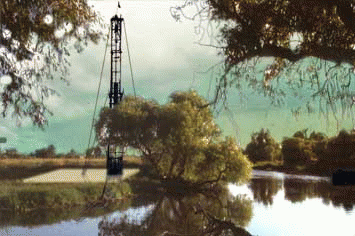
Fracking the Poudre River by Photo credit jdial
Honesty is so refreshing. It was clarifying, if not encouraging, to hear an engineer and non-politician talk about what we know and what we do not know about fracking and its effects on our water supplies. Joe Ryan [1] is pleasant, humorous, and well educated in the unguinous arts. If there is a fault to an engineer's approach, it is that the clean knife of reductionism can somewhat sever one from consequences that beset those engulfed by them.
After 60 years of hydraulic fracturing research, technology development, and experience, we can safely say that we know everything there is to know about hydraulically created fractures, except how deeply they penetrate, their vertical extents, their symmetries about the wellbore, whether they are planer or multi-stranded, their geometries at the perimeter, which directions they go, and what their conductivities are. Other than that, we've got it down pat. [2]
Ryan's emphasis was on the liquid aspects of fracking. Industry emphasizes that fracking fluid is 90% water and that 99.5% of fracking fluid consists of water and sand. Of the chemicals comprising the remaining 0.5% of the fluid, pretty much all are hazardous but their amounts are minuscule. (Of course, the amount of polonium that nuked Alexander Litvinenko was also diminutive.) The industry likes to emphasize the deeper depths of fracking compared to water wells by illustrating, for example, how many Empire State buildings could be concealed within their wells. As they drill through aquifers, oil and gas companies are diligent, they tell us, in casing and shielding to guard against leaks.
Spills happen, as occurred near Windsor, Colorado, in February of this year, when over 84 thousand gallons of fracking fluid spewed from a wellhead. But that's relatively rare and in this case, at least, the spill did not despoil anything unsalvageable. Ryan said Colorado experiences between five hundred and one thousand spills each year and he deems that rate acceptable.
The farther up [the well bore] you come, the less you rely on Mother Nature for protection, and the more you rely on people for protection. When there is five or ten thousand feet of rock between me and what's down there I feel a lot more comfortable than when there's just a driver with an eight-thousand-gallon truck of frack fluid. That's a human driving a human machine; bad things can happen at higher rates. So, spills, ruptures, seepage, drilling fluids, frack chemicals, flowback fluids, which people sometimes call produced water, go where they do not belong. This happens, in my opinion, too frequently in Pennsylvania ... [3]
That's what we know about fracking.
When you poke holes in the earth exchanges occur, some of them unplanned.
What can go wrong from below? Gas, frack fluid, and produced water could migrate up through the formations above. Industry says that's impossible, but no good scientist would ever say impossible. It's improbable and maybe highly so but not impossible. If it happens consequences could be severe or mild; it depends. No one knows. Who is doing modern, computer-based simulation of five-thousand-foot drilling and the probability of something coming up? The industry could be doing it but it's not. Cement can allow fluid migration along the contact between the cement and the rock; you can have migration along the contact between the cement and the casing, called 'loss of bond'; or diffusion of fluids through inaccurately made cement; or fracture of cement that leads to debonding; rupture of the casing. These are all things that can go wrong and have gone wrong in Alberta and British Columbia. [3]
Water, comprising so much of the fracking fluid, returns as flowback. Later there is produced water that had been locked deep within the fractured shale. Currently drillers discard that highly polluted water. Can it be recycled? The issue is complicated by the proprietary secrets guarded by the industry, says Ryan. We don't know what goes into the fracking fluid in the first place, and what returns is a veritable witch's brew. Thus far, attempts to salvage that brew have been expensive and cumbersome. And, frankly, the industry lacks motivation to try. The expense of buying water is just part of the business plan. The fact that it is in no shape to be used again, ever, is of no concern to it.
In the ground, water-borne chemicals have three properties pertinent to engineers: toxicity, persistence, and mobility. Substances possessing any two of the properties are not so bad; chemicals may persist and be mobile yet not be toxic. Or they may be toxic and mobile but soon dissipate. They may be toxic and persistent but remain interred five Empire Buildings down. It is when a chemical possesses all three properties that concerns arise. But, deep as they are, those concerns are difficult to investigate.
Water flows downhill and the flow rate of water is easy to determine as long as you can see it. Underground, measuring becomes a matter not only of flow rate but also of route. Water won't compress, so when more comes in than a space can hold something must give. With no other place to go, water will push upward along an available path. This is called a flow path. Drilling can create deep flow paths, or well bores can intersect existing faults, through which water wends its way. Unrecovered fracking fluid can seep along fracture lines for miles. Even with supercomputers, "predicting the pattern of induced fracturing [and likely flow paths] in an already jointed rock mass is chaotic" [3]. Drilling can affect abandoned wells, which are not necessarily well capped or even identified. During the drilling of one well, fracturing can occur in a nearby well; that's called fracture propagation [3].
If you have a large number of abandoned wells and you don't know where they are, and you haven't done proper seismic investigation of the area you're going to drill and frack, it is possible that you will drill into or frack into an area in which there is a preexisting abandoned well, which is a pipeline to the surface. [3]
It happened in Texas in 2010 when fracking at one wellhead caused a geyser at an abandoned neighbor that gushed for a week. Unfortunately for residents the abandoned well was what they call 'sour'; it spewed hydrogen sulfide gas, and the area had to be evacuated.
Residents of Pavilion, Wyoming, were featured in the movie "Gasland" as they ignited water from their faucets. The flammable substance was identified as benzene, a carcinogen possessing three qualities--toxicity, persistence, mobility--and it now inhabits Pavilion's wells. Measures of casing depth in Pavilion wells, Ryan said, reveal that some casings did not extend deeply enough to prevent aquifer contamination. Oops.
Mother Nature can slip methane into water, although she is not alone. Recall that methane can be biogenic, formed close to the surface by decomposition of organic substances and therefore 'natural'. Or it can be thermogenic, formed at deep places under conditions of high pressure and temperature. It too is 'natural', but it contains a different carbon isotope. The isotope, carbon 13, defines the gas as thermogenic in origin. Drilling disturbs this gas and brings it to the surface, so when thermogenic gas is identified drilling is indicted.
Two wells in Colorado's Garfield County, belonging to Mike Markham and Renee McClure, contained biogenic gas unrelated to oil and gas activity, so there the industry is off the hook. But a third well on Aimee Ellsworth's property contained a mixture of biogenic and thermogenic methane, so in that instance fracking was at least partly to blame. According to Ryan, the bubbling benzene and methane in Garfield County's West Divide Creek arose after a well penetrated an existing fracture, providing an avenue for the gas.
Yet some industry spokesmen assert that no cases of water contamination by fracking have been proved. Keep in mind that some claims are thrown out for lack of baseline measures with which to make comparisons. Think about having your well water tested before drillers invade the neighborhood. It will cost less than bottled water. If it's too late and your water already ignites, know that bottled water is but a partial shield; volatile gases can impair health when inhaled during showers or bathing.
How do high temperatures and pressures effect chemicals? A toxic chemical might detoxify or might take on more toxic qualities, or a previously nontoxic chemical might turn pernicious. Halliburton, up to a couple of Empire State buildings into fracking along with other endeavors, is studying that question but only insofar as heat and temperature might affect the efficacy of its fracking fluids, not as to health risks. One may not be surprised.
By the way, what happens to the chemicals we have injected into the earth over years and decades? No one knows.
As you know, the oil-and-gas industry is exempt from clean air and water laws. Six times since 2000 in Colorado alone, the Environmental Protection Agency has granted so-called "aquifer exemptions' by which drillers are given permission to inject polluted drilling wastewater into drinking-water aquifers. You read that right. EPA imagines that these deep aquifers will never be needed for drinking. They are too deep and too expensive to tap for water, but not too deep and expensive to pollute. Forever.
Water used in the United States by agriculture, industry, and people already exceeds the amount of water we can get from the surface. We take the remainder from aquifers. And they are draining.
The industry celebrates natural gas as a 'bridge fuel'. As long as we're putting our energies into natural gas we'll build the infrastructure to support it (well pads, storage containers, pipelines, roads to and between well pads, trucks to and from all of it), and what building infrastructure means is that we're making it a part of our economy and withdrawing our energies from developing green energy.
One of the biggest problems with solar and wind is what to do when the sun isn't out and the wind stops blowing--how do you 'hold' or contain energy that was produced when the sun was out and the wind was blowing? It is probably the biggest problem with those two sources of energy (unless the real problem is that, with sustainable energy, the industry might no longer receive the unholy profits it siphons from fossil fuels). Okay, storage is a problem. But is the problem insurmountable? I would doubt that. Will it be solved or at least ameliorated while our energies are, forgive me, balls-to-the-wall in pursuit of natural gas? Don't count on it.
They call natural gas a bridge fuel while salivating over a veritable sea of fuel beneath us, just waiting to be released to serve our addiction for the next one hundred years. Honestly, does that sound like a bridge fuel to you?
***
Past articles on fracking:
Everything You Always Wanted to Know About Fracking But Should Be Afraid to Ask--An Overview
Fracking: Water Issues--Colorado-centric, But Applicable to All
Who the Frack's Really in Charge? (on regulation)
Water-Free Fracking--Why Not? (on LPG fracking)
Frack-Flavored Gas (on the trials of Garfield County, Colorado)
***
[1] Joe Ryan is a professor of environmental engineering at the University of Colorado, Boulder, where he has been teaching and conducting research since 1993. He holds a B.S. degree in geological engineering from Princeton and M.S. and Ph.D. degrees in civil and environmental engineering from MIT. His emphasis in teaching and research is on the transport and ultimate fate of contaminants in natural waters. He studies the role of organic matter in the speciation of trace metals in water, and the transport of microbes in subsurface waters. He gravitates toward "real' problems, such as Rocky Flats plutonium, the polycyclic aromatic hydrocarbons that oil spills release, mercury in the Everglades, microbes in groundwater, erosion caused by off-road vehicles at James Creek, and metals draining out of abandoned mines in the Lefthand Creek watershed.
[2] From a paper by Ralph W. Veatch, Jr., SEI, 2006.
[3] From a talk given by Cornell University professor Anthony Ingraffea at Luzerne County Community College in Nanticoke, Pennsylvania, in 2010, and displayed at click here=20130417_PRNLv1_art_1&utm_source=prmrnl&utm_medium=email&utm_content=art1&utm_campaign=20130417-DNLHL.
Authors Website: http://medicalink.com
Authors Bio:
Schooled in psychology and biomedical illustration, of course I became a medical writer!
In 2014 my husband and I and our kitty moved from Colorado, where Jerry had been born, to Canada, where I had been. (Born.)