


 Would you like to know how many people have visited this page? Or how reputable the author is? Simply
sign up for a Advocate premium membership and you'll automatically see this data on every article. Plus a lot more, too.
Would you like to know how many people have visited this page? Or how reputable the author is? Simply
sign up for a Advocate premium membership and you'll automatically see this data on every article. Plus a lot more, too.
 SHARE 
|
|





Gareth Porter (born 18 June 1942, Independence, Kansas) is an American historian, investigative journalist and policy analyst on U.S. foreign and military policy. A strong opponent of U.S. wars in Southeast Asia, and the Middle East, he has also written on the potential for diplomatic compromise to end or avoid wars in Korea, Vietnam, Cambodia, the Philippines, Iraq and Iran. He is the author of a history of the origins of the Vietnam War, Perils of Dominance: Imbalance of Power and the Road to War in Vietnam.
Porter has written regular news reports and news analyses on political, diplomatic and military developments in regard to Middle East conflicts for Inter Press Service since 2005. He was the first journalist to provide a detailed account of the alleged secret Iranian diplomatic proposal to the United States in 2003, and has published an in-depth analysis of an exit strategy for Iraq
OpEdNews Member for 790 week(s) and 3 day(s)
208 Articles, 0 Quick Links, 0 Comments, 0 Diaries, 0 Polls
List By Popularity
Page 1 of 4 First Last Back Next 2 3 4 View All
 Thursday, September 2, 2021
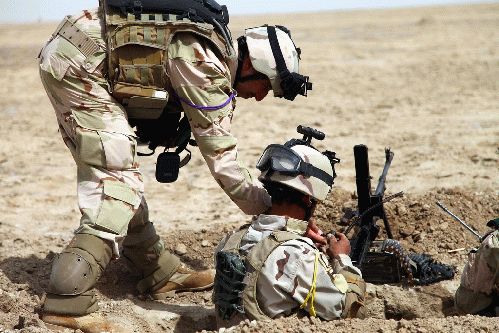
Afghanistan collapse reveals Beltway media's loyalty to permanent war state In the wake of a remarkably successful Taliban offensive capped by the takeover of Kabul, the responses of corporate media provided what may have been the most dramatic demonstration ever of its fealty to the Pentagon and military leadership.
 Monday, August 2, 2021
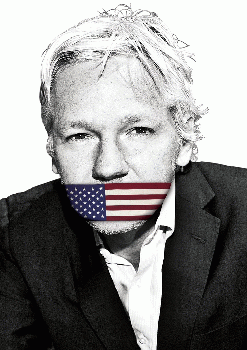
WATCH: A Fiery Defense of Assange Gareth Porter on the Pentagon deceiving and manipulating civilian leaders in the Cold War; Lori Wallach on greed hindering the global vaccine rollout; and Joe Lauria on the myths that mislead many on Julian Assange.
 Sunday, April 11, 2021
Pentagon campaign to recruit Vietnam as military ally against China exposed delusions of US war strategy After convincing itself Vietnam would grant it access for missile bases against China, the Pentagon got a hard dose of reality.
 Sunday, December 6, 2020
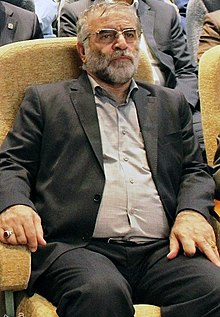
Painting Fakrhizadeh as a Nuclear Mastermind Israel's Mossad intelligence agency eliminated Mohsen Fakhrizadeh, a defense official, despite the knowledge that its public depiction of him as the key architect of an Iranian nuclear weapons program was a deception.
 Saturday, August 8, 2020
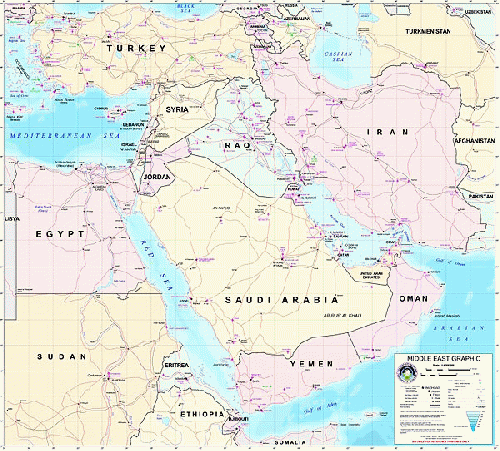
Don't delay military withdrawal from the Middle East The Quincy Institute is right to call for a withdrawal of US troops from the Middle East, but its timeline is too slow.
Saturday, July 11, 2020How the Pentagon failed to sell Afghan government's bunk "Bountygate" story to US intelligence agencies New York Times Russiagate bombshell turns out to be a dud, as dodgy stories spun out by Afghan intelligence and exploited by the Pentagon ultimately failed to convince US intelligence agencies.
 Sunday, June 28, 2020
Israel leverages dubious "Nuclear Archives" to re-enlist IAEA in campaign against Iran The International Atomic Energy Agency (IAEA) has once again lent itself to the political interests of the United States and Israel, provoking a needless conflict with Iran.
 Sunday, June 7, 2020
FBI Launches Open Attack on 'Foreign' Alternative Media Outlets Challenging U.S. Foreign Policy The FBI has publicly justified its suppression of dissenting online views about US foreign policy if a media outlet can be somehow linked to one of its adversaries. The Bureau's justification followed a series of instances in which Silicon Valley social media platforms banned accounts following consultations with the FBI.
 Tuesday, April 14, 2020
COVID-19: Fallout From a Navy Captain's Heroism: The Possible Emergence of a New Idea of "National Security" The conflict between the Navy high command, a captain and his threatened crew could underscore a new meaning of national security after the pandemic runs its course, says Gareth Porter.
 Monday, April 6, 2020
How Generals Fueled 1918 Flu Pandemic To Win Their World War The lack of concern of Washington bureaucrats for the well-being of the troops, as they pursue their own war interests, appears to be a common pattern -- seen too, in the U.S. wars in Vietnam, Afghanistan and Iraq. Now it has been revealed once again in the stunningly callous response of the Pentagon to the coronavirus crisis.
 Sunday, May 12, 2019
Bolton Is Spinning Israeli "Intelligence" to Push for War Against Iran John Bolton has gotten away with a dangerous deception. The national security adviser's announcement Sunday that the Pentagon has deployed air and naval forces to the Middle East, which he combined with a threat to Iran, points to a new maneuver to prepare the ground for an incident that could justify a retaliatory attack against Iran.
 Monday, May 6, 2019
Mueller Stoked Trump-Russia Alarmism, Despite Finding No Collusion The Mueller report doesn't show the Trump campaign collusion the public had been led by media coverage to expect. But it is a siren song for a continued focus on the supposed threat to U.S. democracy from Russian "meddling". It is aimed at maintaining public support for a focus on the threat from Russia, which diverts the attention of the media and Congress from real threats to democracy from Trump's domestic agenda.
Saturday, March 2, 2019The Right May Finally Get Its War on Iran John Bolton has never made a secret of his burning desire to stoke a war between the United States and Iran. But Bolton is not the only one on Donald Trump's national security team who dreams of such a military confrontation. Secretary of State Mike Pompeo has joined with Bolton in recent months to prepare a case for possible war with Iran.
 Wednesday, February 13, 2019
The Real Motive Behind the FBI Plan to Investigate Trump as a Russian Agent - Consortiumnews Deputy Attorney General Rod Rosenstein and senior FBI officials "viewed Trump as a leader who needed to be reined in, according to two sources describing the sentiment of the time." That description by anti-Trump law enforcement officials suggests that the proposed counter-intelligence investigation of Trump served as a means to maintain some leverage over his treatment of the FBI in regard to the Russia issue.
 Wednesday, January 2, 2019
Is the End of the Brutal War in Yemen Finally at Hand? The war's swift conclusion appears all but inevitable. While Crown Prince Mohammed may be committed to final victory, the Saudi regime remains heavily dependent on U.S. political-diplomatic cover, as it has since the beginning of the bombing campaign in Yemen. Ironically, that political reality could now tip the balance toward peace.
 Tuesday, November 27, 2018
U.K. and Ecuador Conspire to Deliver Julian Assange to U.S. Authorities Behind the revelation of those secret charges for supposedly threatening U.S. national security is a murky story of a political ploy by the Ecuadorian and British governments to create a phony rationale for ousting Assange from the embassy. The two regimes agreed to base their plan on the claim that Assange was conspiring to flee to Russia.
 Sunday, November 18, 2018
America's Permanent-War Complex In the new permanent-war complex the interests of the arms contractors have increasingly dominated over the interests of the civilian Pentagon and the military services and dominance has became a new driving force for continued war.
 Saturday, November 3, 2018
33 Trillion More Reasons Why The New York Times Gets it Wrong on Russia-gate Further research shows The New York Times was even further off the mark in blaming Russian social media for Trump's win, as Gareth Porter reports.
 Saturday, October 6, 2018
Could Trump Take Down the American Empire? More than any other presidency in modern history, Donald Trump's has been a veritable sociopolitical wrecking ball, deliberately stoking conflict by playing to xenophobic and racist currents in American society and debasing its political discourse. That fact has been widely discussed. But Trump's attacks on the system of the global U.S. military presence and commitments have gotten far less notice.
 Thursday, August 30, 2018
How the Department of Homeland Security Created a Deceptive Tale of Russia Hacking US Voter Sites The narrative about Russian cyberattacks on American election infrastructure is a self-interested abuse of power by DHS based on distortion of evidence, writes Gareth Porter.
