




On September 24, 2007, in a televised address at Columbia University, the president of Iran issued an official invitation to Columbia students and faculty to visit any of the 400 universities in Iran. He announced that if they accepted the invitation, the students and faculty in Iran would listen to them respectfully and be much more courteous to them than the president of Columbia University had been to him. Mahmoud Ahmadinejad is the heir to an ancient Persian culture that has many techniques for defusing tension and helping all concerned to save face.
Perhaps some Iranian Americans who heard the invitation thought it was just taarof, a polite form of invitation that isn’t meant to be taken seriously. But surely President Ahmadinejad was aware that Americans don’t know about taarof. Also, he added a lot of details, which one doesn’t usually do unless one means it. So here’s what I suggest. Take him up on the invitation!
There is a precedent. Last winter, I, a graduate of the Mailman School of Public Health of Columbia University, spoke to students and faculty at the Free Islamic University of Hamadan, Iran. I had a wonderful time and my “honorarium,” a gorgeous book of photographs of that historic city, now sits on my coffee table.
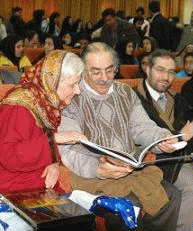
A mountaineering buddy of my son had asked me to speak at his university about new developments in education in the United States. Since a friend of ours, a jazz musician, was visiting from New York City, we thought this would be a good chance to take him to see some historic sites. And of course it was a chance to meet scholars. So I created a modest PowerPoint presentation and dug up a video I’d made long ago of my son’s New York City nursery school. I wasn’t quite sure what the event was all about or how many people would be attending, so I tried to prepare for several different scenarios.
The day before the event, my son’s friend and another man came to fetch us by car in Tehran, where we live part of the year. We did a little sightseeing and ate out near the historic inscriptions carved into a cliff in the mountains on the ancient route to Babylon.

Then, in the morning, a driver picked us up at our hotel. Before we’d driven two blocks, however, the driver’s cell phone rang. There was an electricity outage at the university, so he took us to see the excavations of Ekbatan, the ancient capital of Persia, to kill some time. I enjoyed walking on the scaffolding over the dig, and my friend Russell was a big hit with the schoolgirls who were on a class trip to the on-site museum. We kept asking my husband to read the explanations of the artifacts from previous millenia.
Finally we got the call to come over to the university. Little did I know that I was the guest speaker at the awards ceremony.

I had worn my best new wine-colored Islamic-ly correct outfit, but when I walked into the auditorium (!) I realized that all the other women were wearing shades of black. Oh well. The cameras started flashing and all I could think was, “I must not embarrass my son’s friend in front of his whole school.” He was working the audiovisuals, now that the power was back up. I was introduced to my interpreter, I handed him my text, and away we went.
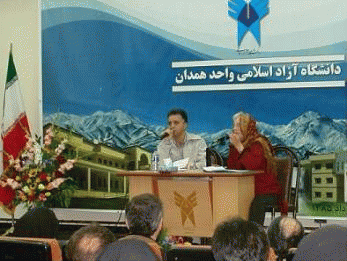
I guess I managed to pull it off, because the standing room only crowd clapped a lot and asked many questions. But then, you can never tell with Iranians because they pride themselves on their hospitality, and I was a guest. However, the camera did catch some university officials and professors laughing at my jokes, so I hope my son’s friend was satisfied. We certainly were. (Actually, my husband had to send me hand signals from the front row to cut it short because nobody was holding up signs announcing 5 minutes, 1 minute, 0 minutes.)
One of the topics I mentioned in my talk was how difficult it has been to abide by the principal of separation of church and state in the U.S. public education system, though we are officially committed to it. This topic seemed to interest some of the students, as they asked about it during the Q&A and afterwards. I was careful how I discussed this, because, again, I didn’t want to embarrass my son’s friend.
If students and faculty from Columbia University visit universities in Iran, they won’t be under the same constraints as I was. With some careful preparation, they may help nurture a dialog about issues that both societies need to discuss. Or, at the very least, they can have fun visiting another country and sharing the latest knowledge in their fields with their counterparts.

After the events in New York City, I asked an Iranian student how she felt about the possibility of a student from Columbia University coming to visit her school. At first she said she didn’t like that the president of Iran had invited people to speak at her university without even asking the students first. But then she admitted that of course it would be very interesting to participate in such an event, even if the way the invitation was issued was a little strange.
No matter how the invitation was issued, this is a historic opportunity. Iranians are eager to have more contact with foreigners, and Americans certainly have a lot to learn about Iran. If students and faculty from Columbia come to Iran with open hearts and minds, it will benefit peace and be a great encouragement to the hundreds of thousands of university students here who are trying to build a better society in Iran.
One last note: In case people think it isn’t safe to visit Iran, or that it’s a dull and backward country, I have to tell you that you’ve been misguided. You will have an awesome time. I guarantee it.
(Note: You can view every article as one long page if you sign up as an Advocate Member, or higher).






