


![]() |
|
Tags for This Article:
Power (1191) GrassRoots (648) Events (340) Sustainability (63) Vegan (21) Earth Day (7) Quilt (2)
|
Add to My Group
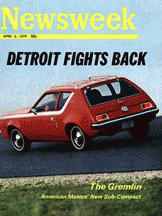
Earth Day is “thirty-something,” and the whole world is invited! On April 22, 1970, 20 million people across America celebrated the first Earth Day in a flurry of coast-to-coast grassroots events often credited with launching the modern American environmental movement. 1970:[1] It was the year of the introduction of the AMC Gremlin and the Ford Pinto, of Apollo 13, and of increased plane hijackings, notably in Japan, Europe and New York. And it was the year that Ohio National Guardsmen killed four college students at Kent State University.
The Grateful Dead played at the Fillmore East, music icons Jimi Hendrix and Janis Joplin both died at age 27, and the Beatles’ Long and Winding Road was their last number one song. It was also the year of the meltdown of fuel rods in the Savannah River nuclear plant near Aiken, South Carolina, an incident that went unacknowledged for 18 years.[2]
The ‘60s had brought a flowering of personal identity, a sense of self-empowerment, and the idea that individuals could indeed, effect change. Nearly 100,000 war protestors peacefully demonstrated at the White House, and finally, the Viet Nam war began to wind down. Heralded by the rock musical, Hair,[3] the Aquarian Age had begun. Earth Day Beginnings What started as a day of national environmental recognition has evolved through the combined efforts of the U.S. government, grassroots organizations, and individuals, into a worldwide celebration honoring the Earth. At a conference in Seattle Washington, in September, 1969, U. S. Senator Gaylord Nelson (D-WI) announced that in the spring of 1970, there would be a nationwide grassroots demonstration for the environment.
Senator Nelson (1916-2005) had been an early voice rejecting the suggestion that economic development should take precedence over environmental protection, stating that, “The economy is a wholly owned subsidiary of the environment, not the other way around.”[4] When the former senator was awarded the Medal of Freedom in 1995, President Clinton said, “As the father of Earth Day, (Nelson) is the grandfather of all that grew out of that event: the Environmental Protection Act, the Clean Air Act, (and) the Safe Drinking Water Act.”[5] In order to prepare for the event he had announced, Senator Nelson hired a youthful Denis Hayes[6] to coordinate coast-to-coast events for the first Earth Day. Later, Time magazine would select Hayes as one of its "Heroes of the Planet," and Look magazine would name him one of the 100 most influential Americans of the 20th Century. Today, Hayes is Honorary Chair of the Earth Day Network.[7] American Heritage Magazine[8] called the first Earth Day, “one of the most remarkable happenings in the history of democracy …”
www.merylannbutler.com Meryl Ann Butler is an artist, author and educator who counts First Lady Dolley Payne Todd Madison as well as two signers of the Articles of Confederation among her ancestors. Mary Ball, mother of George Washington is in the ancestral lineage of Butler's great grandmother, Blanche Ball. Grateful to know that the blood of America's founding mothers and fathers runs in her veins, Butler has been newly filled with matriotism as a direct result of the 2000 and 2004 presidential elections. Lest she appear too uppity, it should be revealed that she also has family ties to James Butler Hickok, better known as Wild Bill. Butler has been actively engaged in utilizing the arts as stepping-stones toward joy-filled enlightenment for the past two decades. A native of NYC, her response to 9-11 was to pen an invitation to healing through creativity, entitled, "90-Minute Quilts: 15+ Projects You Can Stitch in an Afternoon" (Krause 2006). They don't call quilts "comforters" for nothing! www.90minutequilts.com Butler was faculty advisor for "The Love for All Mankind/Anti-Apartheid Quilt" project at ENMU (1993), now in the collection of the Hon. Nelson Mandela. As Arts Advisor for the Center for Improving U.S.- Soviet Relations (CIUSSR) Baltimore, MD; her activities included the "First U.S.-Soviet Childrens' Peace Quilt Exchange" (1987-88), an historic project chronicled in the media of both countries. Citizen diplomacy trips to the U.S.S.R. in 1987 and 1988 included lectures and presentations to fashion designers, craftspeople and artists in Odessa, Moscow, Kiev and St.Petersburg, in which she focused on the topic of creating global peace through international art exchanges. Butler is the proud mother of a daughter and seven stepchildren (all grown), and a passel o' grand younguns. It is to these new generations that she dedicates her political activism. Archived articles www.opednews.com/author/author1820.html Older archived articles, from before May 2005 are here.,
Copyright © OpEdNews, 2002-2008 |
|
||||||||||||||||||||||||||||||||

