

Tags for This Article:

Government (2748)  Corruption (1674)  Change (905)  Poverty (554)  Social Unrest (4)  Cameroon (1)  Cameroon Constitution (1)  Cameroon Strikes (1)  Paul Biya (1) 

Populum Tag Cloud
       Control Panel
Fine tune your search to access content
Articles
Diaries Products
Events All
All time
Last 6 mos
Last month
Last week
Last 24 hrs
From:
Month  Day   Year

To:
Month  Day   Year
Alphabet
Popularity
Count ON
Count OFF
This Level
Sub-levels


Tag(s): ; ; ; ; ; ; ; ;
Add to My Group
April 12, 2008 at 19:54:36

Cameroon Nip Tuck: Fleshing Out African Corruption

by Patty Bates-Ballard     Page 1 of 1 page(s)

www.opednews.com


Tell A Friend

(0.0 from 0 ratings) View Ratings | Rate It

The Cameroonian parliament just conducted a little plastic surgery on the national constitution to allow President Paul Biya to stay in power another seven years. When you witness political corruption turning people’s lives upside down, do you complain or do you start a movement? Cameroonian Julius Awafong is working to build support in Africa for a radical reform called vote sizing. He hopes that giving larger votes to poor, working and middle class people like Njoh Tarke will ease the misery she and others are suffering as a result of corruption.

While President Bush’s reputation may be better in Africa than just about anywhere else on earth, his programs to ease disease, poverty and illiteracy there are hardly making a dent in the widespread corruption that perpetuates these problems. One of the reasons political corruption thrives is that it often seems intangible. But as Njoh Tarke can tell you, corruption is plenty fleshy and bloody.
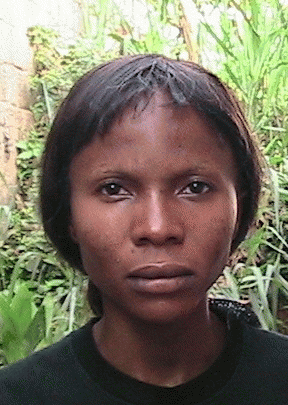

Njoh Tarke

Political corruption has turned 26 year old Cameroonian post graduate student Njoh Tarke’s life upside down. Her younger brother, Tumasang, a typhoid patient, was quietly sentenced to 15 months in prison in March. The family says he was falsely convicted of participation in violent strikes called after Cameroonian President Paul Biya announced his intention to run for an unconstitutional third term. The Tarke family is from the British colonized part of Cameroon where the opposition party is strong, as opposed to the French sector, from which President Biya hails.

Before his arrest, Tumasang provided for Njoh’s upkeep and schooling with his taxi cab job. Now she sometimes has to forego a meal to make sure he gets to eat the restricted typhoid diet that the prison does not offer. Family and friends chip in financially so that she can bring his meals to him in prison. But she wonders everyday whether he will be able to survive the ordeal.


Tumasang Tarke

Tumasang and a friend were on their way home from the grocery store on February 28, the day after the violence subsided, when he and his family say he was beaten and arrested by soldiers in plain clothes. He was sentenced a week later in a nightmare of contradictory, furtive proceedings from which Njoh cannot seem to wake up.  Dozens of Cameroonians lost their lives in the violence.

In all, 1671 people were arrested and 729 had been found guilty as of March 4, according to a report given by Cameroonian Vice Prime Minister Amadou Ali. While many families from the British colonized sectors have alleged discrimination, Ali has given assurances that the process adhered to the law. There is no indication that any further attention has been given to the complaints. Many have found irony in the fact that Biya originally hinted he would continue his presidency past 2011 during an interview with France 24 while calling attention to the need to continue his anti-corruption campaign.

Then Thursday, the Cameroon National Assembly approved the change to the constitution. And now Biya’s re-election in 2011 for a follow-up five year term is no less than a foregone conclusion, barring any health problems. The president, who will be 78 that year, has been president since 1982. Why? Not as much because of widespread popularity. Yes, Biya's Cameroon People's Democratic Movement (CPDM) controls 153 of the assembly’s 180 seats. But the the opposition Social Democratic Front has repeatedly complained of vote rigging in the CPDM’s and Biya’s previous wins.

This is just one window into how corruption devastates the lives of real human beings. Julius Awafong, president of the Fair Choice Party-Cameroon (in formation) travels his country asking how is it that a very few wealthy people live in luxury while the vast majority of Africans live on less than $1 US a day, with little or no access to potable water, sanitation, healthcare or standard housing. After listening to hundreds of Cameroonians desperate for change and watching several cities erupt into violence in late February, his conclusion is that the numerical majority of African voices is no match for the power of the wealthy few.


Julius Awafong

So Awafong promotes a system that would increase the power of ordinary Africans through increasing the size of their vote. Why is he drawn to the radical concept of vote sizing? “Because the people are desperate,” says Awafong. “Corruption is not easy to dismantle. If we want fundamental change, we’re going to have to overhaul the system. Otherwise we can expect more strikes, violence and misery.”

Awafong had just returned from a videotaping trip to northern Cameroon when the recent social unrest broke out across the country. He was able to document some of the young people escaping official tear gas crowd dispersions here : http://www.youtube.com/profile?user=VoteSizer.

Awafong was scheduled to appear on a talk show Thursday but the topic was cancelled by Cameroon Radio and TV officials at the last minute because they said it was too provocative under the current political tensions. Awafong says that in anticipation of further dissent, the government has placed soldiers conspiculously throughout potential trouble areas.

Undeterred, Awafong says he will continue to pursue his effort to establish democratic balance and fairness by getting his message out any way he can. Interested parties may email him directly at Awafong@VoteSizing.org. For more information on vote sizing, go to http://VoteSizing.org.


Patty Bates-Ballard is a mother and writer who advocates respect for the earth and its people. The owner of WordSmooth, a Dallas based communications company, Patty has written for Environmental Design & Construction Magazine, the American Association of Naturopathic Medical Colleges and World Press, among others. Her Socha diversity + effectiveness workshops have been delivered to thousands of employees across the country. A graduate of Austin College, Patty works from her home in Dallas, Texas, where she raises her sons, Kory and Kaden.

Contact Author
Contact Editor
View Other Articles by Author


Bookmark this page: (what's this?)

NETSCAPE      DIGG THIS      Add This Page to Mr Wong!           NEWSVINE      DEl.ICIO.US      Looksmart Furl      My Web      Tag!RawSugar      Blink List     (More...)
Comments: Expand   Shrink   Hide  
3 comments

I'm an anti-civilizationist and election boycott advocate in San Diego. For reasons not to vote in faith-based elections with secret vote counts for candidates you cannot hold accountable if they fail to represent you, check out the discussions, articles, and videos on my website http://noinnovember.ning.com
Mark E. SmithI'm an anti-civilizationist and election boycott advocate in San Diego. For reasons not to vote in faith-based elections with secret vote counts for candidates you cannot hold accountable if they fail to represent you, check out the discussions, articles, and videos on my website http://noinnovember.ning.com

I just emailed Awafong:


Hello Awafong--

I've been an election reform activist in the United States for several years.

The problem isn't the size or the weight of the vote.

The problem isn't how many people vote or who they vote for.

The problem is, as Stalin said, who COUNTS the votes.

When votes are counted by computer, they might as well be counted secretly behind closed doors because nobody can see inside a computer.

When votes are counted secretly by computer, only the person who programs the computer has a vote.

The programmer could direct the computer to give more weight to some votes than others, true. But what they usually do is to program the machines to give a certain percentage of the votes to the person who pays the programmer and fewer votes to their opponents. Sometimes the computer flips the votes, so that the less popular candidate appears to have gotten more votes than the popular candidate. And because citizens can't watch the votes being counted inside the computer, and because the programming that flips the votes can erase itself before an audit can be done, there is no way to prove election fraud by computer programmers.

Poor people don't buy voting machines. Poor people can't even afford to buy pencils so their children can learn to write. Rich people buy voting machines and they are very expensive. Do you think they'd buy machines that weren't guaranteed to give them the results that they want?

Who programs the voting machines, Awafong? Who pays them? Would they be paid if the machines didn't do what the people paying them wanted?

The Zapatistas in Oaxaca, Mexico, have an unusual form of self-government. They have local councils or juntas where everyone gets to speak and everyone is heard. Everyone in a village takes turns every few weeks being on the council so that nobody is there long enough to become corrupted by power. The Zapatista leaders have to "lead by obeying," that is, they must carry out the will of the people or they are removed from leadership. The Zapatistas are very poor indigenous people. But the poorest have the most power because that's how they govern themselves. It is called a direct, participatory democracy because everybody has a direct vote on issues that matter to them, and everyone has a vote on who can or cannot remain a leader. The government of Mexico, backed by the government of the United States, is trying to exterminate the Zapatistas. Most governments do not like democracy.

In a direct, participatory democracy, the poorest have the most power. In a republic, often misleadingly called a "representative democracy," where the people cannot vote directly on important things but can only vote for representatives, the representatives have too much power and are easily corrupted.

The United States, like the Camaroons, is not a democracy. We also have fraudulent elections with rigged voting machines. We also cannot get rid of corrupt officials. I hope you will be more successful than we are.

Respectfully,

Mark E. Smith


by Mark E. Smith (21 articles, 29 quicklinks, 77 diaries, 978 comments) on Sunday, April 13, 2008 at 7:52:59 AM


Outreach Coordinator for Vote Sizing. Julius believes that in order to reduce corruption, we need to start from the root cause which is wealth + power, promoted by 1-person 1-vote model of democracy.

We need to give a weighted vote to poor, working and middle class people in order to have a peaceful and prosperous society.

Awafong JuliusOutreach Coordinator for Vote Sizing. Julius believes that in order to reduce corruption, we need to start from the root cause which is wealth + power, promoted by 1-person 1-vote model of democracy.

We need to give a weighted vote to poor, working and middle class people in order to have a peaceful and prosperous society.

Awafong replies Mark

Hi Mark,

Thanks for the points you've raised concerning Vote Sizing. Thank you also for telling me about the Zapatistas in Oaxaca, Mexico. I've never heard or read about this. What kind of reformation are you trying to put in place in the US as an election reformist activist?

Permit me address your points as they come.

You said:
"The problem isn't the size or the weight of the vote. The problem isn't how many people vote or who they vote for. The problem is, as Stalin said, who COUNTS the votes."

With Vote Sizing, we think that those who suffer most from the outcomes of cheated elections should be given the powers to control the election counting process.

You said:
".... But what they usually do is to program the machines to give a certain percentage of the votes to the person who pays the programmer and fewer votes to their opponents".

With Vote Sizing in mind, my questions are: why would the programmer unconstitutionally give more votes to the guy who has more money? Why would a wealthy guy pay the programmer to illegally deviate all the decisions in his favour? Don't they simply want to succumb to the idea that the more money you have the more power you deserve?

If you take medication that is meant for the sick and give to a healthy guy to control, he might end up selling it to someone who has money. Do you think the sick himself, who feels all the pain and agony, will sell the medications and die if put under his control?

What I mean is those who count elections are simply filled with the spirit of greed and they don’t feel the impact and aftermath of a stolen election. And to my opinion they are not using the powers given to them to count the elections wisely, as well as those who use money to corrupt the programmer are not using their money wisely.

But if we make it constitutional that, the more money you have, the less power you deserve, and vice versa, believe me, people will learn to use their money/powers wisely.

Again with the Vote Sizing approach I think that neither the programmer nor the rich guy is corrupt. They are simply victims of an acceptable culture/belief, or if I can use a computer word, I would a say an operating system which orientates them to do so. So let's stop pointing fingers, let's stop accusing one another, because we are all in it and our fellow brothers and sisters everyday fall prey of this outdated "operating system". If we keep on pointing fingers, we will all one day end in a crash. Let's fix the outdated and corrupt "operating system" which according to Vote Sizing is "1 person 1 vote".

I've been observing how money transfer agencies operate and one thing I noticed is that, it is pretty difficult or almost impossible to cheat the computers programmed to facilitate such operations. You cannot double-collect money transferred to you with the same transfer code. Why? Simply because the guy who owns the business does all to protect his interest and to see that everything works properly.

Now why do you think government, made up of some many stakeholders, isn't able to programme these computers to serve their common interest? If it isn't working today like you rightly pointed out, it's simply because those whose interest are primordial or who suffer most from cheating are not given the tools to watchdog that programmer.

You said:
"Poor people don't buy voting machines. Poor people can't even afford to buy pencils so their children can learn to write. Rich people buy voting machines and they are very expensive. Do you think they'd buy machines that weren't guaranteed to give them the results that they want?".

"It's not a curse to be poor, but it's a curse to be poor and powerless" (Steve Glickman). Wealth + power = corruption = curse. A poor man might not be able to buy a voting machine, but collectively, they can and they should, because they are those who suffer most from failing democracy, I think their collective money through taxes can buy voting machines. By the way why should rich people buy voting machines and not government? When you say rich people do you mean government?

Again, in Cameroon, even if poor people can't buy pencils for their children to learn and write, at least they can buy them hoes and cutlasses to cultivate food that is used to feed the children whose parents can buy them pencils for school. Isn't that also important?

You asked:
"Who programs the voting machines, Awafong? Who pays them? Would they be paid if the machines didn't do what the people paying them wanted?"

Does poverty mean computer illiteracy?  Can't poor people program a computer? Who pays them? The government of course; and one point we should be clear about is that government's money isn't rich people's money. And rich people don't get richer because they pull money from trees or because they drive cabs, sweep streets, drain toilets, teach in classrooms, move around the street to hawk, work on farms, wash dishes in restaurants, or drive children to school in school buses. They are rich because poorer people work tirelessly to fill their accounts. Shouldn't these hard working poorer people be given a weighted vote?

They way you present your points resembles that of those who always tell me that poorer people should educate themselves and become rich. My questions to them are:
- Okay, are they right to think that all poorer people should "formally" educate themselves to be rich? If that happens, everybody will want to be an investor in order to be rich – right? Now is it possible for society to function with more employers than employees? Is it possible for a bus company to move with more drivers than passengers? Is it possible for an aircraft transport company to function with more pilots than travellers?

Poorer people will always be in their majority and wealthy in the minority – we all know that. Poorer people can't live without investors nor can the wealthy live without the hard working poorer class.

You said:
"The United States, like Cameroon, is not a democracy. We also have fraudulent elections with rigged voting machines. We also cannot get rid of corrupt officials. I hope you will be more successful than we are".

It's true, corruption is everywhere and we cannot get rid of it but we can reduce that tide of corruption that's driving the world toward a crash. We define corruption as "when wealth and power overlap". That is "wealth + power = corruption and poverty – power = misery.

So "wealth – power = minimal corruption and poverty + power = happiness".

I can be more successful if and only if you promote my ideas by sharing with others and at the same time criticising in order to help me to fill the loopholes so as to strengthen it.

Thanks once more
Julius

by Awafong Julius (0 articles, 0 quicklinks, 0 diaries, 1 comments) on Saturday, April 19, 2008 at 3:20:49 PM


I'm an anti-civilizationist and election boycott advocate in San Diego. For reasons not to vote in faith-based elections with secret vote counts for candidates you cannot hold accountable if they fail to represent you, check out the discussions, articles, and videos on my website http://noinnovember.ning.com
Mark E. SmithI'm an anti-civilizationist and election boycott advocate in San Diego. For reasons not to vote in faith-based elections with secret vote counts for candidates you cannot hold accountable if they fail to represent you, check out the discussions, articles, and videos on my website http://noinnovember.ning.com

Mark replies....

Thank you, Julius.

I agree with you.

Here is another article I wrote about our voting system here:

http://www.opednews.com/articles/opedne_mark_e___080415_you_can_t_count_your.htm

I don't want a reformation in the United States, I would like a socialist revolution like Venezuela had, but they did it by voting and we can't because our elections are rigged and according to our Constitution our votes don't count anyway. Bush didn't win the popular vote in 2000 or in 2004, but the popular vote doesn't count.

We can't do it with violence because the government is much too powerful and too many people would die. We can't do it with a general strike because people need their jobs and they are afraid of not going to work. And I'm not sure we could do it by boycotting the elections either, because in one town in Ohio with fewer than 400 registered voters, the machines counted 10,000 votes for Bush, so it doesn't seem to matter if we vote or not.

The only thing that seems to work is that sometimes the rich get too greedy and they fall from their own greed. If people are socially conscious and really want a system that cares about people instead of about money, then there is an opportunity to do it. But a lot of people are greedy and want to be like the rich, so not everyone cares about other people like themselves.

One thing that seems to be true is that the more power women have in government, the better things are for everyone. A lot of powerful men just care about themselves, but most women (not all, but most) care about their husbands, their children, their parents, their neighbors, and everyone else. So when a lot of women have power in a country, everything gets better for everybody there.

Thank you for writing. I hope we can discuss this more.

Respectfully,

--Mark

by Mark E. Smith (21 articles, 29 quicklinks, 77 diaries, 978 comments) on Saturday, April 19, 2008 at 3:59:05 PM


3 comments


Tell A Friend


Copyright © OpEdNews, 2002-2008

Blog Ads


Most Popular Articles
in the Last 2 Days
(by Recommend Emails)

John McCain: Morally, Mentally, and Emotionally Unfit by Jim Fetzer

Iran War ~ How It Will Unfold by Lord Stirling

Sarah Palin, A Wolf in Moose Clothing by Anthony Wade

Librarians Against Sarah Palin Founder a Mystery by Judy Swindler

Anne Kilkenny Full Email on Sarah Palin by Rady Ananda

Is McCain Campaign Interfering In Alaska Troopergate Investigation of Palin? by Rob Kall

Protester who interrupted McCain's speech is an Iraq War Veteran by Mary MacElveen

Live OEN Street Medic Report From Occupied St Paul by Michael Cavlan

McCain's heroic story isn't the whole story; questions need asking by Don Williams

Falujah Veteran is Attacked by McCain Republicans at Speech by Dean Powers

Popularity Navigation
Control Panel:

Select Time
6 hrs 12 hrs
1 Day 2 Days
3 Days 1 Week
2 Weeks 1 Month
2 Months 3 Months
6 Months Last Year
Select Content
Articles Diaries
Polls Events
All Op-Eds
News Life/Arts/Science
Select Popularity
Page Views
# of Comments
Recommend Emails
  

Go To Top 50 Most Popular

