




Why aren't banks lending to local businesses? The Fed's decision to pay interest on $1.6 trillion in "excess" reserves is a chief suspect.
Where did all the jobs go? Small and medium-sized businesses are the major source of new job creation, and they are not hiring. Startup businesses, which contribute a fifth of the nation's new jobs, often can't even get off the ground. Why?
In a June 30 article in the Wall Street Journal titled "Smaller Businesses Seeking Loans Still Come Up Empty," Emily Maltby reported that business owners rank access to capital as the most important issue facing them today; and only 17% of smaller businesses said they were able to land needed bank financing. Businesses have to pay for workers and materials before they can get paid for the products they produce, and for that they need bank credit; but they are reporting that their credit lines are being cut. They are being pushed instead into credit card accounts that average 16 percent interest, more than double the rate of the average business loan. It is one of many changes in banking trends that have been very lucrative for Wall Street banks but are killing local businesses.
Why banks aren't lending is a matter of debate, but the Fed's decision to pay interest on bank reserves is high on the list of suspects. Bruce Bartlett, writing in the Fiscal Times in July 2010, observed:
Economists are divided on why banks are not lending, but increasingly are focusing on a Fed policy of paying interest on reserves -- a policy that began, interestingly enough, on October 9, 2008, at almost exactly the moment when the financial crisis became acute. . .
Historically, the Fed paid banks nothing on required reserves. This was like a tax equivalent to the interest rate banks could have earned if they had been allowed to lend such funds. But in 2006, the Fed requested permission to pay interest on reserves because it believes that it would help control the money supply should inflation reappear.
. . . [M]any economists believe that the Fed has unwittingly encouraged banks to sit on their cash and not lend it by paying interest on reserves.
At one time, banks collected deposits from their own customers and stored them for their own liquidity needs, using them to back loans and clear outgoing checks. But today banks typically borrow (or "buy") liquidity, either from other banks, from the money market, or from the commercial paper market. The Fed's payment of interest on reserves competes with all of these markets for ready-access short-term funds, creating a shortage of the liquidity that banks need to make loans.
By inhibiting interbank lending, the Fed appears to be creating a silent "liquidity squeeze" -- the same sort of thing that brought on the banking crisis of September 2008. According to Jeff Hummel, associate professor of economics at San Jose State University, it could happen again. He warns that paying interest on reserves "may eventually rank with the Fed's doubling of reserve requirements in the 1930s and bringing on the recession of 1937 within the midst of the Great Depression."
The Travesty of the $1.6 Trillion in "Excess Reserves"
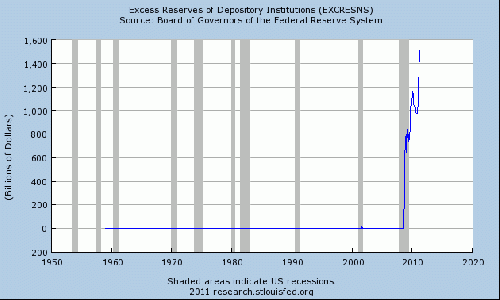
The bank bailout and the Federal Reserve's two "quantitative easing" programs were supposedly intended to keep credit flowing to the local economy; but despite trillions of dollars thrown at Wall Street banks, these programs have succeeded only in producing mountains of "excess reserves" that are now sitting idle in Federal Reserve bank accounts. A stunning $1.6 trillion in excess reserves have accumulated since the collapse of Lehman Brothers on September 15, 2008.
The justification for TARP -- the Trouble Asset Relief Program that subsidized the nation's largest banks -- was that it was necessary to unfreeze credit markets. The contention was that b anks were refusing to lend to each other, cutting them off from the liquidity that was essential to the lending business. But an MIT study reported in September 2010 showed that immediately after the Lehman collapse, the interbank lending markets were actually working. They froze, not when Lehman died, but when the Fed started paying interest on excess reserves in October 2008. According to the study, as summarized in The Daily Bail:
. . . [T]he NY Fed's own data show that interbank lending during the period from September to November did not "freeze," collapse, melt down or anything else. In fact, every single day throughout this period, hundreds of billions were borrowed and paid back. The decline in daily interbank lending came only when the Fed ballooned its balance sheet and started paying interest on excess reserves.
On October 9, 2008, the Fed began paying interest, not just on required bank reserves (amounting to 10% of deposits for larger banks), but on "excess" reserves. Reserve balances immediately shot up, and they have been going up almost vertically ever since.
(Note: You can view every article as one long page if you sign up as an Advocate Member, or higher).
 7
7
 6
6
 4
4






