![]() |
|
|
November 15, 2008 at 07:28:44
Totally New Green Energy Source On a Par With Nuclear Power by bcmarshall Page 1 of 3 page(s) |
|
|
We often hear that solar and wind power are the future of renewable energy, and of course they're important. Important, though, is not enough. We live in a 24/7 society, but neither wind nor solar are 24/7 sources. If you've ever used your computer or turned on a light on a windless night, whether you're aware of it or not, the power is coming from a conventional power plant, fired either by fossil fuels, hydroelectric, or by nuclear power. That's the reality we're facing no matter how much we invest in solar and wind. The technologies simply don't work when the wind and sun are down. While that's obvious to anyone who's ever been outdoors, policymakers and those who have huge amounts of money at stake would prefer that the issue remain unaddressed. You simply can't turn up the sun or wind with demand. They have another problem as well. If you've ever seen a wind farm or a commercial solar system, you know they take huge tracts of land, necessary because the energy source they're tapping is not very dense. At best, it takes a whole lot of real estate to gather enough power to make a difference - assuming, of course, that the source of the needed energy happens to be available at that moment.
Hydrothermal Vents Are the Solution
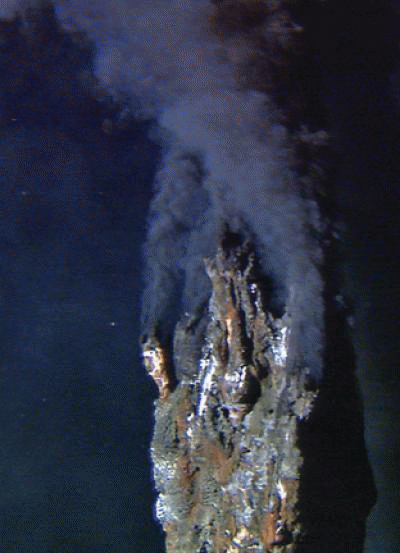
Hydrothermal vents are naturally occurring geysers of superheated water, found along Mid-Ocean Ridges. These are points along the Tectonic Plates, huge tracts of the Earth's crust that move continents around, found where the plates are pulling away from each other. As the crust stretches and weakens, new volcanic crust from the earth's molten core, the magma, rises to create new crust.

Black Smoker Hydrothermal Vent
Although the vents were first confirmed in 1977 and their energy content was immediately apparent, no one had the slightest idea how to utilize this massive energy output. They remained untouched and untouchable at the bottom of a frigid ocean.
Until now.
The Marshall Hydrothermal Recovery System
One night I was watching a National Geographic special on the ocean. Lots of things were discussed, and during a short segment on hydrothermal vents the narrator stated that the energy escaping from just the known vents is about 17 million megawatts, or roughly equivalent to the entire human consumption on the planet.
My first thought was that it was a terrible shame that such abundant energy could not be utilized. Then, as if an invisible hand from a V-8 commercial reached through the screen and slapped me on the forehead, a second thought occurred just a few seconds later which answered the question. Why can't it be used?
In that instant the Marshall Hydrothermal Recovery System was born, a ludicrously simple response to a complex problem. While all previous thought had focused on how to sink a generator to the bottom of the ocean, utilize it effectively and service it, the solution is far simpler.
The Marshall System caps the vent(s) with an insulated pipe, which then ducts the fluid to the surface. A platform similar to that used in oil exploration is stationed above the vent, and the generators are located there, where they're easy to service and access. Undersea cables are then used to bring the power to shore. You can see an animation that completely describes the process here.
From the standpoint of physics, the only thing the fluid is being asked to do is to stay hot and rise. You can't get much simpler than that.
Take action -- click here to contact your local newspaper or congress people:
Support the first new energy source in 60 years
Click here to see the most recent messages sent to congressional reps and local newspapers
http://www.marshallsystem.com
The views expressed in this article are the sole responsibility of the author
and do not necessarily reflect those of this website or its editors.
Contact Author |
Contact Editor |
View Authors' Articles |
|
|
|
|
| 49 comments |
|
Fascinating
This makes sense. I hope you'll keep us informed of your journey, as you present this to government and industry. I suggest you talk to your congressperson, your senators, oil companies. And let us know about your successes and failures. Suggestion: start building license partnerships with companies and nations, for the vents that are within national territories. Lock up the real estate and get the partners motivated to raise the development money. by Rob Kall (953 articles, 4178 quicklinks, 374 diaries, 2087 comments [45 recommended, 3 rejected]) on Saturday, Nov 15, 2008 at 7:37:02 AM
|
|
Reply: Heehee
...you mean like T.Boone Pickens and his water ripp-off plan? by Bia Winter (6 articles, 2 quicklinks, 14 diaries, 760 comments [119 recommended, 0 rejected]) on Saturday, Nov 15, 2008 at 2:21:00 PM
|
|
Reply: Licensing is the answer
I've already been in very deep talks with a major oil company regarding this concept. They flew me to Texas for a conference/videoconference with engineers in several countries, and they ran computer modeling to evaluate the performance of the system. They determined unequivocally that the system works. Surely there are some engineering challenges that must be dealt with, but they decided not to pursue it. I've looked at that decision closely, and the only rationale that makes sense to me is that it was a purely financial decision. They simply can make more money selling oil than they can selling the electricity that would replace it. My objective is to license this technology as broadly as possible worldwide. It makes no sense to create a start-up company, raise funds, hire engineers and personnel, and the like. It's far more reasonable to license it to companies that already have the resources and engineering talent in-house, companies that are positioned to move forward immediately. by bcmarshall (1 articles, 0 quicklinks, 0 diaries, 22 comments) on Saturday, Nov 15, 2008 at 3:27:12 PM
|
|
Ever tried to calculate
the hydraulic resistance of such pipe especially at two- phase? And how can the fluid be directed to the pipe- a special overall manifold? I am not saying that is not possible . But.. people who wanted to go with the generators down- they most likely looked first at what is the price of trying to bring the fluid up... Still, a good perception. I try to develop the way to use the volcanic energy and they can call me crazy too. by Mark Sashine (72 articles, 19 quicklinks, 269 diaries, 4101 comments [131 recommended, 0 rejected]) on Saturday, Nov 15, 2008 at 11:05:09 AM
|
|
Reply: It doesn't matter
The hydraulic resistance is present, but irrelevant. That's because there's no external energy used to overcome that resistance. The heat energy contained in a 3m pipe is approximately 7 gigacalories/second. Hydraulic resistance won't matter one bit. Even if 50% were lost to hydraulic resistance (an absurdly high figure), you'd still have 3.5 gigacalories of absolutely free heat energy. by bcmarshall (1 articles, 0 quicklinks, 0 diaries, 22 comments) on Saturday, Nov 15, 2008 at 3:03:07 PM
|
|
Totally New Green Energy Source On a Par With Nuclear Power
There are many Ways to Produce energy, and this is an excellent suggestion. We do not need to go Nuclear, or Conventional Poluting Oil, and Coal. What we need is the Will, and the Action to get there. Wind and solar have their place. Let's get on with it. by Rolland Miller (1 articles, 0 quicklinks, 0 diaries, 227 comments [78 recommended, 1 rejected]) on Saturday, Nov 15, 2008 at 12:11:04 PM
|
|
Certainly another source better than nuclear or oil.
I would rather see money and effort going to this than simply drilling for more oil. The GHG is still a problem and must be addressed now. The Marshall System certainly does. I would have no problem with the oil, coal, natural gas and nuclear-steam technologies going the way of burning wood or offal for a power source. We need to utilize so much of the free energy being expended around us while we work harder to produce the energy locked into other things. Whether from the thermal vents, the wind, ocean convection and sun light. All waiting to be tapped. Will we save ourselves? I wait to see. by nightgaunt (0 articles, 0 quicklinks, 0 diaries, 449 comments [27 recommended, 0 rejected]) on Saturday, Nov 15, 2008 at 12:57:37 PM
|
|
Geothermal
Energy is being generated by geothermal sources in places all over the world now. If I were in charge of giving out big money it would go to hydrogen. I don't know anything about it, but I have not read of any downsides for it as compared to other energy sources. I have seen large wind farms and have concerns whether they will ever be an popular option because of the cost, size, noise, and impact on the environment. I did see an article on small size nuclear power generating equipment that would fit in something the size of an SUV and generate enough power for 40,000 homes. It would be fully enclosed and buried underground and would last without maintenance for a long time. A company has, from what I understand, working models of it already. Oil is going to be around for a long time. We have the infrastructure to ship, sell, and store it and all that isn't going to disappear over night. Our economy runs on oil. There is plenty of oil here in the US. It is a regulatory nightmare to drill for it then to build refineries to process it. Detroit is going to have to undergo and huge upheaval to make cars that use less fuel. The car companies are losing big money on every small car they make because of high labor and benefits costs. With Congress getting ready to bail the auto companies and the unions out we won't see that situation change for some time. Eventually we will probably be buying all of our cars from China because they will build new computerized factories that we cannot build here that will turn out quality fuel efficient cars at a fraction of the cost of building them here. by Mad Jayhawk (3 articles, 0 quicklinks, 2 diaries, 652 comments [56 recommended, 3 rejected]) on Saturday, Nov 15, 2008 at 1:25:21 PM
|
|
Reply: It's not easy
The thing to remember about hydrogen is that it's an energy-negative fuel. It always takes more energy to extract it from water, natural gas, or another source than can be recovered by burning it. If one chooses to liquefy it, it takes even more energy from an external source. For those reasons alone, hydrogen, while extremely clean, can never completely replace other sources. Also, because the hydrogen atom is so small, it's extremely difficult to contain for storage and transportation. Hydrogen will never be a solution unless it is generated with free energy, like the excess energy from a hydrothermal vent system. In that case, the negative energy component doesn't matter, and it would be useful. However, if electricity from a coal fired plant is used to separate the hydrogen, you're using more than you can recover. No matter what the politicians and enery gurus might tell you, hydrogen is more costly than whatever energy is used to produce it. by bcmarshall (1 articles, 0 quicklinks, 0 diaries, 22 comments) on Saturday, Nov 15, 2008 at 5:32:31 PM
|
|
A stormy future
Just about anything is possible in theory. I was on carriers and when it got rough enough to make a carrier sailor seasick, it was rough. While you can anchor to the bottom, the top will be floating, so even if it has a system designed to stabilize it over the top of the vent, storms at sea might make this idea impractical until someone else develops other materials necessary to hold things together. This isn’t quite as extreme an idea as building a highway between Los Angeles and Honolulu. Don’t laugh, someone actually suggested it. by Dave Kisor (0 articles, 0 quicklinks, 1 diaries, 312 comments [40 recommended, 0 rejected]) on Saturday, Nov 15, 2008 at 2:06:49 PM
|
|
Reply: Existing Technology
I've not proposed anything that exceeds existing technology. I'm relying on the oil platform technology that's currently used in places like the Gulf of Mexico and the North Sea. by bcmarshall (1 articles, 0 quicklinks, 0 diaries, 22 comments) on Saturday, Nov 15, 2008 at 3:13:40 PM
|
|
Reply: risks
Isn't it risky to place these installations at tectonic "ground zero" locations? Earthquakes & volcanism not a problem? Also, it seems to run the risk of all other corporate-controlled centralized energy production systems: lots of profits for the companies while consumers get jerked around like dogs on leashes. by Jim Eldon (0 articles, 0 quicklinks, 0 diaries, 253 comments [15 recommended, 0 rejected]) on Saturday, Nov 15, 2008 at 3:25:09 PM
|
|
Reply: No-fault zones
I can address your question about earthquake fault zones. Hydrothermal vents are a product of the same plate tectonics system that produces earthquakes, but the areas in which they are located are different. Earthquakes are produced when two plates are either colliding with or sliding past each other. The resultant stresses and pressures build until something snaps. That temporarily equalizes pressures on that fault until they build again. Hydrothermal vents are located where the plates are pulling apart from each other. The weakened crust allows magma to flow upward and create new crust, even as old crust is being consumed and returned to the magma at some distant point. Since the plates at that point are neither colliding nor sliding past each other, the zones are relatively earthquake-free. Remember too that humans have learned to co-exosist with geologic forces. We've learned to build freeways and bridges in some of the most earthquake-prone areas of the world. It's an engineering issue, not a reason for disqualification. by bcmarshall (1 articles, 0 quicklinks, 0 diaries, 22 comments) on Saturday, Nov 15, 2008 at 5:48:46 PM
|
|
Reply: address
Engineers without borders I am a member ( under my real name) You address them and I will be the first to do the calculations for free, no matter sceptic or not. by Mark Sashine (72 articles, 19 quicklinks, 269 diaries, 4101 comments [131 recommended, 0 rejected]) on Saturday, Nov 15, 2008 at 4:18:51 PM
|
|
Reply: Thanks
Thanks for the offer, Mike. Please contact me at info@marshallsystem.com and we'll discuss it. by bcmarshall (1 articles, 0 quicklinks, 0 diaries, 22 comments) on Saturday, Nov 15, 2008 at 6:08:20 PM
|
|
This "solution" is an environment disaster.
When you have a system that consistently comes up with solutions that don't work and, more often than not, exacerbate the problems they were meant to solve, the underlying problem is the dysfunctional system. Exactly what part of "sustainability" is it we don't understand? These hydrothermal vents are the foundation of a whole ecosytem, one which we currently know practically nothing about. But what we DO know is that it invariably will be intimately tied in to the earth's biosphere. This "solution" would result in their systematic destruction. Just yet another round of the same madness that has gotten us into the massively unstable and unworkable situtation we are in. Everyone is looking for a quick simple and easy "fix" in exactly the same manner as an addicted gambler looking for the "one last bet" to bail him/her out of his/her self imposed difficulties. What we know would work is conservation and efficiency. This would also create more (and lasting) employment. But, of course, such solutions would threaten established economic interests and our current inability/unwillingness to do that is at the very heart of our problems (just as the core of the addicted gambler's problems is the inability to try to live within his/her means rather than desperately searching for "easy" money. Yes, we need new technologies. But only those that have the potential to work on a sustainable basis without further damage to an already severely threated ecosystem. The oceans are already in very serious trouble as it is. Walt Kelly had it right: "We have met the enemy and he is us!" The way to avoid wasting time on such inherently flawed approaches is to FIRST ask the questions: "Is it potentially sustainable?" and "Would it have serious adverse effects on the environment?" If the answer to either is no, try something else! Read about Biosphere II. Find out just how hard it really is to keep something truly sustainable! M by Jim Barron (0 articles, 0 quicklinks, 0 diaries, 1 comments) on Saturday, Nov 15, 2008 at 2:19:54 PM
|
|
Reply: What's the Alternative?
The environment is an issue I did not address because of space considerations in the article, but certainly it is an issue. I have addressed it in detail on the website, however. http://www.marshallsystem.com/ecology.htm There is no doubt that vents support an amazing ecosystem of creatures found nowhere else on earth. There is also no argument that the Marshall Hydrothermal Recovery System has an environmental impact. The real issue to recognize is that EVERYTHING that mankind has ever done has had some environmental impact. Do you own a car? Well, you're putting pollutants into the air. What about your house? It maybe sits in a former agricultural area, taking up land that might otherwise support animals or people, and causing rain run-off because the land under it can't absorb water. Ever throw a plastic bottle away? Someone will dig it up in 100,000 years and find it in pristine condition. My point is not to pick on you personally. We all impact the environment every single day, and we always will. The real question about hydrothermal vents is a relative one. How much damage do they cause to the environment vs. generating the same amount of power from alternate sources? The first thing to remember about hydrothermal vents is that every one is a temporary structure. They have been opening and closing by nature since the planet began, and when they close every creature dependent upon them for their sustenance dies. Nothing human beings can do will change that. Leave the vents alone, and everything dies. Cap the vent, and everything dies, too. Then, a new vent opens, and life forms spontaneously at the new location. The real issue, therefore, is a relative one. How much environmental degradation occurs from utilizing hydrothermal vents vs. recovering the same amount of energy from another source? Let's take 4 GW as a figure for argument's sake as energy produceable from a vent structure. The creatures dependent on that vent will die. It's a harsh reality, but unavoidable. But if you wanted to get the same 4 GW from coal, it would require building 8 500 MW plants, with all the fuel needed to grade the land and do the construction, plus the damage to the ecosystem whereever the plants are located. Then it requires the mining and transportation of thousands of tons of coal to those plants, and we must deal with the attendant greenhouse gases resulting from their combustion. Or nuclear energy. While nuclear is environmentally clean, emitting no greenhouse gases, there are extremely serious issues of safety and long-term waste storage. While the safety record is fair, a disaster at a nuclear plant is an environmental catastrophe (witness Chernobyl). Imagine if you can some extremely toxic substances produced 10,000 years ago at the dawn of human civilization. Imagine keeping those materials safe and away from others, through all the ensuing millenia, through military conquests, droughts, floods, fires, and changes of civilizations. Then imagine that now, 10,000 years later, it's still toxic as hell...it's just half as toxic as it was when created. That's what we're doing with nuclear power. We have to get the energy from somewhere. Dams, solar plants, and wind farms are not environmentally benign. They all have impact. I will never claim that there is no damage from the utilization of hydrothermal vents. What I believe is that, when compared with the damage that occurs from generating equivalent power from any other source, it is far and away the best trade-off. This is especially true when one realizes that only a very small percentage of vents are even located close enough to populations that need their energy to be considered. The rest will remain untouched and in their natural states forever. by bcmarshall (1 articles, 0 quicklinks, 0 diaries, 22 comments) on Saturday, Nov 15, 2008 at 5:14:13 PM
|
|
HYDROGEN!
(...That's what I thought this article would be about) My husband is working on hydrogen production and its possible adaptations, most of which can be micro instead of Macro-managed. Anyone can build a hydrogen generator on their garage over a weekend or two, at minimal cost, and it can be safely produced, with proper pre-cautionary measures like airlocks and bubblers, from plain water, with a mere 12 volts of electricity (which can be produced any number of ways, as we know), the only bi-product being good clean oxygen. His experiments have already shown a remarkable uptake in energy when small amounts of hydrogen/ oxygen (brown gas) are fed into the carbuerator of an idling roto-tiller -which makes it practically roar! and the air-intake of our wood furnace, which makes it burn twice as hot and clean (eats the carbon/creosote right up!). a neighbor has already adapted this home-made system to his Ford pick-up, getting 50 MPH with that. Many more uses are possible, thinking in terms of adapting this to existing systems, so no total retooling of vehicles, heating systems, etc would be necessary. The information is readily accessible on the web (see Smackboosters.com for instance); the cat is out of the bag! What Detroit needs to do now is make adaptive vehicles. Back in the eighties this was so esoteric, the man who developed it was POISONED on his way to his presentation before top military on how to convert military vehicles to burn water instead of gas. That was Poppy Bush's administration, of course; not something all those Oilmen wanted anyone to hear ! And while Geothermal would take a massive investment and big corporationswould be gloming it up, Hydrogen production can be done ON DEMAND, so, no dangerous storage issues, and no one can corner the market and make huge profits! (Probably why we haven't heard more about it!) It could very well be THE energy answer that everyone can access with a minimal amount of investment, using stuff we already have! by Bia Winter (6 articles, 2 quicklinks, 14 diaries, 760 comments [119 recommended, 0 rejected]) on Saturday, Nov 15, 2008 at 2:43:53 PM
|
|
Reply: OOPs! I meant "IN" their garage!
(sorry!) by Bia Winter (6 articles, 2 quicklinks, 14 diaries, 760 comments [119 recommended, 0 rejected]) on Saturday, Nov 15, 2008 at 2:51:15 PM
|
|
The problem is transmission
T-Boone Pickens realized that he needed help to get the power produced by his wind farms to the national grid. One method is to forego direct connection and instead use the wind energy to produce H2 and O2 from water. Let the O2 go and ship the H2 to places where it can do some good (generators, vehicles, etc.). Your power source is, for all practical purposes, inexhaustible. If properly managed, it could be virtually non-polluting (system would have to be insulated to prevent thermal pollution of shallows, sulphur and other byproducts need to be trapped and bound or used in manufacturing, etc.). The only problem is getting the power from your production plant to the cities on the shoreline hundreds or thousands of miles away. Those "underwater cables" you mention are no easy feat of engineering in themselves, let alone the "mining" of thermal energy from the rifts. Long distance power transmission accounts for most of the innefficiency in our grid today. We lose about two-thirds of the energy we produce at power plants of any kind to the transmission cables that deliver what's left to the users in the cities and suburbs. This will remain a problem until we succeed at making true high-temperature superconducting media for electrical transport. Perhaps you can use the same idea as proposed for wind farms in low-density population sites: use the power to produce H2 and O2 from the water that is all around your plant. Pipe the hydrogen to the shore, and you're in business. Oh, and although this transmission technique would not lose energy over distance, it won't be easy to build either. Good luck! by cosmogenium (0 articles, 1 quicklinks, 0 diaries, 1 comments) on Saturday, Nov 15, 2008 at 3:14:14 PM
|
|
Reply: Alternative Transmission System
I agree with you. When generating such massive amounts of electricity offshore, feeding it into the grid is problematic to say the least. Undersea cables are very expensive and hard to work with, but they are being used today. Go to www.balticcable.com to see the connection between Germany and Sweden under the Baltic Sea. The point is that they exist, right now, and can be utilized immediately. I actually have a second patent which I didn't mention in this article, which concerns a wholly new means of transmitting power from the vents to shore. It could also be used onshore for long-distance power transmission, if desired. The new system utilizes photons instead of electrons as the means of carrying energy. While I may write another article fully describing it, it's sufficient to say that the energy from hydrothermal vent systems can be transmitted by any available technology. Right now, that technology is copper undersea cables, but microwave, light, or any other means that may be developed can also be utilized in the future. The important point to remember is that everything I have proposed is available now. There is no technology that needs to be developed from the ground up involved. With the will and adequate financing, hydrothermal vents could be producing electricity within a few short years. by bcmarshall (1 articles, 0 quicklinks, 0 diaries, 22 comments) on Saturday, Nov 15, 2008 at 6:03:57 PM
|
|
energy with psychopathic humans in the equation
Mr. Marshall, yours is a very interesting and perhaps technically feasible major energy source. Congratulations! It seems success should be yours---and ours, if the feasibility of your sysem maintains, shall we say, under fire. However, out of all the comments here, and all of your solid responses, the most important aspect right now has been, in fact, worded by you: "They simply can make more money selling oil than they can selling the electricity that would replace it." And "They" are in ultimate control...for now at least. Consider war, and peace; "They" make no money on peace, so war will prevail as long as the current psychopatic alpha elites prevail. Solar and wind and all of the newer technologies are allowed to slog to more prevalence because serious profits are being channeled toward "Them", a process that like all legal wrangling, takes heaps of time. I hate to sound negative about this---and certainly don't intend to seem negative about your excellent idea. It's just that humanity is under a dark, dark cloud of elite psychopatholgy that makes truth and justice, reality and science, secondary. RC by Rand Clifford (41 articles, 0 quicklinks, 1 diaries, 13 comments) on Saturday, Nov 15, 2008 at 10:50:39 PM
|
|
Reply: You're Right
Rand, I can't argue with your comment. We are all at the mercy of the moneyed interests that ultimately decide our fates. If those interests decide this is too good and work to suppress it, of course, there's little I can do to counter that. However, I do have one ace up my sleeve, and that is public pressure. I'm on a quest right now to get as much exposure as possible, because ultimately I believe that this will capture the imagination of both the public and private sectors. Perhaps it won't be here in the U.S. where it's applied first. I have no way of predicting that. However, the need for energy is a consummate need, growing exponentially all over the world. Ultimately, if the technology is as logical, reasonable, and do-able as I believe and models and tests have shown it to be, the technology itself will overcome even the resistance of those who can profit more from alternatives. It's a hell of a situation, frankly. I expected people to be beating down my door, but that's not what has happened. Whether this goes the way of Tesla's concept of delivering power through the ether, suppressed and forgotten, or whether it goes the way of his AC motor, universally accepted and used by everyone, remains to be seen. Without trying to sound egotistical, I honestly believe that I have done something that will truly benefit humankind. I've opened wide a door that has never even been cracked before, and created a vehicle for almost limitless energy. It's real, simple, achievable, and worthwhile, but its fate remains in the hands of others. I'm fully aware that it will take hundreds of millions of dollars to implement a system, but I'm also aware that a nuclear power plant in Alberta, Canada is planned for $6.2 billion, and there's no way this could cost that much. All I can do is make my best efforts to get this technology known to the public. Their pressure is the best weapon I have. P.S. If you have any friends in the TV news business, let me know! :) by bcmarshall (1 articles, 0 quicklinks, 0 diaries, 22 comments) on Saturday, Nov 15, 2008 at 11:11:49 PM
|
|
Reply: I have a friend...
who is one of hte head marine biologists at the BOston Aquarium, who does films of National Geographic quality for the aquarium about global warming. I will send her this article and if she so chooses, she may contact you. Thank you for writing this! by Kathryn Smith (110 articles, 2 quicklinks, 43 diaries, 542 comments [23 recommended, 0 rejected]) on Saturday, Nov 15, 2008 at 11:38:46 PM
|
|
Reply: Heat energy
Well, usually I charge 2 cents for my thoughts, but I guess this time I'll let them go for a penny! ;) The heat energy that the vents return to the ocean is certainly a part of the natural cycle. I honestly can't estimate what impact removing that heat from the ocean to use in energy production might have. I can surmise that it will be minimal if not negligible, however. First, you have to appreciate the scale of the Mid-Ocan Ridge system. It's a continuous, massive mountain range that is over 40,000 miles long (50,000 miles if you include non-contiguous segments), which encircles the globe like the seam on a baseball. It is the single largest geological feature on the planet. Although the name Mid-Ocean Ridge is applied, some points are quite close to shore. For example, there are hydrothermal vents just 27 miles off the coast of Hawaii. In other places, it is literally in the middle of the ocean, thousands of miles from the nearest land. By understanding the scale, it is immediately apparent that even if maximum utilization of the technology were made, only a small fraction of the total vents worldwide would ever even be considered for use. I'm just going to make up some numbers for convenience, but let's assume that only 5% of the world's vents are close enough to shore to even be considered, and of those half are rejected for one reason or another. That would leave 2 1/2% of all vents as exploitable, and even if all were used, 97 1/2% of the heat energy formerly emitted into the ocean would remain. These are absolutely fictitious numbers, but I'm using them to make the point that it seems unreasonable to expect any major impact from their utilization. In fairness, I must also say that I'm not in a position to really be able to offer a true estimate. I have invented and patented a vehicle which has the potential of changing the way we think of renewable energy, but I also know that nothing is completely without consequence. I was amazed to find out that dams and hydroelectric power are far more environmentally deleterious than I ever thought possible. http://www.truthout.org/article/hydropower-doesnt-count-clean-energy Again it goes back to the case I made earlier. We have to assume that some damage to the environment will be caused by tapping the vents. The question then becomes a relative one. We need, and will get energy from somewhere. Ultimately it boils down to whether the energy from vents is cleaner and less-damaging overall than obtaining the same energy from other sources. And that returns to my core belief that in fact, this is far less consequential than anything else I've ever seen or heard of. I'd just like to state for the record that I personally have a very strong environmental conscience, and that I care about the health of the planet and about trying to do something to slow or stop Global Warming. I honestly don't like the fact that some incredible animals and organisms that populate vent ecosystems will perish because of these systems, and I wish there were some way that could be avoided. I've suggested transplanting samples of each unique life form to another nearby vent system, but that's not a perfect solution either. I can only present what I believe is a reasonable and rational argument (with which certainly some will disagree). A part of that argument is that these vent systems will naturally close whether humans utilize them or not, and every single creature will die regardless of what we do, as they have for millions or billions of years. The other part is to stress that we must get energy from somewhere. That much surely must be universally agreed upon. Even if no one used a milliwatt more than they're currently using, world population growth alone requires a huge increase in energy production just to break even, and that doesn't include major developing markets like India and China. We know that oil companies and oil producing countries are making incredible sums of money by keeping us as hostages. And we also know that even if we do nothing, we'll still have to do something because eventually even the oil supplies will run out. I'll be the first to admit that the system is not perfect, but then again, nothing is. Everything mankind has ever done has drawbacks. On the other hand, I've looked closely at the relative practicality of this system, and I'm convinced that, imperfect as it is, it is far and away the best choice of those we have available. They say talk is cheap. You sure got a lot of words for your penny! :) by bcmarshall (1 articles, 0 quicklinks, 0 diaries, 22 comments) on Sunday, Nov 16, 2008 at 12:44:36 AM
|
|
Reply: If it's money you need...
..and you can get the people behind you, like Obama did, you can start asking for donations.(He ran his entire campaign on public donations and had some left over after.) It is possible. People all over the world are cncerned about the impact we have had on our Earth and their concerns are growing. If you can convince them that this is the way to go you may be able to get them to start donating enough money to get the ball rolling. Who says you need to have the existing mogels build this for you. With so many more honest and intelligent organizations out there and the will of the people behind you, surely this idea will take off like a rocket. I know I would donate what little I could, but some is better than none and its a start in the right direction. With the election of our first black President it has become apparent that people are ready for change and willing to do what no one thought possible a few years ago. We need change and you are offering the kind of change we need. You have a great idea here and the more people hear about it the better it will be. But, for now it looks like you will be on your own. Just do me a favor and build the first platform close to my house so I can take advantage of the energy you start producing. I have faith in your idea. by Ginger McClemons (17 articles, 1 quicklinks, 12 diaries, 101 comments [25 recommended, 0 rejected]) on Sunday, Nov 16, 2008 at 2:20:57 PM
|
|
Reply: Thanks!
Ginger, I appreciate your offer more than you know. Who doesn't need money? Currently my main concern is not financial help, but help in getting the system known to the rest of the world. I can always go public and raise huge amounts of capital with a stock offering, but that's not my desire. Any efforts any of you can make that will enhance the visibility of this project will also enhance the probability that it will be built. I have tried, and will continue to try to move this forward through my own efforts, but I really think a coordinated group of passionate people will be the most effective means of getting the attention that's going to be required for this to be actively considered. Thanks again. by bcmarshall (1 articles, 0 quicklinks, 0 diaries, 22 comments) on Monday, Nov 17, 2008 at 1:07:57 PM
|
|
Great technology
Mr. Marshall, Kudos for detailing this wonderful technology. I fervently wish for your success! Regarding who would back it / go with it: In the U.S., you would have to convince the power utility conglomerates.... Who do ALL the power generation here. But you have a huge problem there: As long as nuclear fission power is looked upon as "viable"... That is all they want to hear about under the current paradigms. This is because they can make much more money from building nuclear plants that is readily apparent. First, they get the state public utility commissions to allow them to force the CONSUMER to bankroll the building cost (...as they did in the 1970's). Second, they can take advantage of several tax, outright grant, and other loop holes that makes the nuclear alternative more attractive... Imagine how much money they can make in interest alone, when they self-finance a 3.5 billion dollar nuclear plant by having their Customers pay for it through much higher rates. These people even make Billions off of storing their own nuclear waste; at tax-payer expense! After all, "regular" (land-based) Geo-Thermal has been known about for quite some time, and has many of the advantages of which you speak; but they resist moving towards it.... It is not as profitable as nuclear because of the above "perqs". And the cost of off-shore drilling is certainly higher than on land (although the sea bottom thermal vents are much hotter and therefor would likely produce dozens of times more energy per site than "traditional" drill geo-thermal). I believe the route to go would be the governments (...and not necessarily OUR government, which is deeply in the energy corp's pocket). Convince another country to get behind this, build test platforms, and there should be a good chance of success. The U.S. energy /oil and power utility corps WILL NOT embrace this technology until they are FORCED to.... By government ending the free pay-day they get for nuclear, and by making other alternatives such as this just as attractive. One other thing that comes to mind: Unless you use an inner loop of water and heat exchanger for the actual steam pipes; you will need to use VERY corrosion-resistant coatings on all your pipes and pumping equipment (perhaps advanced ceramics). That thermal vent water has to be the most naturally caustic, and corrosive, found on Earth. by Steve Windisch (jibbguy) (17 articles, 0 quicklinks, 4 diaries, 361 comments [54 recommended, 0 rejected]) on Sunday, Nov 16, 2008 at 9:20:19 AM
|
|
Reply: Can't disagree
Steve, I think you've hit the nail on the head. I am absolutely certain that this system will do what I have stated that it will do, and that the payoff in energy will be tremendous. There's no doubt in my mind that the technology will work, but I'm also starting to recognize that this is not going to be widely embraced as rapidly as I had initially hoped. There's a tough slog ahead, and the scenario you laid out seems quite accurate to me. I'm aware of the corrosive nature of the fluid, and it is an engineering problem that is being successfully dealt with in geothermal systems. If one wants to recover the mineral wealth of the earth and desalinate water, then it must be addressed. The closed-loop design is also a part of the patent and allows for a much simpler system which avoids those problems, but the minerals and water are not a natural by-product the way they are in the open pipe design. The options are available, and system operators will make the ultimate decision as to which they prefer. I'm making every effort to get foreign governments and corporations to move forward with this. I have tracking statistics on my website that show visitors from every corner of the globe. While of course I don't know if those visitors are just interested members of the public or well-connected officials, I do know that the system is becoming more and more widely known daily. That in itself is the biggest challenge. People can't be expected to embrace something if they don't know it exists. Try to imagine yourself in my shoes. You've invented something revolutionary, literally capable of changing the way the world generates its power. Now what do you do? Those who have read the article and these comments can help if they truly believe in the astonishing promise of hydrothermal power generation the way I do, and if they want to do what they can to assure that it is implemented. Contact your representatives in whichever country you might reside. Send letters to the editor of newspapers. Contact local, national, and international media outlets. Write to television stations and producers, or hosts of talk shows. Make sure that any corporate contacts you may have in the energy world know about it. You have identified exactly what I'm up against, and it doesn't take a rocket scientist to recognize that the odds are not in my favor. While you and I might consider saving the planet as a high priority, those whose hands control the direction of the ship may not think the same way. They do have different priorities. There seems to be a parallel in politics to what I'm doing. Barack Obama was an unlikely candidate. He had strong ideas, and even though he was sailing against the headwinds of the corporate and institutionally entrenched interests, he won. He didn't do it on his own, however. He created a small army of volunteers that were willing to work and participate because they believed in him. He built his strength through thousands of individual efforts, all of which collectively created the platform from which he was able to achieve his goals. I'm in this for the long haul. I've unlocked the first completely new and untapped source of power since the dawn of the nuclear age more than 60 years ago. It will make a real difference to everything and everyone, from the consumer who turns on a light to governments dealing with balance of trade defecits, but it's going to be a tough fight. I'll need and be grateful for every bit of help I can get. by bcmarshall (1 articles, 0 quicklinks, 0 diaries, 22 comments) on Sunday, Nov 16, 2008 at 11:35:09 AM
|
|
Reply: Nuclear is the only way to go now
I think the solution is nuclear. It's 24/7 and in the *long run* it's cheaper than anything else. Plants are paid off in 20-30 years but they can run for more than 60 years. The 'dangerous' spent nuclear fuel, ALL OF IT, that we have ever produced in commerical plants going back 50 years wouldn't fill up a Sams Club store. It's totally managable and that doesn't include recycling it to reduce it's volume. It's also never killed anyone outside of the once-in-thousand-years Chernobyl accident (and they don't build those kind of plants anymore). We could elimnate coal production in 20 years by building less than 300 nuclear power plants, and we should. Most opposition to nuclear comes out of fear of the unknown...the more people learn about how nuclear works, the less opposition there is to it. I love geothermal but it is NOT available everywhere. It's only really available where the magma is close the surface...you have to ask WHY there is not more geothermal energy produced? Why? Because it's a huge gamble to *assume* that if you drill deep enough (for lots of money) and pump in millions of gallons of fresh water (where to get the water?) than you would be able to build up enough pressure to actually run a turbine (and then use MORE fresh water to cool that turbine). David Walters by David Walters (0 articles, 0 quicklinks, 0 diaries, 2 comments) on Sunday, Nov 16, 2008 at 1:15:22 PM
|
|
Reply: Nuclear v. Hydrothermal
David, I'm fully aware of the arguments you presented. Nuclear is most definitely a proven technology, but the waste issues have yet to be resolved. We have tons of dangerous waste in barrels around Hanford and other plants all across the country, unsecured, with no place to put them. To my knowledge there is still no universally accepted method of long-term storage. Surely you'll agree that nuclear power is not natural, renewable energy. Hydrothermal vents are. There's nothing to store, no waste to dispose of, no fuel to transport or mine or process, and absolutely zero potential for a meltdown/explosion/fire or other things that could potentially befall a nuclear plant. Hydrothermal power is also far less expensive than nuclear. I stated earlier that others would certainly disagree with my assessments. I can only agree with the idea that nuclear energy is clean if the only consideration is greenhouse gases. There are many issues with nuclear power that are not even under consideration with hydrothermal. by bcmarshall (1 articles, 0 quicklinks, 0 diaries, 22 comments) on Sunday, Nov 16, 2008 at 3:23:53 PM
|
|
Reply: One more thing
I just wanted to add that there is no such thing as a "dry hole" with hydrothermal as there might be with geothermal. You can actually see the vent, so there's no question that it's there. by bcmarshall (1 articles, 0 quicklinks, 0 diaries, 22 comments) on Sunday, Nov 16, 2008 at 3:42:29 PM
|
|
Reply: YES
This sounds exciting--I'm onboard. As for the nuclear argument: Nuclear energy to boil water? How progressively neanderthal is that? We've got boiling water already coming out of the earth 24-7, for crissake! The construction of nuclear plants (speaking as a union carpenter who might benefit from such extravagances) is enormously wasteful and expensive. And dangerous. Deaths at nuclear plants among workers are high--around 600-1000 a year by my investigations. And there are a lot more considerations than the simplistic model presented in these letters. Women who live in the proximity of nuclear plants are shown to have a higher incidence of breast cancer. The potential danger alone from a possible nuclear mishap involves life and property on a scale that is indeterminable, but massive, in terms of area and duration. Little 'mistakes' are magnified exponentially when you're dealing with the most persistently toxic poison known to man. And to shrug off the fact that there is no safe place for it or way to dispose of it (other than declaring war on middle-eastern countries in order to transport it in very expensive missiles) should close the case to any reasonable human. It is not worth it! Hey, but that's just me... by Randje Mitchell (0 articles, 0 quicklinks, 0 diaries, 77 comments) on Sunday, Nov 16, 2008 at 5:54:09 PM
|
|
Great joy and still some concern:
Hello BC Marshall I want to say that what you have thought of here really is brilliant and I am on board with you! I think this is an exciting solution. And it has some problems as we have already discussed ("we" meaning all of us collectively here). I want to respond to something you have been reiterating: You said that the geothermal vents are plentiful and that we would be tapping a (projected/estimated) small percentage of them, only 2 or 3 percent in your best guess. And that therefore, we would'nt be causing an oceanic cold spell in so doing. May I suggest that it's not about the percentages of vents we tap into, but about the percentage we draw from each one. If we want to protect the environment, we need to think about how we might be (and would be) impacting the immediate surroundings of the areas we tap. That said, trusting your own best wishes and those of everybody posting here, who is to trust the best wishes on the part of the corporations? Nobody, of course, and rightfully so. The corporations will mine and rake an area clean and leave it to decay or freeze or do whatever it will, if only they have their profits and in good earnest, too. I am concerned that if we use the heat from these underwater vents, that we could be impacting the oceanic temperatures, which could spell disaster. Then there's also the question of what percentage of the rich source of minerals we might be harvesting from each underwater source. It does sound quite exciting but again it sounds like, given corporate profiteering, it also could wreak havoc. Surely we don't want the coral and fish to die for lack of water nutrients, which we so greedily have robbed them of? And whatever happens to the oceans, to the environment itself, surely will come back to haunt us in some way or other. It's time for those who do not think this way (which is not anybody here on this forum, of course) to start to take ONE word of advice: "THINK". Penny for your thoughts here? SOlutions? Thanks so much! I think ultimately the real solutions to our environmental problems will come not from any one source, but from a combination of them. Such a combination will protect the environment. The problem is, the corporations will hear nothing of limits to their bottom line. THis poses a practical problem to the solution which, after all, concerns the even bigger bottom line: Survival. Oops..... by Kathryn Smith (110 articles, 2 quicklinks, 43 diaries, 542 comments [23 recommended, 0 rejected]) on Monday, Nov 17, 2008 at 12:18:00 AM
|
|
Reply: It's Scary
You are right. Suppose the Marshall scheme is wildly successful and also profitable. As with the resource of oil, it will be exploited to the point of diminishing returns, and in very short time on a geological scale. But think about this: The vents have been part of the Earth's ecosystem for eons. We don't, yet, completely understand the complex interactions of the oceanic energy and mineral sources and how they have been affecting climate and sea life for perhaps hundreds of millions of years. You will, I think, agree that Marshall will have to show all the calculations before interrupting and perturbing what might just turn out to be a delicately balanced non-linear system. What are the odds he can perform the calculations? Or that he will even admit they are relevant? Can he address the long-term risk? As a physicist I consider the scheme to be a slow suicide of the planet. by nachamkin (0 articles, 0 quicklinks, 0 diaries, 6 comments) on Monday, Nov 17, 2008 at 1:02:48 AM
|
|
Reply: Planet killer?
I assure you that I am not into the destruction of the Earth, and I resent your implication that I wouldn't even find such things to be relevant. Although some may believe me to be from outer space, I assure you I reside on the same planet you do. My patent was based on several things. You've identified yourself as a physicist, and you prefaced your remarks by supposing that the system became "wildly successful", so it seems pretty clear to me that you find nothing in the physical realm to stop it from working. Many other physicists and scientists have evaluated it and have arrived at the same conclusion. This is a practical, do-able system. Look around you. We have an insatiable demand for more and more energy, not just here in the U.S., but everywhere, and that need is growing exponentially. Everyone understands that oil is not the answer, and so rather than looking at conventional solutions people worldwide are looking to alternatives, trying to come up with new and novel uses for the same basic power sources that humankind has always used. Those are solar, wind, geothermal, wave action, and of course, burning something. Nuclear power was the only other totally new source of power that has been created. Hydrothermal energy is revolutionary. No one has ever before conceived of a practical way to utilize those vents and harness their enormous energy content. I had limited resources available to secure a patent and to do all the associated things that had to be done to move the project to the stage that it is now. I can not hire a staff composed of engineers, physicists, geologists, biologists, and all the other disciplines that might have an interest or a stake in this. I had to either move forward with a patent on the energy aspect, or drop it into a drawer and forget about it. I have done my honest best to evaluate the environmental consequences of this and have come to the personal conclusion that they are less costly than generating the same amount of power than by any other means that I'm aware of. There are questions to be resolved and studies that need to be done. You'll get no argument from me. I repeat my earlier contentions. Nothing mankind has ever done has been environmentally benign. While everything has some impact, certainly some things are more potentially consequential than others. Greenhouse gases are warming the planet, and are also warming the ocean. Perhaps by removing some of the heat the vents contribute we could actually slow the warming effect. Perhaps the effect is negligible. I don't know, and neither do you, but for you to already characterize this system as suicide for the planet is an obvious preconceived conclusion based on opinion and not fact. I have tried to explain the extent of the Mid-Ocean Ridge system, and have shown that the vast majority of vents are too far from land to be practical, so even in that "wild success" you allude to we're still talking only a tiny fraction of the total vent output. I won't state that there are no consequences to even that small fraction, but I sure as hell won't jump off the deep end, waving my arms like Chicken Little and calling it "suicide", either. Everything needs to be looked at, including the comparison between the environmental costs of this system vs. the costs of alternate means of generating the same power. We need more energy and we need it fast. I suspect you'll be the first one to complain when the rolling blackout hits your neighborhood. by bcmarshall (1 articles, 0 quicklinks, 0 diaries, 22 comments) on Monday, Nov 17, 2008 at 12:37:29 PM
|
|
Reply: Good points
Thanks, Kathryn. You made some excellent points. I have thought about a design change for the vent cap that would allow a regulated percentage of the vent flow to escape into the ocean surrounding the vent. It would be designed so that the hot water would spread horizontally instead of directly vertically as the vents do naturally. By making more efficient use of the heat, a reduced volume of water could potentially heat a larger area near the ocean floor, which might allow the vent community surrounding it to survive. It's a thought worthy of exploration. The nutrient question is ia very good one, and I don't have an answer. I will try to find someone that can answer it, but for now I can't provide any guidance at all. by bcmarshall (1 articles, 0 quicklinks, 0 diaries, 22 comments) on Monday, Nov 17, 2008 at 1:11:00 AM
|
|
Reply: Thanks! Comment:
Hello Friend I also would have a concern about mercury content within the mix of wonderfully enriching minerals that spew up from the geological vents. Mercury has been identified by toxicologists to be one of the most toxic substances of the planet (and here we go putting it into our very own mouths, duh!) and one researcher who has studied 65,000 patients world-wide plus tested on animals and consenting adults for 35 years, has (based on this vast amount of research/database) unquestionably traced it to auto-immune attack (cancer, lupus, multiple sclerosis, etc) it's only a matter of time before the mainstream medical establishment stops being the naysayer and frankly they do so not only out of profiteering motives, but also at their own risk. Duh! More poignantly here, I want to reiterate that it's the impact to the local area which we need to be concerned about, not merely to the oceanic environment sum total. If we vacuum up a local area and cause a freeze and rob oceanic life of essential nutrients required to sustain life and nervous system health, then we will also be impacting our own selves. To monitor the amount of clean-up from each area would be key. And again my concern here is that the corporations will never hear of that, let alone follow the instructions. LOtsa luck! FYI I did email my friend who is one of the head marine biologists at the Boston Aquarium, and will await her response. I've asked if she might be interested to get on board in publicizing this cause. We'll see what she has to say about it and what her insights are to the problems discussed here. by Kathryn Smith (110 articles, 2 quicklinks, 43 diaries, 542 comments [23 recommended, 0 rejected]) on Monday, Nov 17, 2008 at 7:51:36 AM
|
|
Reply: Trying to answer
I'm not trying to dominate the discussion here, but I am trying to answer as best I can comments that contain questions. Regarding mercury, I'm sure it's abundant in the vents although I haven't seen it specifically mentioned in vent analyses. But if it's abundant, it will be abundant whether or not we utilize them. If the mercury is being produced, it is being spewed into the ocean and no human hand can stop that. by bcmarshall (1 articles, 0 quicklinks, 0 diaries, 22 comments) on Monday, Nov 17, 2008 at 1:54:24 PM
|
|
"Regulated percentage from heat vent flowing to surroundings
I suggest it needs to be just the other way around. That is, a regulated percentage flows to the platform/generator/cables used for human consumption. If we use more than just a small percentage, there is no doubt that we *will* be impacting the environment. by Kathryn Smith (110 articles, 2 quicklinks, 43 diaries, 542 comments [23 recommended, 0 rejected]) on Monday, Nov 17, 2008 at 8:02:15 AM
|
|
Reply: Imagine....
if the fish begin to die off and the fishing industry ceases. Imagine....as fish die off, then the larger ones dependent on them for their survival also die off. Imagine...the bacterial contamination to the ocean and the waters fed by the ocean, as all the fish die off. Imagine...people thinking this could not and would not happen, imagining the resources to be endless (just as we have done with our atmosphere and in so doing, accomplished what would have been thought to be absolutely impossible: Punched a hole into our ozone layer and caused climate change world-wide). I may be giving (possibly? Possibly not???) exaggerated scenarios here. Even if they do turn out to be exaggerated (and they also may not be), then the exaggeration itself still illustrates a point. And the point MUST be heard if we humans want to survive. I say this not to you Marshall, but to the Industries At Large. by Kathryn Smith (110 articles, 2 quicklinks, 43 diaries, 542 comments [23 recommended, 0 rejected]) on Monday, Nov 17, 2008 at 8:12:29 AM
|
|
Reply: Imagine...or nighmares?
Kathryn, we've gotta look at all sides of this. If the scenarios you paint were in fact the expectations, I'd be the first to say that it shouldn't be built. I'm trying to help humankind here, not destroy it. by bcmarshall (1 articles, 0 quicklinks, 0 diaries, 22 comments) on Monday, Nov 17, 2008 at 12:42:18 PM
|
|
Reply: Regulated Vent Flow
We have to appreciate that the purpose of these systems is to recover energy. Otherwise, no one would build them. Therefore, it must be assumed that any system operator is primarily concerned with the output of the plant. Vents naturally exhaust straight up, and while there is certainly some water that is quite hot nearer the ocean floor, the majority of the heat energy is directed away from the floor. If a regulated proportion of flow were actually directed downward toward the ocean floor, then it's conceivable that the heating of the immediately surrounding area could be made more efficient, enhancing the possibility of vent survival even though the majority of the flow would be directed upward. by bcmarshall (1 articles, 0 quicklinks, 0 diaries, 22 comments) on Monday, Nov 17, 2008 at 12:01:35 PM
|
|
The difference is in alternatives
A nuclear plant (of which there are several on the shores of the Great Lakes in operation now) that went out of control would ENTIRELY RUIN the ecology of the entire Great Lakes downstream from it... Not to mention irradiating millions of families in Canada and the U.S. Just one plant melt-down on the Atlantic Seaboard would kill more fish and wildlife than 30 super-tanker oil spills... And the long-term dangers would last thousands of time longer. This is what we are looking at: Stopping them from building more nuclear plants. So any alternatives are MORE than viable, they are desperately needed right now before the next wave of plants are approved.... Remember McCain's long-term energy policy?? Essentially this: More nuclear plants. He didn't think of that himself lol..... That is "their" plan. It has to be stopped... And one great way to do it is to point out MUCH SAFER, cheaper, and economical alternatives such as this one. I am willing to bet that 3 or 4 of these Hydrothermal mega-platforms could be built for the cost of ONE nuclear plant. Whatever impacts these sites may have, they are THOUSANDS of times less than what could happen in a nuclear plant disaster... Nearly all the nuc's are built near large bodies of water (needed for their cooling). Nuclear fission is like children playing with matches: Something VERY BAD is going to happen, somewhere, sometime... If not from Homer Simpson dropping a donut into the rod control assy, but because they are also prime targets for terrorism. The amount of global ocean temperature change from one of these sites would be astronomically low. You are talking about affecting about .000001% of the volume, in a medium that is the best heat sink available anywhere. It might take thousands of such plants operating for hundreds of years to affect the ocean temp by 1 degree... Meanwhile global warming will have eclipsed this heat loss by dozens of times IN THE OTHER DIRECTION. We have to get energy from somewhere. I believe that eventually new "Free Energy" technologies will do this (such as cheap highly efficient "HHO" Hydroxy production from water using much less energy than it creates, magnetic motors, energy from Plasma and cold fusion), but these are being strongly resisted by both academia who refuse to study them, the military who try to horde it for themselves, and by the energy cartels who don't want to lose their hold on us.... Free Energy will likely continue to be totally ignored for many years yet. Therefor these types of "acceptable" solutions such as Hydrothermal or Geothermal that sneak in under the wire because the technology is not in anyway controversial, are our best hope to get away from the twin terrors of control of the populace via energy scarcity, and the primacy of oil and coal as the means to allow a secret tax via monopoly and price fixing... A tax higher than any ever leveed by any government... That will never stop until WE stop it. Energy should be cheap, clean, and abundant.... It is not now only because those who hold the power of energy over us don't want to lose that power. by Steve Windisch (jibbguy) (17 articles, 0 quicklinks, 4 diaries, 361 comments [54 recommended, 0 rejected]) on Monday, Nov 17, 2008 at 11:24:53 AM
|
|
Marshall, your commitment to humankind's good is very clear
Please know that. I understand that very well, and am sure most readers here would do so too. I admire your impartiality and frankly the utter brilliance of this idea, as well as the thoroughness with which you consider alternatives for implementing it. Bravo!! The mainstream "health" industry has been notorious for hiding the truth about mercury. SOme (if not many) physicians simply don't know the truth, but others are also complicit in covering up the facts, including from the medical schools' training programs. When mercury-containing dental fillings first came into existence, there was an enormous uproar and dentistry became divided into two camps: Those who had special interests and wanted to make money from it, and those who were against it. Alas, the special interests won, and they continue to govern today. So....anybody who tells you this is voodoo or anything else either has not read the studies or is covering up the truth. "First, do no harm". I bring this to your attention because doubtlessly this would be coming up, and in good earnest too. For more info based on 35 years of clinical testing, following up the progress of 65,000 patients world-wide (that figure was as of three years ago, and has doubtlessly increased since then) and double-blind studies plus experiments for 35 years on laboratory animals, see what the mercury connection has to do with human health here: The reason, FYI, that this man had his dentistry license pulled was, as per the judge's pronouncement, because he "Refused to put mercury into peoples' mouths". Considering that (after his post-doctoral work as toxicologist/immunologist) he has unquestionably linked mercury with cancer, Multiple Sclerosis and other serious auto-immune conditions that is is really "good reason" to put him on Quackwatch, eh? Seems to me in calling those against mercury poisoning "the quacks", that we may be questioning all the wrong people. by Kathryn Smith (110 articles, 2 quicklinks, 43 diaries, 542 comments [23 recommended, 0 rejected]) on Monday, Nov 17, 2008 at 3:47:05 PM
|
|
Funding source
The Foundation Center is a database of grantors in every category, funding projects from national to international. The intake question on the grants-to-individuals series is: "What size grant are you looking for: Under $5,000 or over 500,000?" I successfully have applied for and received three out of the four grants I have applied for. I also know that they grant for building projects, ie that some grantors donate in the six and seven-figure categories. I don't know if there is any one grantor who would fund a project of the enormity which you are proposing,but perhaps a combination of grants could get you rolling with the first test to this system you are proposing. From there, once proven, perhaps mainstream utilities would invest. After all, it's to their best interest to have alternative energy sources at their fingertips. Pacific Gas And Electric (PG+E) has already invested in solar and wind power and is going green, has printed a book for consumers to go green themselves, and might be really into this. Check them out. by Kathryn Smith (110 articles, 2 quicklinks, 43 diaries, 542 comments [23 recommended, 0 rejected]) on Monday, Nov 17, 2008 at 4:07:08 PM
|
|
Good Idea, Almost Missed
Your proposal could indeed be beneficial, but I think our times dictate welcoming and implementing every good, clean idea. That said, your absurd and quickly inserted argument against solar and wind energy almost kept me from reading and seriously considering the rest of your article. At that moment I thought you must be some kind of nut. Never fear though, I did read on. For you to effectively make your point, I don't think it's necessary or wise to confuse people by dismissing or deriding the potential power of wind and sun, both of which certainly ARE available 24/7. I'm sure you know we needn't see or feel either to collectively harness their power, any more than we need to see or feel hydro-electric turbines, nuclear reactors, coal fires - or indeed geothermal vents - to benefit from their hourly/daily presence. I'm truly glad I read on, because I think ideas like yours have great merit. In the article itself and the comment thread that follows it, you've shown you're not only sane, but realistic ...and maybe even nobly moved. Clearly, you've already been well considering your proposals' greatest hurdles. Aside from the monumental effort it would take to safely and reliably transmit this much power to the grid, my knee-jerk reactions were to consider the potential environmental impact, then the occupational safety issues nobody seems to have much mentioned, and finally the investment and power lost if the collection station is wrecked or the vent unexpectedly closes. I think a heat exchanger positioned above the vent (apparently suggested as the aforementioned closed loop idea?) would be far easier and in many ways better than the capping and collection described, because... ...it'd lessen climatic impact by not capturing as much of the vent's thermal energy. ...it'd minimize biological impact by not capturing the vent's minerals or altering the ocean's chemistry. ...it'd preclude seismic impact by not restricting the vent's release of heat and pressure. ...it'd almost certainly be less susceptible to storm damage. ...it'd be far more portable (if the vent it's positioned over suddenly closes.) ...it'd use safer steam pressures and temperatures. ...it'd make deep dives less required/more elective. ...it'd spare platform workers exposure to known and perhaps undiscovered toxins, and perhaps uncontrollable steam temperature and pressure spikes. Of course, these are merely thoughtful points I hope you and everyone involved will be considering. What's most important though, is not miring ourselves in a debate over ultimate perfection, prematurely shelving one greener idea, technique or energy source in favor of another. I think we need to pull out all the green stops, investing, manufacturing, building and buying green, diversely and carefully - while allowing for the fact that we'll make mistakes here and there. To me it seems safe to say that even our eventual failures will have benefited us far more than the "successes" we're looking to replace. by Donald Rankin III (2 articles, 0 quicklinks, 3 diaries, 60 comments [4 recommended, 0 rejected]) on Tuesday, Nov 18, 2008 at 3:13:25 PM
|
|
Reply: Right on!
Donald, thanks for your thoughtful input. Solar is a perfect adjunct to conventional sources because the time we consume the most power is when the sun is at its hottest and brightest, and it's also when the solar panels are most efficient. What a perfect marriage! On the other hand, I'm sure you'll agree that solar panel output after dark is virtually zero. (I'm referring only to solar PV here.) I also recognize the timeless simplicity and elegance, as well as the proven efficiency of the wind, and would be foolish to pretend that it isn't destined to be a huge player in alternative energy. My point is still that neither the wind nor the sun are constantly available 24/7. That means that some supply dependent on neither must be available to carry the base load when it exceeds alternative outputs. Hyrothermal is the only renewable source I'm aware of that is constant. Because the vents are powered by the weight of the water above, only a radical change in the level of the sea by several hundred or more feet would likely impact them. Otherwise, water is constantly forced into cracks, and constantly returned without any variation or interruption. The closed loop system I refer to does in fact use a heat exchanger, recirculating a clean working fluid to be heated and cooled much the way an automobile's cooling system works. I absolutely agree with your assessments. The closed loop system is far less likely to impact the environment, and completely eliminates any concerns about the corrosive nature of vent fluids or gases or other materials they may contain. If I were going to bet, I'd put my money on the closed-loop configuration as the first one that eventually will be built. As the technology becomes better known and more widely accepted, others surely will see the riches of the vents as far too useful to leave behind. One only has to look at the effects on the land of surface copper mining, for example, to appreciate that there are environmental advantages to the open loop system as well. There are many engineering challenges ahead to make this system a practical reality, and I have made no effort to resolve them. I have created a vehicle that allows the vents to be used, offering the basic plan that kicks open the door to every other use that may follow. System implementers will certainly address and resolve those challenges as they come up. The problem I mentioned earlier is by far and away the most pressing problem that is likely to cause this system to remain unused, merely a topic of conversation to contributors to these postings who will be wondering twenty years from now whatever happened to the Marshall Hydrothermal Recovery System. I'm up against incredible odds from both entrenched interests that don't want the status quo to change, and from the more newly entrenched interests of the most commonly accepted "green" technologies of solar, wind, geothermal, and ocean wave power. This chips into their rice bowls as well, frankly, and even they have a vested interest in not seeing it built because it could lure funding and support from their ventures. Without public knowledge and discussion of hydrothermal vents as an energy source, this will die. That's why I asked earlier for support from anyone who believes that this system deserves to be a part of the discussion. Unless hydrothermal is included along with the other technologies in arguments made in board rooms, legislative committees and environmental and community groups there is no chance of it ever being implemented. The reality is as grim and bleak as that of one of the tubeworms relying on a vent. It's not encouraging, but it is true. I have created a group at Google Groups for specifically this purpose. It's a site for people who see the promise that hydrothermal vents offer, and are willing to network and brainstorm with me and other members to try to raise its visibility. All interested are welcome to join, by simply sending a blank email to marshallsystem+subscribe@googlegroups.com, and then replying to the autoresponse. I'm not looking for donations. I'm looking for a group of people willing to do little things which collectively add up to very large things, far more than I could do individually. Whether it's writing a letter to or calling a legislator, editor, TV producer, or CEO, or whether it's coming up with ideas and suggestions that can be looked into, or making a suggestion that someone else knows how to implement, I simply need any effort anyone is willing to contribute, and I will be grateful for it. If you believe that hydrothermal at the very least deserves a seat at the same table with the other technologies, I encourage you to join and help in whatever way you feel comfortable with. Have you ever puzzled over a problem and had someone else come up and say, "why don't you do this"? Then you follow by musing about "why didn't I think of that?" That kind of idea contribution alone, with no other effort of any kind, will be critical in breaking the logjam that's keeping this relatively quiet, and is one of the things I'm hoping to accomplish with the group. by bcmarshall (1 articles, 0 quicklinks, 0 diaries, 22 comments) on Tuesday, Nov 18, 2008 at 8:23:03 PM
|
|
Title
by Bob Stuart (1 articles, 0 quicklinks, 0 diaries, 5 comments [1 recommended, 0 rejected]) on Saturday, Nov 22, 2008 at 8:29:35 AM
|
Want to post your own comment on this Article?
|
||||
|
|
|
|
|
|
|
|
Tell a Friend:
|
Copyright © 2002-2009, OpEdNews |