

Tag(s): ; ; ; ; ; ; ; ; ; ; (more...) ; , Add Tags  (less...)
Add to My Group(s)

Must Read 1   View Ratings | Rate It

Promoted to Headline (H4) on 7/18/10:     Permalink
View Article Stats      (3 comments)

The Global Digital Landscape

Add this Page to Facebook!
Submit to Twitter
Submit to Reddit
Submit to Stumble Upon

Tell A Friend

Become a Fan
Get Embed HTML Code
By (about the author)

Become a Fan Become a Fan   -- Page 1 of 1 page(s)

opednews.com


Internet Connectivity by Jurvetson

Jurvetson's
Flickr photostream
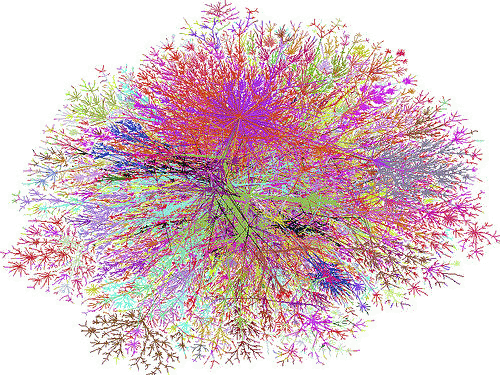
As new technologies mature to become a basic service to the public, there have always been haves and have-nots. One hundred years ago, the telephone could be found in only wealthier homes, but today it would be unimaginable for a household to be denied such basic communication.

According to a recent study by the PewResearchCenter, three out of four adults have internet access in the US. But the "digital divide" remains: internet access is significantly lower for low income households, minorities and the elderly. How we access the internet has rapidly transitioned from dial-up connections to broadband, whether using cable or DSL. That these two technologies compete for customers, rather than companies using a shared platform have slowed progress towards universal access.

Is universal internet access a basic service, a moral and social imperative? The US Federal Communications Commission (FCC) apparently believes it is, by launching the ambitious National Broadband Plan to support high speed access to more than 100 million households by 2020, backed by a budget of $15.5 billion. With such a large investment from our government to support the necessary infrastructure, a goal of universal access may be attainable. United Nations Educational, Scientific and Cultural Organization (UNESCO) seems to agree as well, having articulated a goal towards a global "knowledge society" based upon open access to information.

While the "digital divide" still exists, broadband costs are inexpensive in the US compared to other countries, averaging less than 0.5% of income. This is in sharp contrast to India and China, where access can cost between 5 and 10% of income.


The Global Broadband Spectrum by Matt Mahoney

Image used with permission by author Matt Mahoney (Technology Review published by MIT)

Consider the global landscape portrayed in the "Graphiti" above. The horizontal measures how many people subscribe to broadband services, ranging from 0.1 per 100 inhabitants, to universal access. Tracing vertically, you can see faster speeds from 0.3 Mb/sec to 40 Mb/sec a circle at the extreme upper right hand corner represents universal access at high speeds. To give you an idea of the speed of information transfer, you could download a DVD-quality movie in about ten minutes if your connection were at 50 Mb/sec.

Of course, the speed of information transfer offers far more than convenient entertainment. It could benefit teaching and ultimately our economy. Schools in poor districts with insufficient funds to provide required texts could become transformed if students had open access to the internet, since many educational materials are available at no cost. Given a laptop with a wireless connection, the potential for a child's education is vastly improved. Programs such as One Laptop Per Child are devoted to this goal for developing countries, for a cost of only $199 per laptop. Why not use such programs for the US? Open access to information could become a great equalizer, opening up better education at less cost, preparing students for our future workforce regardless of local school budgets.

Looking at this "Graphiti", you can see right away that access and speed of the broadband spectrum in the US is well behind South Korea, Japan and Scandinavia, boosted by large public and private corporate investments. Yes, the cost is higher in these regions. The FCC's National Broadband Plan could make the US more competitive in this digital race.

Can broadband access benefit the economy and improve job opportunities? While this question is still being debated, a study at MIT and the Brookings Institute concluded that for each percentage point increase in broadband access, an employment increase of 0.2 to 0.3 percent results. If this correlation holds true a 10% increase in access would translate into a 2 to 3% increase in employment - the FCC's plan would indeed improve job opportunities and benefit the economy.


Jeffrey H. Toney is Dean of the College of Natural, Applied and Health Sciences at Kean University and is a Trusted Author at OpEdNews. He received a B.S. in Chemistry at the University of Virginia and an M.S. and Ph.D. in Chemistry at Northwestern (more...)
 

The views expressed in this article are the sole responsibility of the author
and do not necessarily reflect those of this website or its editors.

Contact Author Contact Editor View Authors' Articles

Follow Me on Twitter


Share this page: (what's this?)                   Tell a Friend: Tell A Friend

Add this Page to Facebook!      Submit to Stumble Upon      Submit to Reddit      Add This Page to Mr Wong!           NEWSVINE      DEl.ICIO.US      Looksmart Furl      My Web      Blink List     (More...)

Comments

The time limit for entering new comments on this article has expired.

This limit can be removed. Our paid membership program is designed to give you many benefits, such as removing this time limit. To learn more, please click here.

Comments: Expand   Shrink   Hide  
3 comments
To view all comments:
Expand Comments
(Or you can set your preferences to show all comments, always)

Is it worth the investment? by Jeffrey Toney on Sunday, Jul 18, 2010 at 4:11:23 PM
A Human Right by Tony Bartoletti on Monday, Jul 19, 2010 at 6:11:43 AM
Reader comment: My OpEd is "bogus, Marxist tripe" by Jeffrey Toney on Tuesday, Jul 20, 2010 at 1:57:26 PM

