







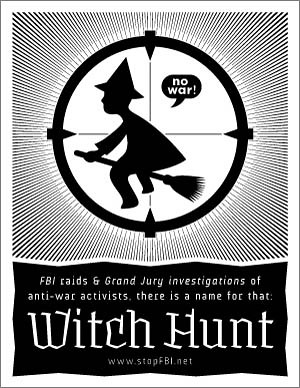
After two Grand Jury dates, the FBI continues to investigate antiwar, labor, and international solidarity activists. by Stop FBI Coalition
In the final week of January, twelve anti-war, labor and international solidarity activists were expected to appear before a grand jury in Chicago. They refused to go before the grand jury.
These activists from Chicago, the Twin
Cities in Minnesota, and other areas have been subpoenaed over the past months.
Several of the activists had their homes raided. Documents, cell phones,
storage disks, computers, and children's artwork were seized from their home.
The subpoenas indicated the FBI was looking for evidence that the activists had
provided "material support for terrorism." And, recently, it was
discovered that the FBI had an informant, who went by the name of
"Karen Sullivan," infiltrate an anti-war group in the Twin Cities.
This "witch-hunt" began on September 24th and, since then, U.S. Attorney Patrick Fitzgerald has been working to get activists to testify before a grand jury in Chicago. So far, all the activists have refused to participate in this "fishing expedition."
Coverage of WikiLeaks cables and the revolutions in the Middle East and North Africa (MENA) especially Egypt interrupted my scheduled coverage of the injustice several are experiencing. I now intend to resume coverage in the midst of uprisings against repression in countries in the MENA. Also, today are conferences in New York City and Chapel Hill, North Carolina. Those involved will be updating those in attendance on the grand jury repression in the context of previous FBI witch hunts in US history.
Now here is a profile of one of the activists:
Sarah Smith
Sarah Smith, a Jewish American woman and avid traveler who lives in Chicago, received a call from the FBI on December 3, 2010. The agent said his name was Robert Parker. He wanted to know if Smith had thirty minutes to sit down and answer some questions.
Smith asked what questions the agent had and the agent said he was not at liberty to discuss the questions. This made Smith think she needed a lawyer. The agent told Smith that it was not necessary to have a lawyer because she was not in trouble. He claimed he had some routine questions.
She asked again what the questions were and, when he refused to tell her again, she said she would have to call him back. The agent then told Smith what this was about. He had some questions on a trip Smith had taken. He said, "I think you know which trip I'm talking about."
Smith realized the agent
wanted to talk to her about the trip she took to Israel and Palestine in
August, just months ago. She reached out to a lawyer with the National Lawyers
Guild, who said he would contact the FBI agent directly. She then contacted her
two Palestinian American friends that went on the trip with her and informed
them the FBI had contacted her. She suggested they both get in touch with a
lawyer. Just as the two were on the phone with a lawyer, the same agent from
the FBI pounded on their door and served them with subpoenas.
(Note: You can view every article as one long page if you sign up as an Advocate Member, or higher).
 2
2
 2
2
 1
1






