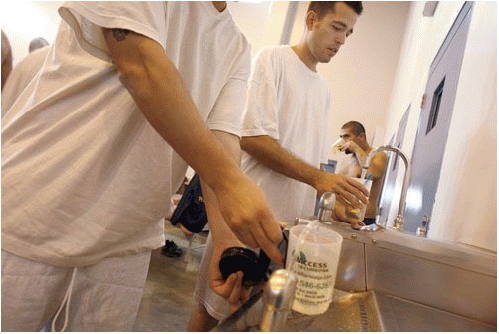
Photo Note the obviously discolored water, even in this small quantity
I would like to share with you a letter sent to me by Daniel Zuma, a member of our UNION prison reform group with a graduate degree who gives us a first person, professionally qualified description of water at Duel Vocational Institute, a prison at Tracy, California and conditions he personally witnessed after he was terrorized by law enforcement. He was harshly sentenced to three years on a first arrest for possesion of recreational drugs. A senior citizen who was harming no one, a well-educated, gentle person who worked for years helping people in state service, thrown into prison. Whom did this benefit? No wonder we have no state budget and so many people are walking around traumatized for life after a ridiculous prison sentence.
Here is Daniel's shocking account. He is now out of prison, but he told me that he will never get over how his own life was devastated by what he endured and witnessed there. It is a key to why nobody is getting out of prison as a better person, but are instead broken in mind, body and spirit. Here's the letter from a very courageous man whose government has destroyed him over a victimless "crime". After his letter, I discuss other instances of poison water in the state's prisons and call everyone to rally with us outside the San Francisco, California federal courthouse on February 4, 2009
Begin Letter from Daniel Zuma
Dear Rev. Bird:
Nobody ever expects to go to prison, least of all someone who has never been in trouble before, and who has retired from a career in civil service. But, a friend of mine got caught for possession of drugs and they offered him his freedom in exchange for mine. The government broke down my front door, destroyed my faith in humanity, ruined me financially, and sentenced me to 3 years in prison for drug possession.
Prison did nothing about my drug use except to traumatize me to an extent that I would only be more likely to use them in the future (drug use is one of the defining criteria of Post Traumatic Stress Disorder). Prison also ruined my physical health, leaving me bitter and in chronic physical pain. To my surprise, the vast majority of the people I met in prison were there for non-violent offenses--mostly for drug possession, or for technical violations of their conditions of parole--things like "failure to follow directions," failing to keep an appointment, or turning in a dirty drug or alcohol test; i.e., things that are not even crimes. Many were over 50 years old, like myself.
I was at Deuel Vocational Institute in Tracy CA, where the water runs gray and sometimes brown from the tap. It tastes of industrial chemicals and fermented cow urine, since a dairy sits atop the shallow aquifer from which the prison draws 620,000 gallons per day. It ´s disgusting even in the best of times; the staff won ´t drink it; there are signs warning visitors not to drink it; and trying to wash anything white only makes them dirtier. In mid-May of 2006, Plant Ops did some routine maintenance changing over the pipes bringing water into the prison. They turned the water off to the entire prison for about 18 hours, and when they turned it back on, the water ran black and thick as paint for nearly a day, after which it gradually went back to its usual gray. The staff brought trash cans full of potable water into the large dorms, and gave the prisoners buckets to help flush the toilets.
The roughly 3,900 prisoners confined two to a cell were completely without water; 379 prisoners and eight staff members were seriously sickened by some sort of diarrheal disease, variously identified as the Norovirus, Campylobacter and, according to one Doctor I spoke to, "a mixture of fecal bacteria" that were never conclusively identified. DVI is a reception center--a feeder prison--which sends about 750 inmates per week to Mule Creek, Wasco, Folsom and elsewhere in the Central Valley. It is, therefore, the first stop for any epidemic entering the prison system. Between May 16 and May 23, 2006, 1,344 inmates and 14 correctional staffers at 10 prisons came down with the disease.
From the 1950s to the 1980s, DVI was used as a firefighter training facility. Chemicals would be ignited in an open pit and extinguished by firefighting personnel. Consequently, there are now high concentrations of Volatile Organic Compounds, such as PCE, TCE, and DCE in the groundwater. The prison dairy contributes significant amounts of nitrates and fecal bacteria, which leach into the water table only 12 feet below. Instead of filtration, the prison relies on high levels of chlorination to suppress fecal contamination, so there are high levels of chlorides (i.e., the "C" in PCE, TCE and DCE) in the water.
In addition to manganese and iron, the water at DVI has a very high salt content due to it ´s proximity to San Francisco Bay. So, the water is very "filling," but it doesn't quench your thirst. During intestinal disease outbreaks and in hot weather, it is very difficult to stay hydrated or to flush the accumulated toxins from your body. (This is a particular danger for the elderly, or the many inmates who are on psychotropic medications due to mental health problems.)
After three months of drinking the DVI water I developed a rash over 80% of my body, which was so itchy I would scratch myself bloody in my sleep. It also affected my joints and my vision, and only cleared up when I was able to obtain bottled water.
I went to Mainline Medical to try to get a prescription or a medical "Chrono" for bottled water, or else a transfer to another institution with clean water. I was told by Dr. Fox, the Chief of the Medical Staff, that they didn't have the power to grant either request, and besides, I couldn't prove medically that it was the water (even though my rash would come back when I started drinking the water again). I was advised to file a Medical 602 , an Inmate Appeal which, in keeping with the normal standard of incompetence in these matters, was routed to the prison ´s Chief Engineer as a "quality of life" issue, who denied it on the grounds that there was nothing he could do about the water.
Unlike many inmates I was fortunate enough to have family who could send me my own money from the outside, and I was able to purchase 2-liter bottles for 90 cents each once a month at the prison canteen. But then CDC suddenly canceled these from the canteen inventory in favor of 20 oz bottles at triple the price. I filed an Appeal on the price increase, citing my own health reasons and the fact that clean water is a necessity of life and health. After nearly a year of working my way through the various levels of appeal, it was finally turned down at the highest level by CDC in Sacramento.
They said that the decision to raise the price on water was made at the state level by a committee and, having been made, it cannot be unmade just for me. Apparently, allowing all prisoners access to clean water--even at their own expense--was not deemed sufficiently reasonable to revisit the committee ´s decision. I know from my own years of experience in state government that there is no impediment to modifying a contract of this sort. They simply did not consider the health of inmates worth the effort.
In the meantime, I began documenting cases of others who had filed grievances at DVI and found a consistent pattern of obstruction and delay--and, when appeals were granted, the outcomes were deliberately calculated to make the situation worse, so as to convince the inmates of the futility of trying to change the system by working within it. All of the organizational self-correcting mechanisms have been disconnected in CDC--there is no meaningful press access; no outside audits; no inmate self-governance; no checks and balances; no whistle blower protection; chaplains can be fired for disclosing substandard conditions; and a recent federal case brought by an inmate at Pelican Bay regarding the serving of hot meals has shown that even the federal courts cannot force CDC to follow its own rules--should a prisoner survive the year-long gauntlet of delay and reprisals that pervades the Inmate Appeals Process.
What I didn ´t know at the time is that polluted drinking water had been known about for decades at DVI and elsewhere, but it has been largely ignored as overcrowded prisons overtax the aquifers from which they draw their water. Nitrate contamination due to fertilizers is especially common in rural areas, such as the Salinas Valley State Prison near Monterey; the California Institution for Men (CIM) in Chino; at the California Men ´s Colony (CMC) in San Luis Obispo; and the nearby California Institution for Women (CIW). Mule Creek State Prison ´s water is contaminated with dry cleaning chemicals; Old Folsom ´s water is contaminated by toxic waste from the old scrap metal, drum storage, industrial manufacturing areas, and a firing range. At Kern Valley State Prison, there are high levels of arsenic in the water. Alkalinity, asbestos and fecal contamination are issues at Avenal. Inmates have also been sickened by the water at the Sierra Conservation Center in Jamestown, and by outbreaks of Helicobacter pylori (a bacterium that causes peptic ulcers) at the California Rehabilitation Center in Norco.
If there is any pollution in the local water table, it tends to get sucked into the prison because of the rates of pumping have to keep up with overcrowding. To make matters worse, prisons only concentrate these pollutants further, and they discharge them back into the host communities, who are forced to subsidize the cost of treating the excess sewage. Between 2000 and 2006, eight of California's 33 state prisons have been cited for major water pollution problems. Folsom State Prison, for example, was fined $700,000 in 2000 for a massive 700,000 gallon sewage spill into the adjacent American River.
When living without air conditioning, water becomes a life or death matter. The summer I was at DVI, several people collapsed from the heat; three others died at Vacaville, a prison not far away. There is absolutely no excuse for not having reverse osmosis units attached to the drinking fountains in the dorms and cell blocks. It isn ´t done because no one in authority thinks that the prisoners need or deserve unpolluted water. There is no public outcry, therefore no reason to care.
In one 214-person minimum security ranch dorm where I was housed, two people died in the space of 6 months because the guards simply would not call the paramedics even though it was obvious that one man was having a stroke, and the other had fallen out of his bunk and was unconscious. Instead, the guards called for a pickup truck to take them to Mainline Medical, which took 45 minutes to arrive. They had to drag the poor men out on a blanket because they had no stretcher or any emergency equipment that paramedics would have normally brought. The prisoners died in Mainline Medical, and their families were told it was due to "natural causes." It was, however, simply cold, callous neglect.
Daniel Zuma
 This is Y-Dorm at DVI. I lived in Z-Dorm which is on the other side of the back wall partition. It is twice the size but there are only 14 working toilets for 300 people. Prisoners are issued one eating utensil and one cup, but there are only two sinks (adjacent to the toilets), and no hot water or dish soap. Notice the lack of places to sit and write letters. Prisoners have to sit crouched or lay or their bunks upwards of 20 hours per day, causing all sorts of back and neck problems. There is no air-conditioning or ice here, and temperatures regularly climb into the 100s in the summer.
Sources:
------------------------------
More notes from B. Cayenne Bird about tainted water  and what we need to do about it.
The media is banned from California ´s prisons which is outrageous when a full blown humanitarian crisis is taking place out of public view, which I believe is the reason that journalists can ´t interview specific inmates and often have their notes seized. There are four journalists with loved ones in prison in our group, and hundreds of family members who refuse to cooperate with this unconstitutional media ban, even though there is severe retaliation against those who file lawsuits and report the news from inside. There is less retaliation against the family members for reporting the news, since there is no way for the wardens and guards to know the source of information. Every effort is made by CDCr and state employees to cover up wrongdoing, which doesn ´t work when people are educated and  courageous patriots who will write and make comments at the news sites.
The UNION ´s jailhouse lawyers are suffering increased and severe retaliation during the final phases of the Plata trial in a concerted effort to silence them. There is very little help coming from the State lawmakers and officials to do anything to stop the deliberate physical and psychological torture being inflicted. I will be writing more on this topic soon and have been invited to be a guest on a national talk show to discuss the fact that there is no one who will assist families or inmates with real intervention even in life and death emergencies, unless they are able to write big checks or have a friend in office, which is rare. Losing a loved one to Prison is emotionally and financially devastating, which is why there are no large public outcry ad campaigns.
On February 4, 2009, we are planning to rally outside the Federal Courthouse at 450 Golden Gate Ave., San Francisco at 9 am. In order to get national media involved, at least 500 folks need to be there to stand up against medical neglect and continued abuse of the mentally ill in California's horrific prisons. While more than 100 family members attended our Nov 21 rally, we need five times more than that to make a stronger point that no one is addressing folks who are suffering and dying right now. Many are inmates who could be released right now to save the state billions and give some relief to the parents who are out of their minds with sick worry as an inmate dies daily. Many more will die before this gets resolved, but each of us must be the public outcry and fill up our cars for this historic day. Go here, hit print and mail 50 copies into an inmate to help spread the word, we are all unpaid volunteers in the UNION and cannot afford large mailings. This is a way everyone can help, we need crowds to bring in the national media so the lawmakers will do something to prevent more deaths which are highly visible right now.
Here's the flyer for Feb 4, when closing arguments before Judges Thelton Henderson, Lawrence Karlton and Stephen Reinhardt will take place in the Plata case. The power of noisy numbers is the only solution, suffering in silence doesn't work.
Over the last decade, I have published in my columns and editorials information about poison water at most of the prisons. The first time I encountered the problem was when I visited Calipatria State prison in 1999 and saw warning signs posted in the waiting room to the visitors that the water was dangerously contaminated and not to drink it. Alarmed, I contacted Sen. John Burton ´s office about the inmates being forced to drink this water even with public safety notices, and his aide, Nettie Sabelhaus, assured me that the water was safe, in spite of the signs.
When one of our UNION journalists whose sister in Norco came down with H-pylori, we were able to convince the Riverside Press Enterprise to do an investigation, but prison officials were able to slide out of having to correct the problem. That story is in their news archives, so when the second flare up of h-pylori was discovered, the evidence is there that we tried very hard to get assistance in 2004, which never came.
Instead of treating some 200 women who had contracted this bug that causes ulcers and great gastrointestinal suffering in many folks who get it, the warden simply transferred all these women to other prisons to keep it out of the news and then retired from her position two weeks later before we could organize an outcry on this medical neglect.
Yes, CDCr scattered all these women, ill with a contagious bug, without treating them before the UNION families could find their relatives and gather enough support for a lawsuit. It was quiet until the same situation of h-pylori in the water at Norco arose in the headlines again just last month.
I hope that everyone with a loved one at Norco has filed a complaint with the Riverside County Grand Jury so that something will be done about this ignored problem. If nobody cares enough to make noise in the media, comment at the news sites and file complaints with grand juries, then problems are never corrected. The lack of objection in the form of informative comments at the news sites and large protests is what enables the medical neglect, torture and murder taking place in the prisons to continue. We have had some luck when 50 or more UNION members file complaints with some of the grand juries who are also lied to and blocked from doing real investigations.
The more info the grand jury has, which are mostly made up of citizen ´s from the community, the more chance for actual resolution. The prisoners cannot do this type of complaint effectively for themselves, it is necessary for the family members to file these complaints in large numbers.
There is no place to go for help at any level, even in life and death emergencies. The lawmakers are elected into office with the dollars and votes of law enforcement labor unions in the majority of cases, so writing to most of them for help for inmates is a complete waste of time. That ´s because the state runs off the dollars and budgets generated by the court system through fines and the human bondage industry is California ´s largest. We, the people need to stop electing law enforcement's picks for office, and start electing some who are smart on crime, and represent the rest of us for a change.
This callousness is one reason why the feds have had no choice but to take over the prisoners ´ medical care, due to the deliberate indifference of most state lawmakers and officials who are should be doing the right thing, but who clearly are unresponsive. What goes on in the dark is deadly and empowers the cruelty that takes place in our mismanaged dungeons and I, as an old-fashioned journalist who has devoted four decades of my life serving the public ´s right to know, am never going to cooperate with this cover up, even though the price I pay for reporting about the abuses is very high, more than I can tell you here.
Michael Rothfield of the Los Angeles Times did an important series on arsenic-laced water this week which the prisoners are being forced to drink in site of the danger of cancer and other symptoms of slow poisoning.
I don't remember "give them cancer" as being part of the prisoners ´ sentences. And, when the state allows this torture to happen, the amount of money we'll pay for their healthcare costs will go up. It's wrong on multiple levels, including humanitarian and financial. Maybe you think this isn't your concern.
But do you know that there are three million Californians who never thought that they or someone they love would land in prison, so someone you know is likely affected by the humanitarian crisis taking place inside due to criminal neglect. Poison water is a public health crisis, but due to too much silence and inaction by the families that could force lawmakers to comply, this cruel and unusual punishment continues to exist. The fact that the State has known about arsenic in the water for several years and has no plans to resolve it is pure madness. What in God's name is going on here!! And why would anyone with a modicum of common sense buy into this?
I would dearly love to add a lawsuit due to water poisoning to the 100 or so that our UNION families have already filed over wrongful deaths, but we are limited by funds and volunteers to do everyone ´s fighting for them without more workers.
I will continue to educate the public, so that if and when folks who are suffering ever decide to take legal action over their loved ones being forced to drink poison water, there will be a public record of it which was published nationwide. Our volunteer jailhouse attorneys pay for many of these battles out of their own empty pockets and suffer severe retaliation for even filing them, so the UNION families are choosing what we will take on in the future by vote only. Not all of the lawsuits we have filed are being litigated by jailhouse lawyers. Some families are sacrificing everything they own to hire private lawyers to go into court in a system that favors the guards.
With enough participation, more lawsuits would be possible, as nothing is for free, someone pays for every lawsuit the UNION families have filed. Lawsuits are the only language the bureaucrats understand. Still, I do not like witnessing this slow murder and torture and would rather be able to do something about it, rather than stand like an idiot on the sidelines and simply watch it take place like so many folks do who place no value on prisoners ´ lives or simply do not understand how to organize and end these practices. We cannot have too many volunteers working on organizing a large voice to stand up for inmates beneath articles at the news sites, who will bring 20 protesters in their car on Feb 4, who will help with gas money and other costs of doing a meaningful campaign.Â
UNION
p.o.b. 340371
Sacramento, Ca 95834
Chart by Rady Ananda, from info provided by Justice Policy Institute, U.S. Dept. of Justice Bureau of Prisons, and PEW Center on the States.





 4
4
 3
3
 1
1






