

Tag(s): ; ; ; ; ; ; ; ; , Add Tags
Add to My Group(s)

Must Read 4   Well Said 4   Supported 3   View Ratings | Rate It

Promoted to Headline (H3) on 7/2/11:     Permalink
View Article Stats      (7 comments)

How the Bailout Killed Local Lending -- And How Some States Hope to Bring It Back

Add this Page to Facebook!
Submit to Twitter
Submit to Reddit
Submit to Stumble Upon

Tell A Friend

Become a Fan
Get Embed HTML Code
By (about the author)

Become a Fan Become a Fan  (98 fans)   -- Page 1 of 2 page(s)

opednews.com

"Wall Street banks have cut back on small business lending... [by] more than double the cutback in overall lending.... [Small business] options just keep disappearing."

 -Elizabeth Warren, Chair of the TARP Congressional Oversight Panel
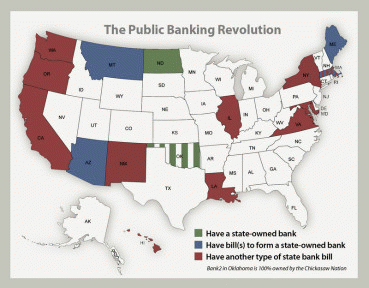
  
States with Public Bank Bills 7-11 by Public Banking Institute

The Wall Street bailout of 2008 has radically altered the banking business. The bailout was supposed to keep credit flowing to Main Street, but it has wound up having the opposite effect. Small and medium-sized businesses have traditionally been the main engines for increasing employment, and they need bank credit for their working capital; but today credit to local businesses has collapsed nearly everywhere.

That's why so many states--the total is now fourteen--are considering turning to state-owned banks to get local credit flowing again.

The Bailout that Missed Main Street

The credit collapse of September 2008 was triggered by the speculative activities of giant Wall Street banks. These profligate banks, which would have gone bankrupt without federal support, have emerged from the crisis bigger and more powerful than before. The federal government has supported and subsidized bank consolidation, resulting in the elimination of more than a thousand community banks by takeover or failure.

The five largest banks now hold 40 percent of all deposits and 48 percent of all bank assets. These banks--Bank of America, Wells Fargo, JPMorgan Chase, Citigroup, and PNC--currently control more deposits than the next largest 45 banks combined.

They are big, they are powerful, and they have lost interest in local lending. In the past three years, the four largest banks have cut back on small business lending by a full 53 percent. The two banks that were the largest recipients of TARP funds, Bank of America and Citigroup, have cut back on local lending by 94 percent and 64 percent, respectively.

Why? In 2010, the six largest bank holding companies made a combined $75 billion; and of this, $56 billion was in trading revenues--income from speculating in derivatives, futures, commodities, and currencies. If the too-big-to-fail banks win on these bets, they win big and can pocket the proceeds. If they lose, the federal government can be relied on to bail them out. In those comfortable circumstances, why lend to risky local businesses that might go bankrupt, or to homeowners who might default?

Why Banks Aren't Lending Locally

Another perk of the bailout that has put a tourniquet on local lending involve interest rates. The Federal Reserve dropped the Fed funds rate (the rate at which banks lend to each other) to an extremely low 0 to 0.25 percent. It was a very good deal for the big banks--too good to be wasted on local lending. As Dirk van Dijk, writing for the investor website Zacks.com, explained in April 2010:

"Keeping short-term rates low should be good for the stock market, and is particularly helpful to the big banks like Bank of America (BAC) and JPMorgan (JPM) . Their raw material is short-term money, which is effectively free right now . They can borrow at 0.25% or less, and then turn around and invest those funds in, say, a 5-year T-note at 2.50%, locking in an almost risk-free profit of 2.25%.

"On big enough sums of money, this can be very profitable, and will help to recapitalize the banking system (provided they don't drain capital by paying it out in dividends or frittering it away in outrageous bonuses to their top executives)."

It can be very profitable indeed for the big Wall Street banks, but the purpose of the near-zero interest rates was supposed to be to get banks to lend again. Instead, they are, indeed, paying "outrageous bonuses to their top executives;" using the money to engage in the same sort of unregulated speculation that nearly brought down the economy in 2008; buying up smaller banks; or investing this virtually interest-free money in risk-free government bonds, on which taxpayers are paying 2.5 percent interest (more for longer-term securities).

Investing in Treasury bills is an attractive alternative for banks, not just because it provides 2.25% of risk-free profit but because it requires no capital investment. The amount of capital a bank must hold against its assets (mainly loans) depends on how risky the assets are. T reasuries are considered "risk-free," so there is NO capital requirement for holding them. Naturally, banks prefer investing in Treasuries under these circumstances over making risky loans, against which they must maintain capital reserves of 7%. The banks can borrow virtually for free and make a nice return at taxpayer expense without tying up their capital, which can be used instead to speculate in the market.

Next Page  1  |  2


Ellen Brown is an attorney, president of the Public Banking Institute, and author of 11 books. Her websites are http://WebofDebt.com, http://EllenBrown.com, and http://PublicBankingInstitute.org. In her latest book, "Web of Debt: The Shocking (more...)
 

The views expressed in this article are the sole responsibility of the author
and do not necessarily reflect those of this website or its editors.

Contact Author Contact Editor View Authors' Articles

Follow Me on Twitter


Share this page: (what's this?)                   Tell a Friend: Tell A Friend

Add this Page to Facebook!      Submit to Stumble Upon      Submit to Reddit      Add This Page to Mr Wong!           NEWSVINE      DEl.ICIO.US      Looksmart Furl      My Web      Blink List     (More...)

Comments

The time limit for entering new comments on this article has expired.

This limit can be removed. Our paid membership program is designed to give you many benefits, such as removing this time limit. To learn more, please click here.

Comments: Expand   Shrink   Hide  
7 comments
To view all comments:
Expand Comments
(Or you can set your preferences to show all comments, always)

state banks are the dog wagging its tail by Ernie Messerschmidt on Saturday, Jul 2, 2011 at 11:16:43 PM
dog wagging its tail by Ellen Brown on Sunday, Jul 3, 2011 at 9:03:16 AM
The Hit on Small Savers by Siegfried Othmer on Sunday, Jul 3, 2011 at 1:27:57 AM
startups can't get loans by Ellen Brown on Sunday, Jul 3, 2011 at 9:04:25 AM
State owned Banks by Mike Kirchubel on Sunday, Jul 3, 2011 at 12:51:31 PM
fractional reserve money printing by Ellen Brown on Sunday, Jul 3, 2011 at 1:10:14 PM
A Creative Political Solution to an Existential Problem by Luis Magno on Sunday, Jul 3, 2011 at 5:05:23 PM

