Tag(s): ; ; ; ; ; ; ; ; ; ; (more...) ; ; ; , Add Tags  (less...)
Add to My Group(s)

View Ratings | Rate It

Promoted to Headline (H4) on 8/5/09:     Permalink
View Article Stats      (3 comments)

Fidel Castro, My Life - Chapter Fifteen: Cuba and Africa

Add this Page to Facebook!
Submit to Twitter
Submit to Reddit
Submit to Stumble Upon

Tell A Friend

Become a Fan
Get Embed HTML Code
By (about the author)

Become a Fan Become a Fan  (7 fans)   -- Page 1 of 2 page(s)

opednews.com

<

A Spoken Autobiography

- Fidel Castro and Ignacio Ramonet


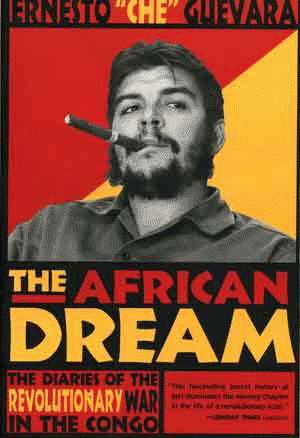
El Che while in Africa

When the Cuban Revolution emerged onto the scene in the late 1950s, it did so as the first successful liberation of any nation since the yoke of Yankee imperialism had taken over the two continents at the beginning of the century. But it wasn't alone in the world.

After WWII, countries across the globe started seeking their freedom from colonial domination. In 1946, the US granted independence to the Philippine Islands. In 1947, India was given its independence by the British Parliament. But by 1960, Algeria, a French colony since 1847, was still fighting for its independence.

Barely two years after the revolution, in 1961, President Castro sent a ship laden with arms, including cannons and 105mm howitzers to Algerian leader Ahmed ben Bella. Such was Fidel Castro's overwhelming desire to fight against imperial oppression wherever it is found. During the war hundreds of thousands of Algerians lost their lives and as of the writing of the book, the French military has not delivered all the maps of all the mines they planted there before leaving.

Two other extraordinary events also took place during that initial, feeble attempt to fight colonization beyond Cuba's borders. The first occurred at the return voyage of that first ship filled with weaponry. Rather than returning empty, President Castro decided to fill it with around 100 war-orphaned children, thus starting a Cuban precedent of reaching out to the most innocent and most victimized of any war the children, and helping as many as possible.

The second Cuban precedent that began with President Castro's assistance to the Algerian rebels was the addition of dozens of Cuban doctors to the list of deliverables. Even though over half of Cuba's doctors fled the country during the first months of the revolution, President Castro still found it necessary to ensure that medical help was never far behind military necessity.

This concept of providing relief as well as the means of liberation is something that Cuba still practices today. When Hurricane Katrina battered the states of Louisiana and Mississippi in late August, 2005, Cuba offered to send over 1,000 doctors to aid in the recovery. Even though this aid was flatly refused by then President Bush, who preferred condemning his own citizens to death than accepting aid from Cuba, President Castro went on to form the Henry Reeve International Contingent of Doctors Specialized in Disaster Situations and Serious Epidemics to help nations around the world who have been struck by major natural disasters. In honor of American Henry Reeves, who gave his life to the Cuban revolution in 1878, the contingent today comprises thousands of doctors from Cuba and beyond and have worked to save lives in Pakistan, Guatemala and elsewhere.

But the Cuban anti-imperialist assistance didn't stop with Algeria. Cuban forces were sent to Angola and Guinea-Bissau in 1965 to aid in their independence. Guinea-Bissau, a Portuguese colony, had been struggling for sovereignty since 1956 and would continue to struggle another ten years before finally achieving the inevitable in 1974. But Amílcar Cabral, leader of the African Party for the Independence of Guinea and Cape Verde, never gave up. When their day of liberation finally arrived, there were 600 Cubans, of which 70 were doctors, there to celebrate with them.

By July, 1975, Cuba had helped liberate the countries of Cape Verde Islands, São Tomé and Principe from Portugal. They had helped the Mozambique Liberation Front (FRELIMO) and its leader Samora Machel gain independence from Portugal as well, even though South Africa started illegally invading the country as soon as it was granted nationhood. Zimbabwe was liberated much in the same fashion with South Africa constantly crossing the border in illegal raids.

But the liberation of the Belgian Congo was a different story altogether. On December 11, 1964, Che Guevara strongly condemned the American and Belgian killings in the Congo stating, "Every free man in the world must be ready to avenge the crime committed against the Congo." On April 24, 1965, El Che arrived in Kibamba, Belgian Congo, with a small Cuban contingency. The Congolese revolutionary forces were in severe disarray having lost many recent battles against battle-hardened White South African, Rhodesian and German mercenaries. These troops, in turn, were under the command of Belgian and American military officers.

President Fidel sent reinforcements to Brazzaville, in what was at the time the French Congo, and they quickly formed three more columns of fighters. These new additions, along with those trained and supported by El Che and the original Cuban contingent, helped the insurgent forces tremendously.

Angola was another hot spot of Western dominance. The corrupt dictator of Zaire, the former Belgian Congo, had wanted to make it a playground for himself and the Whites of South Africa. The struggle that faced the Cuban forces in freeing the country of Angola from the grips of Western and South African dominance were unique in the annals of warfare for any nation.

The country was scheduled to declare its independence on November 11, 1975, but less than a month prior, Congolese and South African troops attacked on two separate fronts trying to drive a wedge through the heart of the as-yet undeclared nation and keep it from succeeding. However, in 1975 for the first time ever, a nation was armed with nuclear weapons by one of its allies. The United States sent several atomic bombs to South Africa to strengthen its military hand in the fight in Angola.

Next Page  1  |  2


54 year old Californian male - I've lived in four different countries, USA, Switzerland, Mexico, Venezuela - speak three languages fluently, English, French, Spanish - part-time journalist for Empower-Sport Magazine. I also write four newsletters.

The views expressed in this article are the sole responsibility of the author
and do not necessarily reflect those of this website or its editors.

Contact Author Contact Editor View Authors' Articles


Share this page: (what's this?)                   Tell a Friend: Tell A Friend

Add this Page to Facebook!      Submit to Stumble Upon      Submit to Reddit      Add This Page to Mr Wong!           NEWSVINE      DEl.ICIO.US      Looksmart Furl      My Web      Blink List     (More...)

Comments

The time limit for entering new comments on this article has expired.

This limit can be removed. Our paid membership program is designed to give you many benefits, such as removing this time limit. To learn more, please click here.

Comments: Expand   Shrink   Hide  
3 comments
To view all comments:
Expand Comments
(Or you can set your preferences to show all comments, always)

If OEN Continues It's Arc of Progress and Development, by GL Rowsey on Wednesday, Aug 5, 2009 at 9:59:10 PM
thank you, pancho by John Little on Wednesday, Aug 5, 2009 at 10:24:46 PM
Maybe in a way, by GL Rowsey on Thursday, Aug 13, 2009 at 8:16:18 AM