Home
Refresh   Tag(s): ; ; ; ; ; ; ; ; ; ; (more...) ; ; ; ;  (less...)
Add to My Group
July 22, 2009 at 04:26:20

View Ratings | Rate It

Promoted to Headline (H4) on 7/22/09:

Chapter Thirteen: The Cuban Missile Crisis of October, 1962

submit to twitter
submit to reddit
submit to digg

Tell A Friend

By John Little (about the author)     Page 1 of 2 page(s)

opednews.com     Permalink

For OpEdNews: John Little - Writer

Fidel Castro, My Life

A Spoken Autobiography

- Fidel Castro and Ignacio Ramonet

Chapter Thirteen: The Cuban Missile Crisis of October, 1962


cuban missile crisis

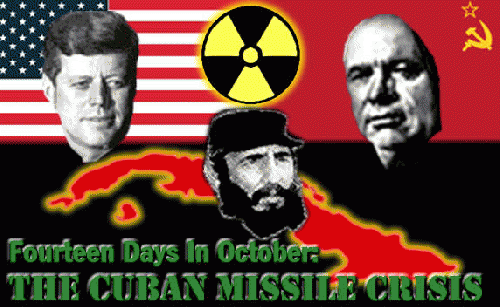
Just eighteen months after the illegal invasion of Cuba at the Bay of Pigs, another crisis placed Fidel Castro's new government front and center on the world's dynamic stage. The event, which to date, has brought the world closer to total annihilation than any other single event, the Cuban Missile Crisis, nearly ended all life on planet Earth. For two weeks the two superpowers stared at each other, neither willing to blink, until a final compromise was reached where both sides agreed to relinquish certain far away control. The story is at once nerve-wracking and surreal and, at least from the standpoint of Fidel, fraught with missed opportunities and unnecessary backpedaling.

After the Bay of Pigs fiasco which planted egg on the face of President Kennedy and the entire US foreign policy, there were numerous terrorist attacks perpetrated by the exiled Cubans living in Miami and funded by the CIA. Operation Mongoose was approved by then President Kennedy in November, 1961, and implemented by the Pentagon and the CIA until October, 1962, when a halt to all covert actions against Cuba was agreed to by both superpowers. However, the CIA still sent out a terrorist group on November 8, 1962, which blew up a Cuban factory killing 400 workers.

But the story begins ten months after the Bay of Pigs defeat. The Soviet Union uncovered part of Operation Mongoose, the part that openly discussed the invasion of the island of Cuba in 1962. They informed Fidel of their findings while keeping the source of their information confidential. They asked Fidel what he thought would be the best way to proceed. "Make a public statement that any attack on Cuba would be considered an attack on the Soviet Union," Fidel quickly responded.

Energetic discussions then proceeded between both sides with the Soviets insisting that such a statement, in and of itself, was useless without some teeth of some kind to back it up. Fidel insisted that the time for the statement was now and couldn't wait for any potential build up to be completed. He then went to consult the National Directorate of the Revolution which consisted of Raúl Castro, Fidel's younger brother, Blas Roca, Che Guevara, Dorticos and Carlos Rafael. He informed them that the Soviet Union was not only wishing to protect Cuba against this new American threat, but that they wanted to counter recent American missile build up in Turkey near the Soviet border.

After several hours of intense debate, it was agreed that Cuba would install 42 medium-range rockets, a regiment of MiG-21 fighter planes, four brigades of motorized infantry with personnel carriers and tanks, missile-equipped patrol boats and a regiment of tactical nuclear arms with the controls given to the commander in charge without the need for approval by anyone else before launch. At the same time, priority was given to the project to push it ahead of all others. If Cuba was going to successfully stave off a subsequent American attack, an attack with an unknown commencement date, there was no time to lose.

On October 14 and 15, 1962, a U-2 flyover of the island, which had been recommended after Soviet Colonel Oleg Penkovsky had given the US intelligence services the exact coordinates, revealed the launching pads and pending installations of the medium-range missiles. From the beginning, the Soviets had made little attempt to camouflage these systems and their eventual outing was pretty much a formality once their locations were given.

On October 20, on the advice of DoD Secretary Robert McNamara, President Kennedy imposed a 183-ship naval blockade of the island, among which were eight aircraft carriers and 40,000 Marines on transport ships. He also sent 579 combat planes to Florida along with five army divisions and put two elite air divisions on alert, the 82nd and 101st airborne.

With the news that the U-2 planes had spotted the launch pads, Cuba's reaction was to go on full alert. The installations, which had already been proceeding at maximum speed, were accelerated even more. On October 16, no launch pad was ready. By the 18th, there were eight and by the 21st, there were twenty. The entire country was mobilized. 300,000 people were brought up for active duty. On October 23, Fidel Castro spoke to the nation, denouncing the US aggression and warning of the risk of imminent invasion.

The entire affair moved to an even greater height of tension on October 24, 1962, at 2:00 pm on the high Atlantic seas off the coast of Cuba. At that moment, 23 Soviet vessels came into contact with the 183-ship blockade by the US. Had either side launched even one missile in attack on the other, war could have easily broken out.

Meanwhile, on October 25, at the UN Security Council, the debate between US Ambassador Adlai Stevenson and Soviet Ambassador Valerian Zorin turned into a complete sham. While Ambassador Stevenson presented the U-2 evidence gathered the week before, Ambassador Zorin never countered. Instead of presenting the evidence of a pending US invasion, the right of sovereignty of the people of Cuba and their international right to self defense, he merely denied the claims by the US and refused to debate the issue.

Next Page  1  |  2


54 year old Californian male, born on the third planet revolving Sirius, no seriously - I've lived in three different countries, USA, Switzerland, Mexico - speak three languages fluently, English, French, Spanish - part-time journalist for (more...)
 

The views expressed in this article are the sole responsibility of the author
and do not necessarily reflect those of this website or its editors.

Contact Author Contact Editor View Authors' Articles


Book Recommendations for "Citizens Crisis Information"
Alabama and the energy crisis (Citizen information report ; no. 12)
by William Histaspas Stewart


Number of pages: 53
Publisher: Bureau of Public Administration, University of Alabama

View All Book Recommendations

Share this page: (what's this?)                   Tell a Friend: Tell A Friend

FACEBOOK      DIGG THIS      Add This Page to Mr Wong!           NEWSVINE      DEl.ICIO.US      Looksmart Furl      NETSCAPE      My Web      Tag!RawSugar      Blink List     (More...)

Comments: Expand   Shrink   Hide  
3 comments
To view all comments:
Expand Comments
 

thanks for this, Juan. by GL Rowsey on Wednesday, Jul 22, 2009 at 6:56:50 PM
Pancho by John Little on Wednesday, Jul 22, 2009 at 10:07:49 PM
Yes, history was almost a blur it was changing so fast by GL Rowsey on Thursday, Jul 23, 2009 at 8:43:15 PM

 
Want to post your own comment on this Article? Post Comment


Tell a Friend: Tell A Friend

Copyright © 2002-2009, OpEdNews

Powered by Populum