




SFGate reports that the new Constitution also broadens President Rafael Correa's powers, letting him run for two more consecutive terms, and allowing him to consolidate the 'citizen's revolution.' Correa is expected to swiftly overhaul the judiciary, the Central Bank and other key institutions, giving the U.S.- and European-trained economist greater liberty to fashion what he calls a 'new political model.' Correa has not, however, nationalized telecommunications or electric utility companies.
According to a report by Cyril Mychalejko, the new constitution gives nature the "right to exist, persist, maintain and regenerate its vital cycles, structure, functions and its processes in evolution" and mandates that the government take "precaution and restriction measures in all the activities that can lead to the extinction of species, the destruction of the ecosystems or the permanent alteration of the natural cycles." Mychalejko continues:
Ecuador's leadership on this issue just may have a global domino effect as the [Community Environmental Legal] Defense Fund is now fielding calls from other countries such as Nepal, which is currently writing its first constitution. This could begin to make neoliberal development models obsolete and have a tremendous impact on multinational corporations, especially those in the extractive industries, from entering new markets and conducting "business as usual"."I expect them to fight it," said the Defense Fund's [Mari] Margil. "Their bread and butter is being able to treat countries and ecosystems like cheap hotels. Multinational corporations are dependent on ravaging the planet in order to increase their bottom line."
The class-action lawsuit in Ecuador against Chevron is a testament to Margil's forecast. Tens of thousands of Ecuadorians accuse the California-based company of dumping millions of gallons of toxic waste into the Amazon (when it was formerly Texaco), and as a result causing massive environmental destruction and widespread health problems. Chevron, which could be forced to pay as much as $16 billion, refuses to take responsibility and calls the action a "shakedown."
"The ultimate issue here is Ecuador has mistreated a U.S. company," a Chevron lobbyist who asked not to be identified told Newsweek in July. "We can't let little countries screw around with big companies like this-companies that have made big investments around the world."
Chevron is lobbying Congress to squeeze Ecuador on the issue by threatening to withhold the renewal of the Andean Trade Preference Act. Chevron took similar measures in 2006 by lobbying for the exclusion of Ecuador from Andean Free Trade Agreement negotiations as retribution for the lawsuit--something Democratic Presidential nominee Senator Barack Obama (D-Ill) and Senator Patrick Leahy (D-VT) criticized at the time in a letter to then U.S. Trade Representative Rob Portman.
Jorge Daniel Taillant, President of the Center for Human Rights and Environment (in Argentina), recently wrote that, "The crude reality of the Chevron lobbyist comment, brings home what few politicians or oil industry representatives want to admit, that our societies have been unsuccessful in properly balancing our need for oil and containing the negative impacts that this industry has on our natural and social environment."
(Read more for an excellent discussion of what Mychalejko calls "populist greenwashing.")
The successful lobbying efforts of the Pachamama Alliance prompted the Ecuadorian Constituent Assembly to invite the Community Environmental Legal Defense Fund to assist in developing and drafting provisions for the new constitution to put ecosystem rights directly into the Ecuadorian constitution, based on ordinances developed and adopted by U.S. municipalities.
"Ecuador is now the first country in the world to codify a new system of environmental protection based on rights," stated Thomas Linzey, Executive Director of CELDF. "With this vote, the people of Ecuador are leading the way for countries around the world to fundamentally change how we protect nature," added Mari Margil, Associate Director.
CELDF, founded in 1995, explains that most laws legalize environmental harms by regulating how much pollution or destruction of nature can occur. Rather than preventing pollution and environmental destruction, these laws instead codify it.
The Pachamama Alliance works to preserve the Earth's tropical rainforests by empowering the indigenous people who are its natural custodians. Through educational programs and organized tours to the Andes, it raises awareness of an indigenous worldview that seeks to preserve ecodiversity. The Alliance recognizes that:"The destruction of the world's rainforests is driven by a complex web of social and economic forces, many of these a logical result of modern society's worldview -- a view that, although rich in technological insight, is often ignorant of the value of nature's apparently free and limitless services. It is a view guided by maximum short-term financial gain while disregarding the long-term costs of ecological degradation. It is a worldview in which tropical forests can show up as a cash crop to be harvested rather than as an irreplaceable ecosystem to be protected."
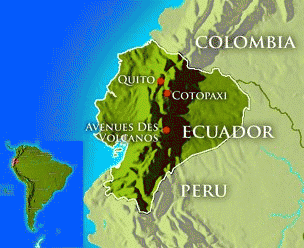
Ecuador sits on the western edge of South America, at the equator. Darwin's famous Galapagos Islands, not pictured in the map below, lie 700 miles from the coastal town of Manta.
 4
4
 3
3
 2
2






