




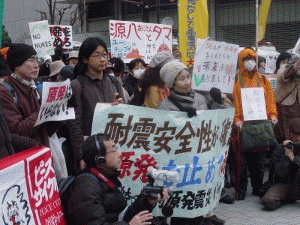
As radiation levels from Japan's melting reactors reach new highs, public anger toward the Tokyo Electric Power Company (TEPCO), the power company that owns them, seems to be below the boiling point.
"Get caught in the rain and you'll lose your hair." That's what the kids used to chant when I was a girl, says a fifty-something native of Yokohama. It was the late sixties and radioactive particles carried by the wind from above ground nuclear testing in the South Pacific had pushed radiation levels sky high. "Compared to now, the radiation level was actually much higher around here back then," she utters with a shrug and look that says she has seen this all before. "Shoganai," says her nephew. It's a common Japanese expression, an almost fatalistic resignation that we are powerless in the face of events that have unfolded like a rolling pair of dice or perhaps fate. It seems to roll off peoples tongues here at the worst of times.
In the wake of the magnitude 9.0 earthquake that triggered the monster wave which has swallowed whole towns and rocked the Fukushima nuclear power plant to its core you can here "shoganai" echoing from just about every corner of Japan. Fears of radioactive contamination blowing downwind have touched off a roller coaster of emotional responses in the capitol area 170 miles south of the leaking power plant, but anger seems to be the most subdued. While Twitter and internet sites rage with tirades against TEPCO, for a chain reaction of failures in response to the accident, that anger hasn't spilled over into the streets. Japan's nuclear nightmare has sparked huge anti-nuke demonstrations as far away as Germany, yet a rally outside the TEPCO headquarters in Tokyo this Sunday barely drew a crowd of three hundred.
The idea of a public demonstration is not an alien concept here either. In March of 2003 thousands filled the streets in protest of the US-led coalition's impending invasion of Iraq. The Asahi Shinbun, a major Japanese daily, in their coverage of that anti-war demonstration quoted rally organizers who estimated the number of protestors at 50,000. The successful turnout at that event was largely credited to a full-page announcement of the rally paid for by Greenpeace that ran in an area newspaper days before. The well-planned organizing strategy paid off in big crowd figures. That was eight years ago and long before Twitter, the social networking tool that is being leveraged to topple regimes across northern Africa, was a twinkle in anyone's eyes. If any place were ripe for a Twitter revolution, it would be Japan where a cell phone is de rigueur for just about everybody over the age of ten.
One would think that an impending nuclear nightmare on their doorstep would send Tokyoites out their doors in droves but that's obviously not the case. A recent survey by a major metropolitan daily newspaper, the Tokyo Shinbun, revealed that residents of Tokyo are evenly divided with more than half willing to accept whatever risks may accompany nuclear power in return for the electricity they need to keep everything humming along. While for now self-restraint has prompted the nuclear power industry to put the breaks on new plant construction from one end of this island nation to the other, it looks like that could all change. The nuclear power industry could be back to business as usual before we know it. If you look at the numbers at the Aril 3 demonstration in Tokyo, it would seem that Japan lacks the critical mass of people needed to erase nuclear power from the energy map. Then again when it comes to nuclear physics you need only just enough material to sustain a chain reaction. It's possible that Japan's anti-nuke movement has enough momentum to keep the sustainable energy ball rolling. While the Japanese no-nuke revolution may be hushed, I hear the words of the famed cultural anthropologist Margaret Mead echoing: " Never doubt that a small group of thoughtful, committed citizens can change the world. Indeed, it is the only thing that ever has."
Related articles by this author:
Lingering Fear in a Shaken Country(Baltimore Sun)
This Is Not a Test (Japan Today)
 1
1
 1
1
 1
1






