




While activists and politicians discuss different audit schemes to check the accuracy of computerized election results, the audit debate obscures the reality that most of the US has stopped reliably counting all the ballots. Whatever percent audited is the only percent of ballots that are reliably counted in the U.S., because repeated scientific studies show that software-driven voting systems provide us with no rational basis to trust reported results.
We can applaud these activists and officials for comprehending the need for hard, discrete evidence. We do need a reliable count independent of software, given the undetectably mutable nature of software. Both the National Institute of Standards and Technology (NIST) and the National Science Foundation's ACCURATE center promote "software independence." Why? Because we cannot trust results produced on undetectably mutable software.
Why, then, insert this expensive, non-securable, unverifiable, non-transparent election system between the ballots and a reliable count? Qui bono?
I suppose this question is similar to asking why finance a war, when our own infrastructure is crumbling. The answer is the same: profits for the few, at the expense of the many.
Beyond mentioning the absurdity of using expensive gadgets that don't work, this essay does not seek to engage the audit debate. The point is that a sample is not a full count of the ballots, by definition. The larger point is,When and who decided we should stop counting all of our ballots?
Because states chose to accept federal funds to buy unreliable computerized technology, we are forced to rely on some other means of determining election results. Informed activists and public officials recognize we must hand count the ballots, and this is what prompts the audit debate. The only "other means" our legislatures will consider is a small statistical sampling of the paper ballots.
In those jurisdictions that use computerized voting systems and that do audit the voter-completed ballot, only a tiny percentage of all ballots cast is reliably counted. This represents well over 90% of US elections with less than 5% of all ballots reliably counted.
That is the reality. With the exception of New York State, and some scattered hand-count jurisdictions, US elections are no longer reliably counted in full.
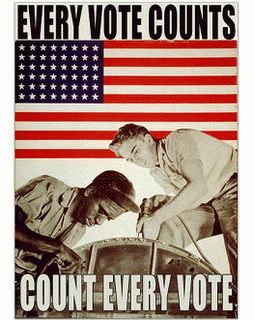
Only sampling our ballots, and never counting all of them, is inappropriate as a means to determine election results in a democracy. It is especially inappropriate given that the public was not consulted regarding this decision to reliably count only a small percent of all ballots cast.
The raging audit debate misses this point, showing how election integrity advocates have been misled into a discussion that supports the continued use of faulty technology.The frame is not what percent do we audit, but should we stop counting all the votes.
Legislation that permits only a small portion of all ballots to be counted in a reliable manner abrogates the public's right to have all our votes reliably counted.






