

![]() |
By John Little (about the author) Page 1 of 2 page(s)
For OpEdNews: John Little - Writer A Spoken Autobiography - Fidel Castro and Ignacio Ramonet
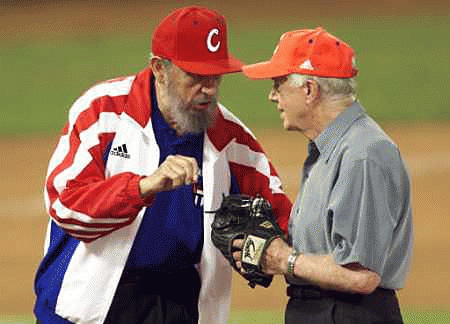
fidel castro and jimmy carter baseball game cuba may 2002
Along with General Ochoa, other high ranking officials were also arrested, Colonel Tony de la Guardia, Captain Jorge Martinez, and Major Amado Padrón. These men were all found guilty as charged and were sentenced to the death penalty which was carried out on July 13 of that year. Others who were also arrested were sentenced to long prison terms.
At the same time, and in a related case, Minister of the Interior José Abrantes, along with several others, were also found guilty of the same crimes and sent to 20-year prison sentences. José Abrantes died while in prison two years later.
The world sat stunned as these events unfolded. In 1989, the Soviet Union had not yet folded, though it was obviously on its last legs, and had shifted its major focus from assisting liberation causes around the world to ending hunger and suffering from diseases around the world. The rumblings from the great imperial giant to the north had ebbed a bit and normalcy seemed to be slowly returning to the region when the case of General Ochoa blasted the journalistic calm.
The origins can be found in the same immoral embargo that still grips the island today. From the very beginning of the embargo, Cuba was forced to find spare parts wherever it could. The Ministry of the Interior had to set up small companies that would take Cuban exports, cigars, coffee beans, sugar cane, etc., and use them to buy the much needed maintenance parts. This became routine as the years and the embargo continued. Although profits were generally frowned upon, a usury fee was often added to pay for the time and effort involved in getting the parts in the first place.
But along with parts, other commodities began being shipped as well. Since one of the destinations of these small companies was Medellín, Colombia, a new product was added to the trading list, cocaine. A ring eventually formed whereby certain agents would go to Colombia, perform the usual transactions for spare parts, and return. Only the return trip would include an item not found on the manifest.
Soon, shipments were flying in direct from Medellín, dropping off the illegal merchandise, and groups on the ground would quickly deposit this same into waiting boats headed for the US. When the smuggling ring was finally uncovered, it was the Revolutionary Council's decision to make an example of these criminals for all the islanders to see.
In June, 1989, during trial #1, Hero of the Revolution, three-star General Ochoa, along with co-conspirators Colonel Tony de la Guardia, Captain Jorge Martinez, and Major Amado Padrón, were found guilty of corruption and drug trafficking and were sentenced to death. Other, lesser figures, were given harsh prison terms. On July 9, the Council of State ratified the decision, and on July 13, all four men faced the firing squad and were executed. In trial #2, held at the same time, Minister of the Interior José Abrantes and several others were also found guilty of the same charges and were sentenced to up to 20 years in prison.
The message from the Cuban government couldn't have been clearer. Corruption and drug trafficking, two rather common crimes throughout the hemisphere, were not to be tolerated at all on the island, and those who are found guilty would receive the severest of all punishments up to and including the death penalty itself. Cuba may have many problems with its giant neighbor to the north, but it will never be found guilty of collusion in any corruption or drug trafficking crimes committed by anyone anywhere. No more obvious line in the sand could have been drawn.
Cuba's revolution has come to mean much more than just the overthrow of a puppet dictator who ruled over a puny island of sugar cane plantations and cigar fields. It has transcended that early, raw definition of a mere Socialist state, Soviet puppet state, or wayward, dictator cult state. As the pressure of the US embargo, the illegal assassination attempts, the illegal invasions, the illegal use of biological and chemical agents on the crops and waters of the island, as well as the illegal terrorism by American agents who blew up markets, offices and other places, rolled on year after year, the resistance of the Cuban government and the resilience of the Cuban people started to take on more mythic proportions.
With the fall of the Soviet Union, one of the final pseudo-labels, that of a mere Soviet puppet regime wholly dependent on Moscow for survival, was finally laid to rest. Cuba is rightfully called a Socialist country, just as much as the US can be rightfully called a Capitalist country. But just as it would be wrong to say that the US is merely a generic form of Capitalism, it would be wrong to classify Cuba as a generic form of Socialism. Each country has evolved far beyond the textbook definitions and classroom qualifications that are typically used to study these economic forms in school. They are much more than just the few sentences penned by Marx in the 19th Century or Arthur Young in the late 18th Century.
Where the Club of Rome, the Council on Foreign Relations, the Trilateral Commission, and other institutions have colluded with Western Capitalist nations to run roughshod over the rest of the world in an unparalleled race of global hegemonic proportions during the last forty years that could very well be sending the entire human race on a collision course with its own distinction, the Socialist nations have gone in the reverse direction. The collapse of the Soviet Union, the Westernization of China and the entry of the former Eastern Bloc countries into the European Union have set Socialism on its ear.
1 | 2
The views expressed in this article are the sole responsibility of the author
and do not necessarily reflect those of this website or its editors.
Contact Author |
Contact Editor |
View Authors' Articles |
| 3 comments |
Want to post your own comment on this Article?
|
||||
Tell a Friend:
|
Copyright © 2002-2009, OpEdNews |

