

Tag(s): ; ; ; ; ; ; , Add Tags
Add to My Group(s)

View Ratings | Rate It

Permalink
View Article Stats

Beauty and the Beast

Add this Page to Facebook!
Submit to Twitter
Submit to Reddit
Submit to Stumble Upon

Tell A Friend
Become a Fan
Get Embed HTML Code
By (about the author)

Become a Fan Become a Fan  (2 fans)   -- Page 1 of 2 page(s)

opednews.com

"There's so much pollution in the air now that if it weren't for our lungs, there'd be no place to put it all." Robert Orben

Settlers Primary School in Austerville, South Durban holds the Guinness world record for the highest rates of asthma in a primary school anywhere in the world. It is located between the Engen and SAPREF oil refineries south of the port of Durban, South Africa. Engen is the second largest integrated oil company in southern Africa, after Sasol, and came about when Mobil sold its southern African operations to Gencor. SAPREF is a business combination of Shell and British Petroleum (these days BP markets itself as "Beyond Petroleum").

Recently I stood with community activist Desmond D'Sa on a section of the high vegetation-covered sand dune that forms the Bluff and observed an oil tanker discharge its high sulphur crude through a pipeline to one of these refineries. The tanker was docked at an elementary platform about 500 meters offshore that consists mainly of florescent orange markers to indicate connectors to the mouths of the pipes.

Below us, the open concrete canal that transects the dune and separates the refineries drains onto the beach and into the ocean. A nearby subsistence fisherman cast his hook into water that he knows produces contaminated fish. He also knows that he is denied access to this section of the beach. But, as D'Sa pointed out, "What choice does a poor man have who must feed his family? His father fished here too. But now their way of life is under assault." The cost of a fishing license has risen to the point that few subsistence fishermen can afford it. Moreover, fishermen are under tremendous pressure from business and government to move elsewhere ...yet they have never been presented a viable alternative to the livelihood they have practiced for generations.

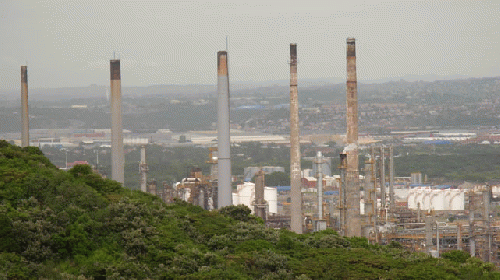
This is a disorienting sight, one local residents refer to as "Beauty and the Beast": on one side of the dune glorious Indian Ocean waves break on the fine sand beach; on the other side at least two dozen smoke stacks of varying heights reach into the sky amid oil tank farms, the Mondi Paper mill, and other industries. A SAPREF smoke stack flared as we watched.

Engen and SAPREF refineries, built in the early 1950s, are at the end of their effective lifespans yet they soldier on operating at or below the minimum industrial standards. In 2005 Engen was fined for the first time ever for exceeding the permitted emissions levels. The cost? Ten thousand rand, the equivalent of approximately US $1,300. There have been ten explosions in the last two years. A month before my visit in early February 2010 the vast roof of an empty mercifully! Engen oil storage tank collapsed during the night.

Word is out that Chevron seeks to erect a refinery here too. And why not? Profits are excellent, the ANC-led government bends over to accommodate multinationals and despite the hype of South Africa's constitution as the "most liberal in the world" few of its environmental protections are enforced. Those that are enforced do not mess with big business in this big basin.


SAPREF – the aging oil refinery Beast. Photo: Susan Galleymore, February 2010.

Meanwhile, about half a mile away in the valley, Settlers Primary School has an air quality monitoring station that measures benzene, sulphur dioxide, total reduced sulphur, hydrogen sulphur, CO2, and nitrous oxide. Yet, according to the Canadian Public Health Association's 2000 Position Paper, 250 different toxins are released into the air during flaring, including toluene, mercury, carbon di-sulphide, carbonyl sulphide, arsenic, chromium, methane, and polycyclic aromatic hydrocarbons (PAH).

D'Sa, who lives in the area and is chairman of the South Durban Community Environmental Alliance (SDCEA), says an odd thing happens to the monitoring station when there is an industrial incident. "It seems to shut down right at the point of impact so our communities don't even get information about the release amounts of the pollutants that are measured."

From 2001 to 2007 SDCEA recorded over 28 serious accidents from spills to explosions and fires that led to multiple deaths. In May 2002, Settlers School recorded two incidents within two weeks that made children ill with toxic emissions. While many children suffer diarrhea and complain of pain in their chests and heads while at this school data shows that the children who live in outer neighborhoods have these symptoms only while at school. Despite fifty-two percent of the students and teachers diagnosed with chronic asthma and a history of children dead from leukemia industry representatives deny the illnesses come from industrial pollution.

The school's sick bay has a nebulizer and some oxygen masks but no trained nurse and teachers are not trained to administer emergency care. If there is a major industrial accident the principal must summons local ambulances to transport victims to hospital.

What is clear from the vantage point of the high sand dune is that the area is geographically constrained. The narrow industry-filled valley with one or two lane roads in various states of disrepair is hemmed in by the ocean and sand dune on one side and overcrowded, shanties and apartheid-era "townships,"and a major freeway on the other. Moreover, it sits upon more than a million liters of petroleum leaked into the porous soil from at least one of a network of seventeen aging underground pipelines. Several families in one neighborhood along Tara Road can no longer live in their homes. Here a covered swimming pool is filled with gasoline and I counted seven monitoring wells in the same small front yard. An Engen security guard lurked in the garden to discourage voyeurs like me and ensure passers-by refrain from smoking cigarettes. The lake in a nearby nature reserve has been drained and refilled by both Engen and SAPREF due to their spills and leaks; in 2001 SAPREF was responsible for the worst leak to date in South Durban. No one talks about how or if that contaminated lake water is treated... or where it goes if it is not treated.

While oil refineries thrive here they are not the only game in town. Mondi Paper mills sit on the banks of the canal. Residents blame the German owned multinational Hosaf Fibres and its outdated technologies for the asthma and wheezing their children experience when they play in the park next door. Then there is the walled off chemical storage facility that locals call Durban's Bhopal. The high wall surrounding that compound housing over 300 dangerous chemicals is referred to as the Security Barrier or the "Apartheid Wall" since it resembles the wall that surrounds the West Bank and Gaza; South Durban's wall is topped off with razor wire.


“Durban's Bhopal”, a chemical storage tank farm with luxury ocean cruise liner

This region is a disaster awaiting a catastrophe and it has no publicized, easy to follow emergency plan.

Next Page  1  |  2


www.motherspeak.org

Susan Galleymore is the author of Long Time Passing: Mothers Speak about War and Terror, sharing the stories of people in Iraq, Israel, Palestine, Lebanon, Syria, and U.S. [Pluto Press 2009]. She is also host and producer of Raising Sand Radio (more...)
 

The views expressed in this article are the sole responsibility of the author
and do not necessarily reflect those of this website or its editors.

Contact Author Contact Editor View Authors' Articles

Follow Me on Twitter


Share this page: (what's this?)                   Tell a Friend: Tell A Friend

Add this Page to Facebook!      Submit to Stumble Upon      Submit to Reddit      Add This Page to Mr Wong!           NEWSVINE      DEl.ICIO.US      Looksmart Furl      My Web      Blink List     (More...)

Comments

The time limit for entering new comments on this article has expired.

This limit can be removed. Our paid membership program is designed to give you many benefits, such as removing this time limit. To learn more, please click here.

Comments: Expand   Shrink   Hide  
No comments

